wayground logo

Free Printable Worksheets

NEW

Font size

S
M
L
XL
Worksheets

Chapter 8 Review: Universal Gravitation

Total questions: 26

Worksheet time: 15mins
Name
Class
Date
1.
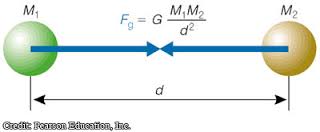
If I double the mass of one object, but don't change anything else... WHat happens to the gravitational force between two objects?
a)
Doubles
b)
Quadruples
c)
Cut in Half
d)
4x Smaller
2.
If I double the distance between two objects, what happens to their gravitational Force?
a)
4x bigger
b)
4x smaller
c)
2x bigger
d)
2x smaller
3.
What happens to Gravitational force if I double both of the masses but don't change their distance?
a)
doubles
b)
half as big
c)
4x bigger
d)
4x smaller
4.
Complete the following statement: The farther away two planets are the _______ the gravitational force between them.
a)
more
b)
same
c)
dosen't matter
d)
less
5.
The period of a satellite refers to the satellite's  _______.
a)
mass
b)
speed
c)
time of orbit
d)
gps shift
6.
The number 6.67 x 10 -11 N* m^2 / kg^2 is called the _______________.
a)
universal speed constant
b)
the speed force
c)
universal gravitational constant
d)
Earth's gravitational constant
7.
Kepler's first law that refers to the shape of planetary orbits is called ___________.
a)
the Law of Equal Areas
b)
the Law of Ellipses
c)
the Law of Harmonies
d)
the Universal Law of Gravitation
8.
Kepler's second law that refers to the amount of distance covered in equal time intervals along an orbit is referred to as ____________.
a)
the Law of Ellipses
b)
the Law of Equal Areas
c)
the Law of Harmonies
d)
the Law of Universal Gravitation
9.
Compute the distance separating two asteroids having masses of 3.0 x 10¹⁰ kg and  2.1 x 10¹² kg. It has been determined that they attract each other with a force of  2.50 x 10¹⁵ N.
a)
5.8 x 10^5 m
b)
.04 m
c)
40 m
d)
5.8  x 10 ^-11 m
10.
The gravitational force between two objects that are   2.1x10‐1 m apart is   3.2x10‐6 N.  If the mass of one object is 55 kg, what is the mass of the other object?         
a)
50.1 kg
b)
55.5 kg
c)
38.4 kg
d)
Asteroid 2 has no mass
11.
Luke Skywalker has a mass of 13 kg and weight of 127.4 N on earth. Find his weight on the Endor moon. Acceleration due to gravity of 2 m/s/s.
a)
254.8 N
b)
13 kg
c)
26 N
d)
127.4 kg
12.
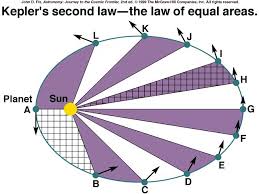
Where is the planet moving faster
a)
Position A to B
b)
Position B to C
c)
Position H to I
d)
Position I to J
13.
Planets orbit the Sun in a shape called a(n)
a)
circle
b)
ellipse
c)
focus
d)
perihelion
14.
A planet moves __________ when it is farthest from the sun.
a)
faster
b)
slower
15.
What is true about the area between points A, B and the Sun, and the area between points H, I and the Sun?
a)
The area between A, B and the Sun is the largest.
b)
The area between H, I and the Sun is the largest
c)
Both areas are equal in size
d)
There is not enough information to determine the areas
16.
Objects with a larger mass with have __________ gravitational force than objects with a smaller mass.
a)
less
b)
more
17.
 The planet travels faster when it is closer to the sun and slower when it is farther away when it is closer to the sun and slower when it is farther away describes which of Kepler's Laws (see illustration)
a)
1st
b)
2nd
c)
3rd
d)
None of the above
18.
The square of a planet’s orbital period (T2) is proportional to the cube of the average distance (r3) between the planet and the sun is Kepler's___ Law?
a)
1st
b)
2nd
c)
3rd
d)
None of the above
19.
Mars has a mass of about 6.4 × 10^23 kg, and its moon Phobos has a mass of about 9.6 × 10^15 kg. If the magnitude of the gravitational force between the two bodies is 4.6 × 10^15 N, how far apart are Mars and Phobos?
a)
18.7x10^10 m
b)
8.99x10^11 m
c)
9.4x10^6 m
d)
19.76x10^-10 m
20.
Predict the magnitude of the gravitational force a 66.5 kg person would experience while standing on the surface of each of Earth
Mass: 5.97 × 10^24 kg Radius 6.38 × 10^6 m
a)
246 N
b)
651 N
c)
38.5 N
d)
0.692 N
21.
Predict the magnitude of the gravitational force a 66.5 kg person would experience while standing on the surface of Mars:
Mass 6.42 × 10^23 kg
Radius 3.40 × 10^6 m
a)
246 N
b)
38.5 N
c)
651 N
d)
0.692 N
22.

Predict the magnitude of the gravitational force a 66.5 kg person would experience while standing on the surface of each of Pluto

Mass 1.25 × 10^22 kg

Radius 1.20 × 10^6 m

a)

0.692 N

b)

651 N

c)

246 N

d)

38.5 N

23.

An asteroid revolves around the sun with a mean average orbital radius of twice that of Earth's. Predict the peroid of the asteroid in Earth years

a)

1 year

b)

2.83 years

c)

4.74 years

d)

2 years

24.

Mars is 1.52 times as far from the sun as Earth. Predict the time required from Mars to circle the sun in Earth days

a)

684 days

b)

365 days

c)

486 days

d)

757 days

25.

What is the speed of a satellite that orbits earth with a radius of 5.67x10⁷ m?

a)

2000 m/s

b)

2555 m/s

c)

2650 m/s

d)

3000 m/s

26.

What is the period of a satellite that orbits earth with a radius of 5.67x10⁷ m?

a)

123456 seconds

b)

234432 seconds

c)

134432 seconds

d)

135432 seconsd