Wayground logo

Free Printable Worksheets

Font size

S
M
L
XL
Worksheets

Elements of Fiction

Total questions: 26

Worksheet time: 3hrs 47mins

Name
Class
Date
1.
Foreshadowing is...
a)
the main story in a text
b)
a play about ridiculous and absurd situations
c)
clues that hint at events that will occur later in the plot
2.
Joseph and Caitlin were choosing the players for their teams. It was Caitlin's turn to choose, and only Jason was left. Caitlin said, "Jason."

We can infer that…
a)
Jason was the best player.
b)
Caitlin wanted Jason on her team.
c)
Jason was not a very good player.
d)
Caitlin had a hard time choosing a team member.
3.
When making an inference, the most important thing is...
a)
What you know about the topic
b)
The topic of the text
c)
The characters in the text
d)
Being able to prove your inference using evidence from the text.
4.
What is verbal irony?
a)
When what is said is different than what is meant
b)
When what happens is the opposite of what is expected
c)
When the audience knows something a character doesn't know. 
5.
What is dramatic Irony?
a)
When what is said is different than what is meant
b)
When what happens is the opposite of what is expected
c)
When the audience knows something the character doesn't
6.

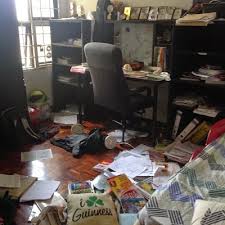
Looking at her son's messy room, Mom says, "Wow, you could win an award for cleanliness!"

a)

Verbal irony

b)

situational irony

c)

Dramatic irony

d)

Ironic irony

7.
In Toy Story, human characters are not aware that the toys speak and move while the audience is aware
a)
verbal irony
b)
dramatic irony 
c)
situational irony
d)
none of the above
8.
What is the foreshadow in this passage? 
The dark storm clouds rolled across the lake and Rebecca couldn’t help but shiver.  The ominous feeling the black clouds gave her made her pull her wool coat closely around her.  She started walking faster and faster, hoping that whatever was coming would pass quickly.
a)
A)It is going to be a sunny day.
b)
B)She wasnt afraid of the storm and she was going to take it head on. 
c)
C)That Rebecca is really looking forward to the storm that is going to come in. 
d)
D)There is going to be an intense rain storm that Rebecca is scared of. 
9.

Which point of view is the following:

"There is one mirror in my house. It is behind a sliding panel in the hallway upstairs. Our faction allows me to stand in front of it on the second day of every third month, the day my mother cuts my hair."

from Divergent by Veronica Roth

a)

second person

b)

first person

c)

third person

10.
In the school cafeteria, John felt lonely and out of place. He wished he could return to his old school and each lunch with his friends. 
 On the other side of the table, Ron looked at the new student. He wondered if they had much in common. "What's your name?" Ron asked the new student.
a)
First Person
b)
Second Person
c)
Third Person
11.
Your teacher says...Make sure you study your notes tonight!
a)
Foreshadow
b)
Flashback
12.

The smell of homemade chocolate chip cookies conjured up a memory of Susan's grandmother standing in a flour-covered apron.

a)

Foreshadow

b)

Flashback

13.
Tone can best described as
a)
attitude of the reader
b)
the overall mood or feeling in a story
c)
the author's attitude toward his writing
d)
reader's point of view
14.

There go the loves that wither [dry up], The old loves with wearier wings;

And all dead years draw thither [there] And disastrous things;

Dead dreams of days forsaken, Blind buds that snows have shaken, Wild leaves that winds have taken,

Red strays of ruined springs. ...

And love, grown faint and fretful With lips but half regretful Sighs, and with eyes forgetful Weeps that no loves endure [last].

QUESTION: What mood do the details in the poem convey?

a)

Wastefulness and excess

b)

Happiness

c)

Sadness and despair

d)

Mistrust

15.
Which questions about the story will the setting answer?
a)
What is the author's attitude toward the characters?
b)
Where and when does the story take place?
c)
Who are the people the story is about?
Why and why did the author write the story?
16.
Which of the following might describe the setting of a story?
a)
a frog and a witch
b)
happy and loving 
c)
a high school in 1956
d)
love is stronger than fear
17.
The sequence of events in a story or novel is called the ________. 
a)
action
b)
conflict 
c)
setting
d)
plot 
18.

Which part of the story is represented by this blue blob?

a)

exposition

b)

rising action

c)

climax

d)

resolution

19.
Which part of the story is represented by this blue blob?
a)
exposition
b)
rising action
c)
falling action
d)
resolution
20.
Which part of the story is represented by this blue blob?
a)
climax
b)
rising action
c)
falling action
d)
resolution
21.
Which part of the story is represented by this blue blob?
a)
climax
b)
rising action
c)
falling action
d)
resolution
22.
Which part of the story is represented by this blue blob?
a)
climax
b)
exposition
c)
falling action
d)
resolution
23.
Which part of the plot
introduces the characters?
a)
Exposition
b)
Rising Action
c)
Climax
d)
Falling Action
24.
What is conflict?
a)
Two characters getting along.
b)
A struggle between two opposing forces.
c)
The climax in a story.
d)
Part of the resolution.
25.
Elsa has to be hidden away from the outside world because of her secret magical powers.
a)
Character vs Character
b)
Character vs Nature
c)
Character vs Society
d)
Character vs Self
26.
a)
Character vs Character
b)
Character vs Nature
c)
Character vs Society
d)
Character vs Self