
 Worksheets
Basic Electronics (For Arduino)
Total questions: 45
Worksheet time: 26mins
Name
Class
Date
1.
Electronics is the science and technology concerned with regulating flow of:
a)
Heat
b)
Electricity
c)
Water
d)
Power
2.
Electricity is:
a)
Flowing electrons
b)
Still electrons
c)
voltage x wattage
d)
amps x watts
3.
Choose the true statement below concerning DC currents:
a)
DC stands for Direct Computing and electrons flow in multiple pathways
b)
DC stands for direct current and electrons flow in multiple directions
c)
DC stands for direct current and the electrons do not flow
d)
DC stands for direct current and the electrons flow in only one direction
4.
The symbol for voltage is:
a)
Vo
b)
V
c)
W
d)
Amp
5.
Current is measured in:
a)
Ohms
b)
Voltage
c)
Amperes
d)
Watts
6.
An expression for the overall power in a circuit is:
a)
watts
b)
voltage
c)
current
d)
resistance
7.
If you have three 1.5V batteries in series, what would be total voltage be?
a)
3.4 V
b)
4.5 V
c)
1.5 V
d)
3 V
8.
An AA battery holder with 6 cells provides how many total volts?
a)
1.5V
b)
6V
c)
9V
d)
3V
9.
A tool that measures voltage, current, resistance, and continuity is called a:
a)
voltmeter
b)
resistor
c)
multimeter
d)
screwdriver
10.
Continuity measures:
a)
The voltage between two points.
b)
The resistance between two points.
c)
The wattage between two points.
d)
Whether or not there is a current between two points.
11.
In all electronics applications you should never:
a)
Connect power directly to ground.
b)
Offer resistance to the flow of electricity.
c)
Reverse the probes of the multimeter.
d)
none of the above
12.

What does this picture show?
a)
A multimeter
b)
A breadboard
c)
A circuit board
d)
A resistor
13.
A means of fusing together two metal objects to create an electrical connection is called:
a)
soldering
b)
wiring
c)
programming
d)
welding
14.

The correct way to hold this object is like a:
a)
a hammer
b)
a tennis racket
c)
a pencil
d)
a football
15.

This is used to:
a)
warm up the iron
b)
clean the iron
c)
get metal onto the iron
d)
none of the above
16.
The thickness of a wire is called its:
a)
resistance
b)
amperage
c)
thickness
d)
guage
17.
Which color wire is used for ground?
a)
red
b)
black
c)
green
d)
yellow
18.
What material is a resistor made of?
a)
Graphite
b)
Carbon
c)
Glass
d)
Mica
19.
What type of circuit is the most efficient?
a)
Combination circuit
b)
Series circuit
c)
Parallel circuit
d)
Isometric circuit
20.
What does the 3rd band on a resistor represent?
a)
A number
b)
The Tolerance level
c)
The multiplier
d)
The electronic range
21.
A flow of electrons through a conductor is called:
a)
A river
b)
A spark
c)
An electron flow
d)
A current
22.

What kind of circuit is this?
a)
series
b)
parallel
23.

What kind of circuit is this?
a)
Series
b)
Consecutive
c)
Parallel
d)
Training
24.
A material in which electrons are able to move easily
a)
Circuit
b)
Insulator
c)
Resistance
d)
Conductor
25.
A material in which electrons are not able to move easily
a)
Circuit
b)
Insulator
c)
Resistance
d)
Conductor
26.
measure of electric current
a)
watt
b)
ohm
c)
volt
d)
amp
27.
measure of resistance
a)
watt
b)
ohm
c)
volt
d)
amp
28.
measure of power
a)
watt
b)
ohm
c)
volt
d)
amp
29.

What type of circuit is this?
a)
series
b)
parallel
30.

What type of circuit is this?
a)
series
b)
parallel
31.
tiny particles that have a negative charge
a)
protons
b)
neutrons
c)
electrons
d)
circuits
32.
provides more than one path for the electrons to follow
a)
series circuit
b)
parallel circuit
c)
insulator
d)
conductor
33.
there is only one path for the electrons to follow
a)
conductor
b)
insulator
c)
parallel circuit
d)
series circuit
34.
Electricity is the flow of ______.
a)
electrons
b)
protons
c)
neutrons
d)
atoms
35.
What is a benefit of using a parallel circuit?
a)
It gets confusing.
b)
There are no problems.
c)
If one light goes out, it does not affect the others.
d)
If one light goes out, they all go out.
36.
What is one problem with using a series circuit?
a)
It has a lot of series.
b)
If one light goes down, they all go down!
c)
It doesn't work properly.
d)
There are no problems.
37.
In most electrical circuits, the pathway is made of:
a)
Wood
b)
Plastic
c)
Metal
d)
Static
38.
Metals such as copper, iron, gold, and silver are ...
a)
conductors
b)
brittle
c)
insulators
d)
resistors
39.
What size resistor would produce a 3 Amp current flow with a 12 Volt battery
a)
1 Ohm
b)
3 Ohms
c)
4 Ohms
d)
12 Ohms
40.
How many Volts would we need to produce a current flow of 8 Amps through a 6 Ohm resistor
a)
12 volts
b)
24 volts
c)
1.3333
d)
48 volts
41.
If the battery produced 12.6 Volts and what would be the current flow be for a 6 Ohm resistor
a)
2.1 Amps
b)
2.4 Amps
c)
1.71 Amps
d)
15 Amps
42.
What is Resistance?
a)
The flow of electrons
b)
Electric potential difference
c)
A battery
d)
The ability to reduce the flow of electrons
43.
The mathematical relationship among Voltage, Current, and Resistance
a)
Faraday's Law
b)
Tesla's Law
c)
Edison's Law
d)
Ohm's Law
44.
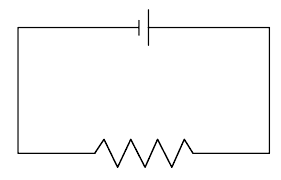
This circuit has a 24 volt battery and the resistor is 8 ohms. How many amps are running through the circuit?
a)
3 Amps
b)
192 Amps
c)
2 Amps
d)
4 Amps
45.
Residential House uses this kind of Current
a)
Direct Current
b)
Alternate Current
c)
Jumper Current
d)
None of the choices
100 %

