Wayground logo

Free Printable Worksheets

Font size

S
M
L
XL
Worksheets

Chapter 3 and Chapter 5 Review Quiz

Total questions: 43

Worksheet time: 46mins

Name
Class
Date
1.
19th Century nativist organizations advocated--
a)
limiting federal military power through the organization of local militias
b)
conserving natural resources through the creation of national parks
c)
globalizing the economy through participation in free-trade agreements
d)
restricting immigration to keep jobs for native-born Americans
2.
Which of the following occurred between 1865 and 1900 as a result of the rapid industrialization of the US?
a)
Social and economic class divisions began to disappear.
b)
Concerns about air pollution led to stricter environmental regulations.
c)
Union membership increased as workers sought better pay and conditions.
d)
Factory owners introduced wage-equality policies for women in the workplace.
3.
Which of the following best characterizes the Gilded Age?
a)
The discovery of goldfields in the West led to an increase in the amount of money issued for circulation.
b)
Industrialists used their connections with corrupt government officials for material gain and political power.
c)
In the Deep South a sharp increase in immigration brought a boom in construction and industry.
d)
Small, family-owned farms were bought and consolidated to form large agricultural corporations.
4.
"New Immigrants" came from
a)
Northern and Western Europe
b)
Canada and Latin America
c)
Southern and Eastern Europe
d)
China and Southeast Asia
5.
Which of the following is a correct cause-effect relationship for this era?
a)
Reform movements led to expansion of slavery.
b)
New inventions led to immigration.
c)
Industrialism led to growth of cities.
d)
Inventions led to reform movements.
6.
What factor led many farmers, families, and young women to move to cities during the nineteenth century?
a)
the growing availability of factory jobs
b)
the constant fear of an influenza outbreak
c)
the declining interest in westward expansion
d)
the educational opportunities at free universities
7.
 How did Railroads impact the economy during this time?
a)
Moved raw materials (steel, lumber, coal) to factories 
b)
Used to make artillery and weapons
c)
Provided money for other industries
d)
Materials were more expensive and quicker to ship
8.
Why was steel so important? What was it used for?
a)
Used to make artillery and weapons
b)
Cheap to import from China
c)
It came from Minnesota
d)
Strong. Used for bridges, railways, nails, & skyscrapers 
9.
Define a monopoly.
a)
A card game
b)
businesses that are owned by investors
c)
A company controls all or most of businesses in an industry.
d)
Poor families
10.
Many immigrants were forced to live in __________, or run-down, dirty, and cramped apartment-like buildings.
a)
Tenements
b)
Ghettos
c)
Townhouses
d)
Plantations
11.
What processing station did Immigrants go through on the WEST coast?
a)
Ellis Island
b)
Angel Island
c)
Devil Island
d)
Alcatraz
12.
Which best describes the working conditions of most immigrants.
a)
Most immigrants worked long hours in low-paying industrial jobs
b)
Most immigrants worked as farmers in rural areas
c)
Most immigrants worked as bookkeepers or other professional jobs
d)
Most immigrants worked as tailors or other skilled jobs
13.
 Which factor contributed to the shifting of population from rural to urban areas from 1870-1900?
a)
Not enough families took advantage of the Homestead Act
b)
Great Plains Indians left their reservations to buy new farmland
c)
Houses in cities were less expensive than those in the counttryside
d)
 Better jobs in industry attracted farmers and laborers to cities
14.
Chinese Americans contributed to which project that forever changed the American West?
a)
the Lewis and Clark Expedition
b)
the Pony Express
c)
the Transcontinental Railroad
d)
the Missouri Fur Company
15.
In late nineteenth century America, recent immigrants made up a large portion of the population of big cities, such as New York and San Francisco. Which of the following best describes why immigrants in these cities established their own separate neighborhoods, such as New York's Little Italy and San Francisco's Chinatown?
a)
They did so in order to ensure that they were able to receive high wages and benefits for factory work.
b)
They did so in order to establish their own political parties that could influence both local and state government.
c)
They did so in order to continue practicing the traditions that they brought over from their home countries.
d)
They did so in order to build and open their own factories that could compete with others in the city.
16.
in 1882, the Government passed this legislation that restricted immigration for 10 years from a certain group into the United States.
a)
Nativist Act
b)
Mexican Reparition Act
c)
Dawes Act
d)
Chinese Exclusion Act
17.
During the 19th and early 20th century, These men helped immigrants with jobs and housing in order to control votes during election? 
a)
political parties
b)
El Chapo
c)
political bosses
d)
republican party
18.
Men such as Andrew Carnegie believed in giving money to libraries, musuems and schools to help benefit people who wanted to move up in the social ladder. 
a)
geopolitical
b)
political bosses
c)
anthropolgy
d)
philanthropy
19.
The Pendleton Act of United States in 1883 decided that government jobs should be awarded on the basis of merit (test) instead of political affiliation.
a)
direct voting
b)
civil service reform
c)
political machines
d)
civil labor unions
20.
Described as a time marked by gross income inequality and corrupt practices by corporations and abuse of workers, the term "Gilded Age" was coined by what writer?
a)
Upton Sinclair
b)
Andrew Carnegie
c)
Mark Twian
d)
Henry George
21.
Andrew Carnegie used this method; when a company owns the raw materials & transportation systems of a product
a)
vertical integration
b)
horizontal integration
c)
time-study analysis
d)
taylorism
22.
Whose book led to the direct passage of the Meat Inspection Act and indirect of the Pure Food and Drug Acts?
a)
Jacob Riis
b)
Lewis Hines
c)
Ida Tarbell
d)
Upton Sinclair
23.
Pioneer in the field of social work who founded the settlement house movement through the establishment of Hull House in Chicago, Illinois.
a)
Margaret Sanger
b)
Jane Addams
c)
Booker T. Washington
d)
W.E.B. DuBois
24.
Former slave who founded the Tuskegee Institute that focused on teaching African-Americans trade skills to earn a living and gain the trust of white society.
a)
Margaret Sanger
b)
Jane Addams
c)
Booker T. Washington
d)
W.E.B. DuBois
25.
Woke America up to the lynchings that were happening in the US. Fought for federal anti-lynching legislation.
a)
Thomas Nast
b)
Jacob Riis
c)
Ida B. Wells
d)
Upton Sinclair
26.

What is the development of industries on a wide scale?

a)

Monopolization

b)

A trust

c)

Corporations

d)

Industrialization

27.

What industry was John D. Rockefeller best known for?

a)

Oil

b)

Railroads

c)

Timber

d)

Steel

28.

By owning over 90% of the nation’s refineries and pipelines, Rockefeller was able to create a ____________.

a)

Monopoly

b)

Railroad

c)

Labor Union

d)

Skyscraper

29.

A method whereby workers organize together to protect their rights as employees is....

a)

A Riot

b)

A Boycott

c)

A Protest

d)

A labor Union

30.

What industry was Andrew Carnegie best known for?

a)

Railroads

b)

Steel

c)

Timber

d)

Oil

31.

Where is Ellis Island located?

a)

Pacific Ocean

b)

Florida

c)

New York City Harbor

d)

Washington D.C.

32.

Give examples of immigrant "push" factors.

a)

Promise of a better life

b)

War or religious persecution

c)

Religious Freedom

d)

Better opportunities

33.

This is the policy of protecting the interests of native-born or established inhabitants against those of immigrants.

a)

Nativism

b)

Isolationism

c)

Immigration

d)

Imperialism

34.
 Immigration  pull factors are…
a)
reasons people come to a new place
b)
reasons people leave their homelands
c)
reasons people begin working
d)
reasons people stop working
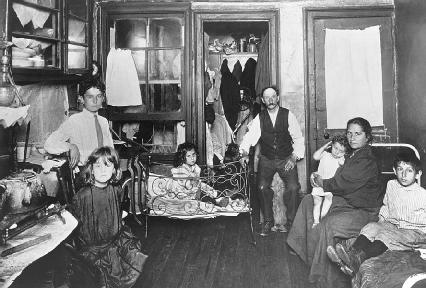
35.
The photo demonstrates one of the problems with
a)
overcrowding urban tenements.
b)
labor union activism in urban areas.
c)
the overproduction of consumer goods.
d)
the growth of political machines.
36.

New __________________ like the light bulb made manufacturing processes more efficient.

a)

Innovations

b)

Manufactoring

c)

Ideas

d)

Infrastructure

37.
The political party that advocated for farmers was known as the ______party.
a)
Republican
b)
Democrat
c)
Populist
38.
Which candidate was the Populist party's candidate?
a)
Andrew Johnson
b)
Ulyssess Grant
c)
William Jennings Bryan
d)
William McKinley
39.

Which of the following always hurt farmers?

a)

Gold Miners

b)

Railroads

c)

American Indians

d)

Exodusters

40.

Which group preferred silver money?

a)

Lawyers

b)

Politicians

c)

Bankers

d)

Farmers

41.

Which of the following examples reflects the philosophy of the “Gospel of Wealth”?

a)

Carnegie expands his steel monopoly.

b)

Carnegie establishes libraries throughout the nation

c)

Rockefeller expands his oil monopoly

d)

Rockefeller funds presidential candidates.

42.

The Social Gospel movement conflicted with the theory of Social Darwinism because the Social Gospel movement

a)

relied on government ­funded programs to correct problems in society

b)

required support from wealthy individuals to help less fortunate people.

c)

utilized economic relationships to encourage personal growth

d)

relied on training to help individuals overcome difficult circumstances

43.

Which best describes the Social Gospel movement?

a)

belief that certain cultures will be unable to sustain existence

b)

emphasis on the Christianization of native peoples

c)

emphasis on Christian principles to solve societal problems

d)

belief that capitalism helps the lower class