wayground logo

Free Printable Worksheets

NEW

Font size

S
M
L
XL
Worksheets

Seasons and Shadows Review

Total questions: 42

Worksheet time: 1hrs 24mins

Name
Class
Date
1.
What causes shadows? 
a)
An object blocking the light source
b)
The water cycle
c)
An object letting the light source through
d)
The moon
2.

From what direction does the sun appear to rise?

a)

North

b)

South

c)

East

d)

West

3.

From what direction does the sun appear to set?

a)

North

b)

South

c)

East

d)

West

4.
What time of day are shadows the shortest? 
a)
Early morning
b)
Late Morning
c)
Noon
d)
Sunset
5.
True or False: The shadows are longest in the early morning and late afternoon. 
a)
True
b)
False
6.

How does the sun's position appear to change every day?

a)

The sun rises in the north and sets in the south

b)

The sun comes up in the east, overhead at noon, and sets in the west

c)

The sun rises in the east, is in the west at noon, and sets in the north

7.

The higher the sun is in the sky, the ________ the shadows are

a)

tall

b)

shorter

c)

darker

8.
A student draws his shadow at 9am.  How will his shadow look at noon?
a)
shorter than the morning shadow, or no shadow at all
b)
longer than the morning shadow
c)
the same length as the morning shadow
d)
it is impossible to predict how his shadow will change size
9.
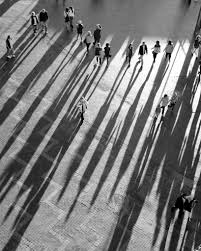
Look at the picture.  Would the sun be low or high in the sky in the afternoon picture?
a)
The sun would be directly above.
b)
You would not be able to see the sun at all.
c)
The sun would be low in the sky.
d)
The sun has nothing to do with shadows.
10.
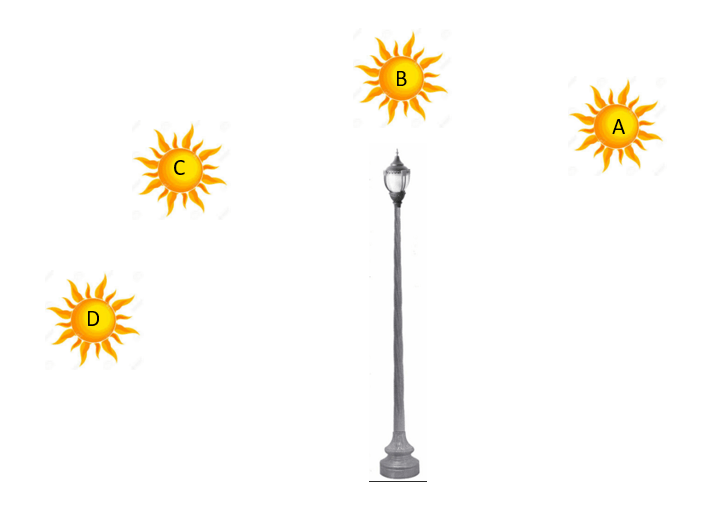
At which location of the sun would the shadow of the light pole be the longest?
a)
A  at 11 a.m
b)
B at noon
c)
C at 2 p.m.
d)
D at 6 p.m. 
11.
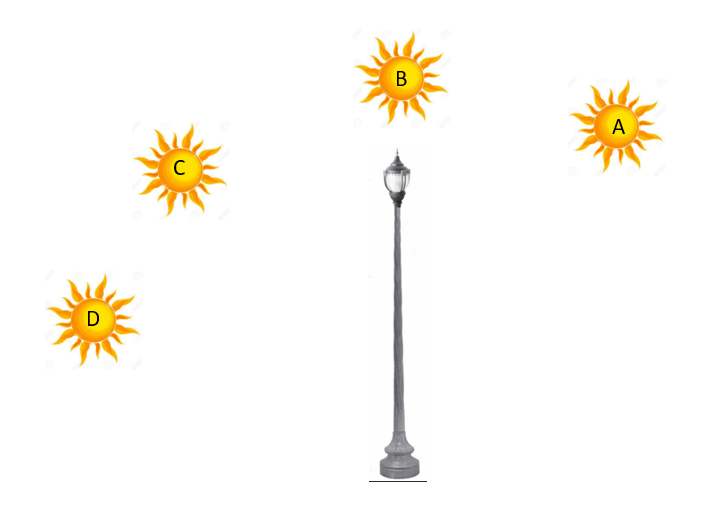
At which location of the sun would the shadow of the lamp post be the shortest?
a)
A
b)
B
c)
C
d)
D
12.

What causes the seasons to change?

a)

The warming and cooling of Earth's core.

b)

The distance from the sun.

c)

Earth's orbit and tilt in relation to the sun.

d)

Earth's rotation on its axis.

13.
What is the order of the seasons?
a)
summer, winter, fall, spring
b)
fall, winter, spring, summer
c)
summer fall, spring, winter
d)
winter, summer, fall, spring
14.
Which season is the coldest?
a)
summer
b)
fall
c)
winter
d)
spring
15.

Which season is the warmest?

a)

summer

b)

fall

c)

winter

d)

spring

16.
During what season do the leaves change color?
a)
summer
b)
fall
c)
winter
d)
spring
17.
Do the seasons repeat every year?
a)
No
b)
Yes
18.
What season is this?
a)
Spring
b)
Fall
c)
Winter
d)
Summer
19.
What season is this?
a)
Winter
b)
Summer
c)
Spring
d)
Fall
20.
What season is this?
a)
Winter
b)
Summer
c)
Fall
d)
Spring
21.
What season is this?
a)
Winter
b)
Fall/Autumn
c)
Summer
d)
Spring
22.
In the spring you could find people...
a)
Swimming at the lake
b)
Planting a garden
c)
Building a snowman
d)
Picking pumpkins
23.
In the winter you could find people...
a)
Swimming at the lake
b)
Planting a garden
c)
Building a snowman
d)
Picking pumpkins
24.

When the sun gets higher in the sky, shadows get ______.

a)

longer

b)

gone

c)

shorter

d)

darker

25.

When the sun gets lower in the sky, shadows get______.

a)

longer

b)

gone

c)

shorter

d)

darker

26.

When was this picture most likely taken?

(Hint: think about the shadow's length)

a)

morning or evening

b)

night

c)

noon

d)

afternoon

27.

When was this picture most likely taken?

(Hint: think about the shadow's length)

a)

morning or evening

b)

night

c)

noon

28.

The sun appears to __________.

a)

rise in the east, set in the west

b)

rise in the west, set in the east

29.

If it is winter in the Northern Hemisphere at position 1, what season is taking place in the Northern Hemisphere in Position 2?

a)

Winter

b)

Spring

c)

Summer

d)

Fall

30.

If it is winter in the Northern Hemisphere at position 1, then what season is taking place in the Northern Hemisphere in Position 3?

a)

Winter

b)

Spring

c)

Summer

d)

Fall

31.

If it is summer in the Northern Hemisphere at position 3, then what season is taking place in the Northern Hemisphere in position 4?

a)

Winter

b)

Spring

c)

Summer

d)

Fall

32.
During the phases of the Moon, the Moon appears to change shape.  This change in appearance is due to the Moon...
a)
physically changing size and shape.
b)
moving closer and then farther away from Earth.
c)
reflecting a different amount of light due to alignment with Earth and the Sun.
d)
having craters on its surface.
33.
The cycle of the moon lasts about a _.
a)
day
b)
year
c)
week
d)
month
34.

How long after a new moon will it take to see another new moon?

a)

12 days

b)

29 1/2 days

c)

27 days

d)

365 days

35.
Which phase of the moon is represented by the letter E?
a)
New Moon
b)
Full Moon
c)
First Quarter
d)
Waning Crescent 
36.
If the last full moon was on April 4th, when can you expect to see the next full moon? 
a)
April 29th
b)
July 4th
c)
May 4th
d)
September 12th
37.
 True or False: The moon does not produce its own light.
a)
True
b)
False
38.

What causes the moon's phases

a)

Where you are standing on Earth

b)

the amount of sunlight reflected onto the moon from the sun

c)

The tilt of Earth

d)

how fast the moon is moving

39.

Name the moon phase

a)

Half Moon

b)

Last Quarter

c)

New Moon

d)

Full Moon

40.

What is the source of the moon's light?

a)

Earth

b)

the sun

c)

the moon

d)

Mars

41.

The moon phase cycle repeats about every

a)

365 days

b)

20 days

c)

29 days

d)

15 days

42.

Name the moon phase

a)

No moon

b)

Last Quarter

c)

New Moon

d)

Full Moon