wayground logo

Free Printable Worksheets

NEW

Font size

S
M
L
XL
Worksheets

Nuclear Chem

Total questions: 40

Worksheet time: 41mins

Name
Class
Date
1.

What is emitted during Beta Radiation?

a)

Electron.

b)

Protons.

c)

Neutrons.

d)

Nuclei

2.
How is the alpha particle written in a nuclear equation?
a)
42He
b)
24He
3.

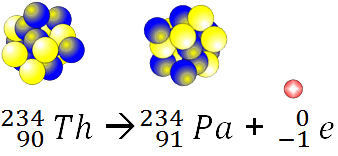
Which type of nuclear radiation is seen here?

a)

Alpha

b)

beta

c)

gamma

d)

none

4.
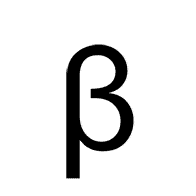
Has the symbol
a)
Alpha
b)
Beta
c)
Gamma
5.
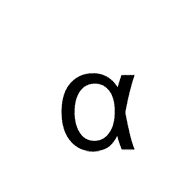
Has the symbol
a)
Alpha
b)
Beta
c)
Gamma
6.
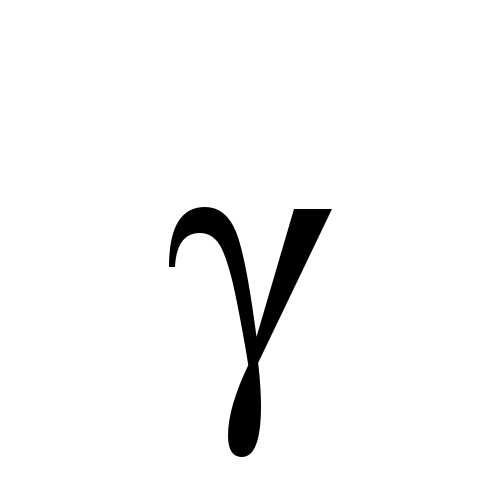
Has the symbol
a)
Alpha
b)
Beta 
c)
Gamma
7.

In Alpha decay, the atomic number decrease by _________

a)

1

b)

2

c)

3

d)

5

8.
Balance the following equation:
146C --> 0-1e + ________
a)
145B
b)
146C
c)
147N
d)
42He
9.

Solve this equation for alpha decay.

88226Ra --> ___ + 24He

a)

86222Rn

b)

89226Ac

c)

84224Po

d)

88225Ra

10.

Solve this equation for alpha decay.

85209At --> ___ + 24He

a)

83205Bi

b)

86209Rn

c)

81207Tl

d)

85208At

11.

Solve this equation for beta decay.

614C --> ___ + -10e

a)

410Be

b)

714N

c)

210He

d)

613C

12.

Solve this equation for beta decay.

2760Co --> ___ + -10e

a)

2556Mn

b)

2860Ni

c)

2358V

d)

2759Co

13.
Balance the following equation:
146C --> 0-1e + ________
a)
145B
b)
146C
c)
147N
d)
42He
14.

In the symbol 167N what the 7 stand for?

a)

Mass number

b)

Atomic number

c)

Atomic mass

d)

Number of neutrons

15.
What makes something radioactive?
a)
elements with an atomic number above 81
b)
an unstable nucleus
c)
contaminated sewage
d)
It decays over time
16.

What is nuclear fission?

a)

Big nucleus splits to two smaller nuclei

b)

Small nuclei combine into a bigger more stable nucleus

17.

_______________ is when an unstable atoms breaks down emit radiation until they become stable.

a)

Radiation

b)

Chemical Reaction

c)

Radioactive Decay

d)

Isotopes

18.
What type of radioactive decay is shown here?
a)
Alpha decay
b)
Beta decay
c)
Gamma decay
19.

_________________ is when two smaller atoms combine to form a larger more stable atom

a)

fission

b)

fusion

20.
Nuclear power uses ____ for fuel.
a)
steel
b)
coal
c)
uranium
d)
hydrogen
21.
The splitting of a nucleus into smaller nuclei is
a)
fusion
b)
fission
c)
decay
d)
gamma radiation
22.
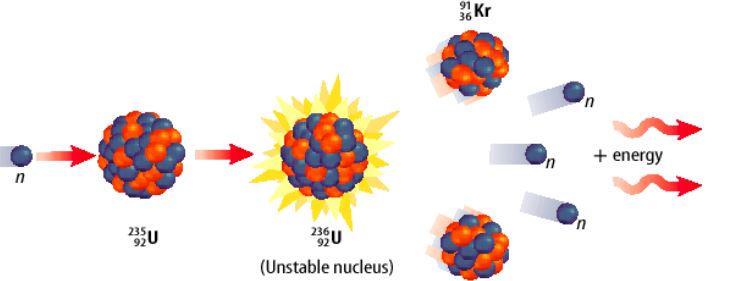
This is an example of...
a)
Fission  reaction
b)
Fusion reaction
c)
Decomposition reaction
d)
Decay
23.
An example of an uncontrolled fission reaction is _______________
a)
Nuclear power plants
b)
Radio active decay
c)
Atomic Bomb
d)
On the surface of the sun
24.
Negative charge in an atom that does not contribute to the mass 
a)
proton
b)
neutron
c)
nucleus 
d)
electron
25.
Particle in the nucleus that has no charge but affects the mass of the element 
a)
proton
b)
neutron
c)
nucleus 
d)
electron
26.
A particle with a positive charge that determines the element
a)
proton 
b)
neutron 
c)
nucleus
d)
electron
27.
When two protons collide and fuse 
a)
proton
b)
photon 
c)
core of the sun
d)
the first step of fusion 
28.
Where fusion occurs 
a)
proton
b)
photon
c)
core of the sun 
d)
the first step of fusion 
29.
This particles is created that emits light in fusion
a)
proton
b)
photon
c)
core of the sun 
d)
the first step of fusion 
30.
What happens to the atomic number during alpha decay?
a)
The atomic number decreases by 4
b)
The atomic number increases by 1
c)
The atomic number decreases by 2.
d)
The atomic number stays the same.
31.
Which of the following is a disadvantage of nuclear energy as a power source?
a)
Nuclear energy produces less energy than the burning coal
b)
Nuclear energy produces air pollution
c)
Nuclear waste must be safely stored
d)
The fuel source is very limited
32.
What does it mean when an element is radioactive?
a)
atom emits radiation
b)
nucei unstable due to uneven p to n ratio
c)
nuclei changes to become stable
d)
all of the above
33.
What is the missing isotope that will balance the following nuclear equation?
94Be  +  11H →  _____  +  42He
a)
105B
b)
105Ne
c)
63Li
d)
63C
34.

What is a beta particle?

a)

created when a neutron changes into a proton and an electron

b)

created when a proton changes into a neutron and an electron

c)

composed of two protons and two neutrons

d)

negatively charged nucleus

35.

Which of the following is not a nuclear process

a)

Fusion

b)

Fission

c)

Radioactive Decay

d)

transmutation

e)

electron movement

36.

What type of radioactive decay essentially occurs with every type of nuclear decay?

a)

Alpha emission

b)

Beta emission

c)

Positron Emission

d)

Electron capture

e)

Gamma ray emission

37.
Which nuclear emission involves the release of helium nuclei?
a)
alpha
b)
gamma
c)
positron
d)
beta
38.
Which of the following nuclear emissions has the greatest penetrating power?
a)
alpha
b)
gamma
c)
beta
d)
positron
39.
What element does carbon-14 become after undergoing beta decay?
 
a)
 7N13 
b)
5B14
c)
7N14 
d)
6C14 
40.
Which of the following correctly describes the charge of beta particles and alpha particles? 
a)
Alpha particles are positively charged, and beta particles are negatively charged.
b)
Alpha particles and beta particles are both negatively charged.
c)
Alpha particles are negatively charged, and beta particles are positively charged.
d)
Alpha particles and beta particles are both positively charged