
 Worksheets
chemical kinetics Part 1
Total questions: 20
Worksheet time: 32mins
4 factors that affects reaction rate.
temperature
surface area
presence of catalyst
Chemical nature of reactant
In solid form
Which of the following are true of reaction rates?
I. The overall rate law is determined by the fastest step of a reaction
II. The presence of a catalyst will increase the number of molecules entering the transition state
III. An increase in temperature will increase the rate of a reaction
IV. Increasing the concentration of reactants will increase the rate at which products yield
II+III+IV
I+IV
II + III
I+II+III

The iodide ion reacts with hypochlorite ion in the following way:
OCl- + I- ⟶ OI- + Cl-.
This rapid reaction gives the rate data shown. What is the rate law?
rate = [OCl-]2[I-]
rate = [OCl-][I-]2
rate = [OCl-][I-]
rate = [OCl-]
A reaction is found to be second order with respect to carbon monoxide. If the concentration of carbon monoxide is doubled, the rate of reaction __________.
doubles
remains unchanged
increases by a factor of 4
is reduced by a factor of 2
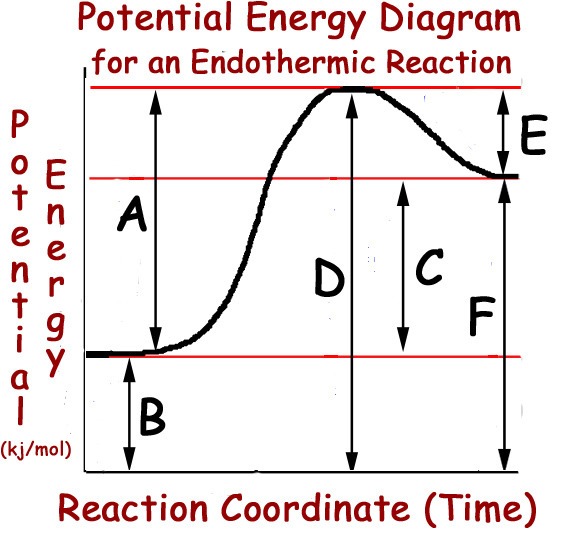
What letter represents the activation energy?
A
B
C
D

Which of the two graphs show a state of equilibrium being reached?
A
B
A and B
Neither.
Which of the following best describes why increasing temperature increase reaction rate?
Activation energy is reduced.
Collisions become more frequent.
Collisions become more energetic.
Collisions become more frequent and more energetic.

Which species is the catalyst in this reaction mechanism?
R
W
X
There is no catalyst.

What is the rate law for this mechanism?
rate = k[A][B]2
rate = [B][X]
rate = [A]0.5[B]1.5
rate = [W][Y][Z]
Name the compound, N2O5
Nitrogen Pentoxide
Dinitrogen (V) oxide
Dinitrogen Pentoxide
Dinitrogen Oxide
X + Y → Z + Q ΔH = +22kj/mol
How can above reaction be classified in terms of energy exchange during chemical change?
Balance the following chemical reaction?
Al + O2 → Al2O3
4Al + O2 → Al2O3
Al+ 3O2 → Al2 .2(O)3
2Al + 1/2O2 → Al2O3
4Al + 3O2 → 2Al2O3


What would the rate constant of the reaction be given the following set of experiments?


An addition of a catalyst to the following reaction would have what effect?
A would be increased
B would be increased
C would be decreased
No change

Using the following data, which is the correct rate law of the sample reaction?
A + 5B + 6C → 3D + 3E


Which of the following is true regarding the addition of a catalyst to a reaction?
rate of reverse reaction decreased
Energy of activated complex will decrease
The ΔG of a reaction is decreased
the equilibrium favors the products upon catalyst addition

