
 Worksheets
Reporting Category 3 Review #1
Total questions: 25
Worksheet time: 34mins
Name
Class
Date
1.
What kind of weather is usually associated with a high pressure system?
a)
Sunny weather
b)
Precipitation (rain, snow, etc.)
2.

What does this symbol on a weather map indicate?
a)
High pressure system
b)
Low pressure system
c)
Cold front
d)
Warm front
3.
The boundary between two air masses is known as:
a)
front
b)
storm
c)
climate
d)
flood
4.
Which condition usually means cloudy, stormy weather?
a)
high pressure
b)
low pressure
5.

A _____ is a large, swirling, low-pressure system that forms over the Atlantic Ocean.
a)
blizzard
b)
cold front
c)
tornado
d)
hurricane
6.
What evidence did Wegener use in his theory?
a)
Continents and fossils fitting together/matching-up like puzzle pieces
b)
glacier scars and evidence from temperature
c)
mountain ranges and coal deposits line up across continents
d)
all of the above
7.
What does the theory of continental drift state?
a)
The continents were once joined in a super-continent and have moved over time
b)
Continents are stationary and do not move
c)
The Earth is broken into lithospheric plates that move due to convection currents
d)
none of the above
8.
What causes the crust to move?
a)
convection
b)
conduction
c)
tension
d)
radiation
9.
When looking at mid ocean ridges the oldest rocks are
a)
In the middle
b)
Found close to the rift zone
c)
Found far from the mid ocean ridges
10.
What causes seafloor spreading to occur?
a)
Old crust is destroyed at divergent boundaries.
b)
New crust forms at divergent boundaries, pushing old crust outwards.
c)
Old crust pushes new crust towards divergent boundaries.
d)
New crust forms as plates move over hotspots.
11.
A subduction zone is formed...
a)
when one tectonic plate sinks below another
b)
at every type of convergent plate boundary
c)
at every type of divergent plate boundary
d)
at transform boundaries
12.
When the Northern Hemisphere is pointing towards the sun, what season is the Southern Hemisphere?
a)
Winter
b)
Spring
c)
Fall
d)
Summer
13.
What are the reasons for the seasons?
a)
Earth's tilt and rotation.
b)
Earth's rotation and revolution.
c)
Earth's tilt and revolution.
d)
Earth's tilt and resolution
14.
When the moon is in between the earth and the sun it is a
a)
New Moon
b)
Full Moon
c)
First Quarter
d)
Third Quarter
15.
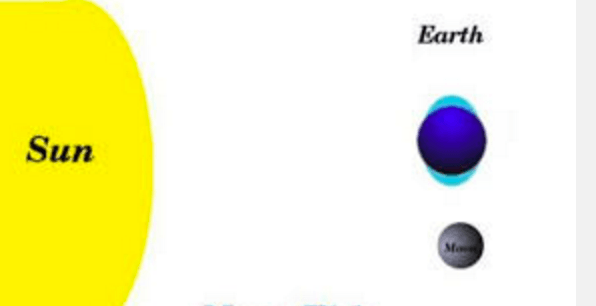
Which moon phase is shown in this diagram?
a)
new moon
b)
1st quarter
c)
full moon
d)
last quarter/3rd quarter
16.
Differences in the moon's and sun's pull on different sides of the Earth cause _________.
a)
gravity
b)
lunar phases
c)
tides
d)
dabbing
17.
Day and night is caused by the _____________ of earth on its axis.
a)
revolution
b)
orbit
c)
rotation
d)
space
18.
Where are the most hours of daylight going to occur?
a)
Southpole when it is winter in the southern hemisphere
b)
North pole when it is Summer in the northern hemisphere
c)
The equator when it is summer in the southern hemisphere
d)
The north pole when it is winter in the southern hemisphere
19.
Waxing means...
a)
Growing
b)
Dying
c)
Losing light
d)
Moving
20.

Which season is taking place in the Southern Hemisphere in Position 1?
a)
Winter
b)
Spring
c)
Summer
d)
Fall
21.
Measure of a stars brightness as seen from Earth
a)
Luminosity
b)
Apparent Magnitude
c)
Absolute Magnitude
22.
Which is the correct lists by order of increasing mass?
a)
Milky Way Galaxy, Earth, solar system, universe
b)
Earth, solar system, universe, Milky Way Galaxy
c)
Earth, solar system, Milky Way Galaxy, universe
d)
universe, Milky Way Galaxy, solar system, Earth
23.

Which star is a yellow star that is very dim
a)
Deneb
b)
Van Maanen
c)
Sun
d)
Alpha Centauri
24.

The blue section of the wave is measuring _________________.
a)
wavelength
b)
crest
c)
trough
d)
amplitude
25.

This wave has the second highest frequency on the spectrum.
a)
microwaves
b)
visible light
c)
x-rays
d)
gamma ray
100 %

