

wayground logo

Free Printable Worksheets

Font size

S
M
L
XL
Worksheets

Life Science- Populations and Competition

Total questions: 18

Worksheet time: 55mins
Name
Class
Date
1.
Largest number of individuals of a population that the environment can support...  
a)
carrying capacity
b)
population crash
c)
lag phase
d)
mutualism
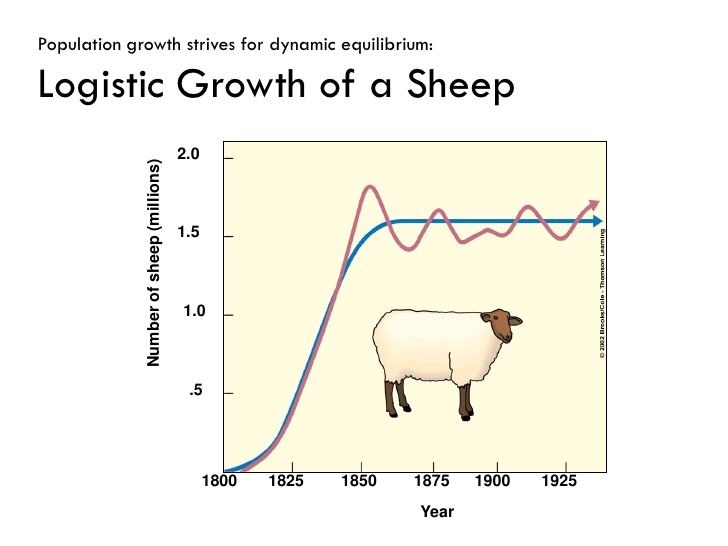
2.
What is the carrying capacity for this sheep population?
a)
1.8 million
b)
1.25 million
c)
1.6 million
d)
1.o million
3.
When a population grows past the ecosystem's carrying capacity, what happens to the population?
a)
Continues to grow
b)
The population starts to die off to return to carrying capcity
c)
The population will go extinct due to lack of resources
d)
The population grows then finds a new carrying capacity
4.
Food, water, sunlight, shelter, and space are resources that are often __________.
a)
limiting factors
b)
wet
c)
messy
d)
found in rocks
5.
In a forest ecosystem, which of the following is the best example of a limiting factor for a rabbit population?
a)
Squirrel Population
b)
Sunlight
c)
Grass available
6.
What happened to the wolf population between 1980 and 1982?
a)
it increased rapidly
b)
it decreased rapidly
7.
According to the graph, What is causing the deer population to decrease
a)
They Got sick
b)
The wolf population is decreasing
c)
The wolf population increased
d)
Nothing it's a coincidence
8.
Natural disasters can be considered limiting factors.
a)
true
b)
false
9.

Two or more organisms seeking resources at the same time is

a)

population

b)

competition

c)

ecosystem

d)

organism

10.

Any living or nonliving feature that restricts the number of individuals in a population are

a)

Limiting factors

b)

Biotic Factors

c)

Abiotic factors

d)

Necessary factors

11.

A nonliving factor is also called

a)

an abiotic factor

b)

a biotic factor

c)

an adaptation

d)

a limiting factor

12.

A biotic factor means that it is

a)

living

b)

nonliving

c)

limiting factor

d)

adaptation

13.

The same species living in the same area or ecosystem are called a

a)

organism

b)

biotc

c)

population

d)

different

14.
________ are consumers that eat plants and meat.
a)
Herbivore
b)
Omnivore
c)
Carnivore
15.
_______ are consumers that eat only meat.
a)
Herbivore
b)
Omnivore
c)
Carnivore
16.
Which organism make their own food through the process of photosynthesis? 
a)
decomposer
b)
consumer
c)
herbivore
d)
producer 
17.

Can be as small as a single celled bacteria or as large as a whale

a)

threatened species

b)

organism

c)

community

d)

limiting factor

18.

The largest number of individuals of one species that an ecosystem can support is

a)

maxfactor

b)

carrying capacity

c)

the x factor

d)

limiting factor
