
NEW
Font size
 Worksheets
4.3/4.4 How Atoms Differ/Radioactive Decay
Total questions: 15
Worksheet time: 12mins
Why are all atomic masses not nearly whole numbers?
This is due to the mass of all the electrons in the atom.
This is because of experimental error.
This is because atomic masses are the weighted average of the masses of all naturally-occurring isotopes.
This is due to binding energy of the atoms.
The atomic number of an element is defined by its number of ________.
protons
neutrons
electrons
nuclei
The sum of the protons and neutrons in a nucleus is __________.
the atomic number
the mass number
Avogadro's number
the element number
Which of the following is true for any atom?
atomic number = number of protons = number of electrons
atomic number = number of neutrons = number of electrons
mass number = number of protons = number of electrons
mass number = number of protons = number of neutrons
How is the atomic mass unit (amu) defined?
1/12 the mass of a carbon-12 atom
1/14 the mass of a nitrogen-14 atom
1/13 the mass of a carbon-13 atom
1/16 the mass of an oxygen-16 atom
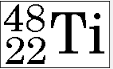
24.1% of all the isotopes of a an element have a mass of 75.23 amu, 48.7% have a mass of 74.61 amu, and 27.2% have a mass of 75.20 amu.
What is the atomic mass of this element?
74.92 amu
24.97 amu
75.01 amu
74.51 amu

In the figure below, why are beta particles deflected more than alpha particles?
Beta particles are less massive than alpha particles.
Beta particles have a larger electric charge than alpha particles.
Beta particles have more energy than the alpha particles.
Beta particles have a negative electric charge.
What is the charge of an alpha particle?
1+
2+
1-
0

Identify the missing substance in each of the following nuclear reactions.
_____→13756 Ba + 0−1B
13755Ba
13757La
13856Ba
13755Cs

