Wayground logo

Free Printable Worksheets

Font size

S
M
L
XL
Worksheets

Year 7 Earth Space Science revision

Total questions: 28

Worksheet time: 16mins

Name
Class
Date
1.
When the Northern Hemisphere is pointing towards the sun, what season is the Southern Hemisphere?
a)
Winter
b)
Spring
c)
Fall
d)
Summer
2.

What are the reasons for the seasons?

a)

Earth's tilt and rotation.

b)

Earth's rotation and revolution (orbit around the sun).

c)

Earth's tilt and revolution (orbit around the sun).

d)

Earth's tilt and resolution

3.

How long after a new moon will it take to see another new moon?

a)

12 days

b)

29.5 days

c)

1 day

d)

365 days

4.

What moon phase is represented by "A" (remember to check direction of arrows for direction of moon around the Earth)

a)

Full moon

b)

New moon

c)

Waxing crescent

d)

Waning crescent

5.

What moon phase is represented by "E" (remember to check direction of arrows for direction of moon around the Earth)

a)

Full moon

b)

New moon

c)

Waxing crescent

d)

Waning crescent

6.

What moon phase is represented by "B" (remember to check direction of arrows for direction of moon around the Earth)

a)

Full moon

b)

New moon

c)

Waxing crescent

d)

Waning crescent

7.

What moon phase is represented by "H" (remember to check direction of arrows for direction of moon around the Earth)

a)

Full moon

b)

New moon

c)

Waxing crescent

d)

Waning crescent

8.

What moon phase is represented by "D" (remember to check direction of arrows for direction of moon around the Earth)

a)

Waxing crescent

b)

Waning Gibbous

c)

Waxing Gibbous

d)

Waning crescent

9.

What moon phase is represented by "F" (remember to check direction of arrows for direction of moon around the Earth)

a)

Waxing crescent

b)

Waning Gibbous

c)

Waxing Gibbous

d)

Waning crescent

10.

What moon phase is represented by "C" (remember to check direction of arrows for direction of moon around the Earth)

a)

Waxing crescent

b)

Waning Gibbous

c)

Ist quarter

d)

Last (3rd) quarter)

11.

What moon phase is represented by "G" (remember to check direction of arrows for direction of moon around the Earth)

a)

Waxing crescent

b)

Waning Gibbous

c)

Ist quarter

d)

Last (3rd) quarter)

12.
At position A, which hemisphere would have summer?
a)
Northern hemisphere
b)
Southern hemisphere
13.
What happens when the area in which you live tilts away from the sun?
a)
It is summer.
b)
It is spring.
c)
It is winter.
d)
It is fall.
14.
Why is the Equator warmest?
a)
Because it is closest to the sun.
b)
Because it receives the most direct sunlight
c)
Because no clouds form here.
d)
Because it is far from the sun
15.
Which season is taking place in the Southern Hemisphere in Position 1?
a)
Winter
b)
Spring
c)
Summer
d)
Fall
16.
Which season is taking place in the Northern Hemisphere in Position 1?
a)
Winter
b)
Spring
c)
Summer
d)
Fall
17.
In order to have an eclipse, the Moon, Sun and Earth have to be?
a)
Below each other
b)
Above each other
c)
In alignment
18.
A lunar eclipse can occur only during the _________________.
a)
Full moon
b)
New moon
c)
Waxing moon
19.
A solar eclipse can occur only during the _________________.
a)
Full moon
b)
New moon
c)
Quarter moon
20.
Which type of eclipse occurs when the Moon comes directly between Earth and the Sun?
a)
Lunar eclipse
b)
Solar eclipse
21.
Which type of eclipse occurs when the Earth comes directly between the Sun and Moon?
a)
Lunar eclipse
b)
Solar eclipse
22.
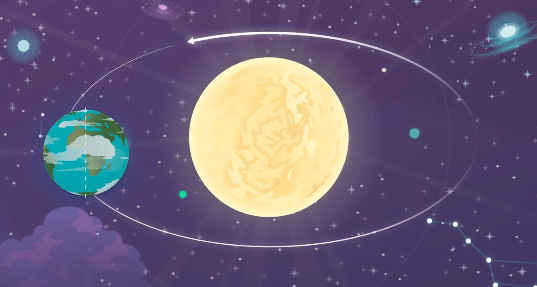
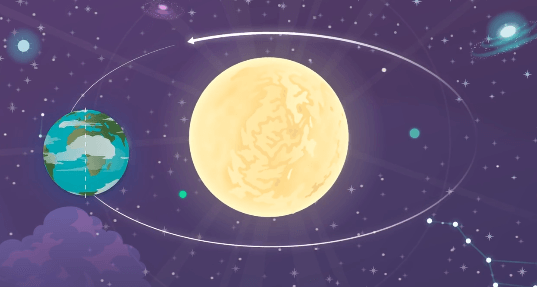
How long does it take for the Earth to make one full orbit around the Sun?
a)
one day
b)
one week
c)
one month
d)
one year
23.
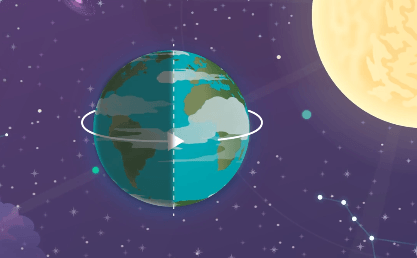
The Earth is rotating on its axis, creating _____
a)
the 12 months
b)
the years
c)
the seasons
d)
day and night
24.
When the Earth completes a full orbit around the Sun, it has completed _____ rotations or days
a)
7
b)
30
c)
91
d)
365
25.
What looks to be the motion of the Sun in the sky is really caused by the motion of _____
a)
the Earth
b)
the stars
c)
the planets
d)
the Earth's axis
26.
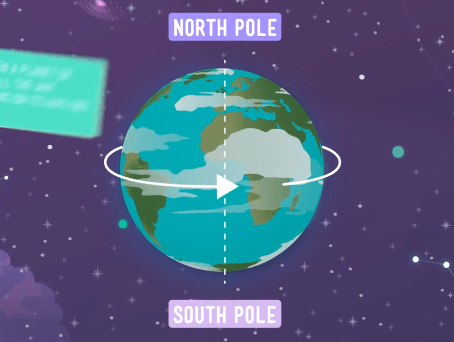
The spinning movement of the Earth about its axis is called the Earth's _____
a)
revolution
b)
rotation
c)
precession
d)
orbit
27.
The movement of the Earth around the Sun is called its _____
a)
revolution
b)
rotation
c)
precession
d)
gyration
28.
The invisible line that passes through the North Pole and the South Pole is called Earth's ____
a)
axis
b)
equator
c)
ecliptic
d)
prime meridian