wayground logo

Free Printable Worksheets

NEW

Font size

S
M
L
XL
Worksheets

Triangles: Congruent, Isosceles, Equilateral

Total questions: 45

Worksheet time: 4hrs 57mins

Name
Class
Date
1.

Which angle is the vertex angle?

a)

<C

b)

<A

c)

<B

d)

There is no vertex angle

2.
If two sides of a triangle are congruent, then the _________________ opposite those sides are congruent.
a)
sides
b)
vertices
c)
angles
d)
measures
3.
If an isosceles triangle has a base angle measuring 40°, then what measure is the vertex angle?
a)
120°
b)
100°
c)
40°
d)
80°
4.

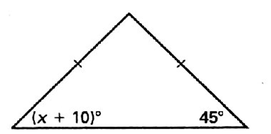
Find x

a)

90

b)

45

c)

80

d)

35

5.
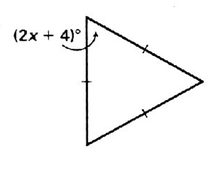
Find x
a)
60
b)
48
c)
30
d)
28
6.
Solve for x.
a)
7
b)
9
c)
10
d)
-11
7.
Find the measure of the indicated angle. 
a)
145
b)
113
c)
102
d)
78
8.

Find the measure of ∠BDE

a)

12o

b)

57°

c)

78o

d)

45o

9.

Find the measure of ∠CED

a)

52o

b)

64°

c)

76o

d)

128o

10.

Find the value of x.

a)

6

b)

1

c)

3

d)

5

11.
Which of the following is NOT a triangle congruence criteria?
a)
SAS
b)
AAS
c)
SSA
d)
ASA
12.
What does CPCTC stand for?
a)
Corresponding Parts of Congruent Triangles are Congruent
b)
Congruent Parts of Congruent Triangles are Corresponding
c)
Colorful Pieces of Corresponding Triangles are Congruent
d)
Congruent Pieces of Congruent Triangles are Congruent
13.
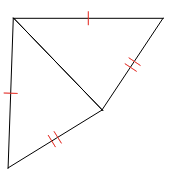
What triangle congruence criteria is shown in the given diagram?
a)
AAS
b)
ASA
c)
SSA
d)
SAS
14.

What is the missing piece of information required to prove these triangles congruent by SSS?

a)

QY ≅ QY

b)

NY ≅ PY

c)

∠N ≅ ∠P

d)

QY is the perpendicular bisector

15.
What is the "reason" for step 5 of the proof?
a)
Angle Bisector Theorem
b)
Reflexive property
c)
CPCTC Theorem
d)
Proof
16.
Which equation would you use to find x?
a)
2x-6=7x+4
b)
2x-6+7x+4=90
c)
2x-6+7x+4=180
d)
2x-6+7x+4=360
17.
Can the triangles be proven congruent?  If so, how?
a)
ASA
b)
Cannot be proven congruent
c)
SAS
d)
SSS
18.

What is the "reason" for step 2 of the proof?

a)

Reflexive property

b)

CPCTC

c)

SAS

d)

Given

19.
What is the "statement" for step 2 of the proof?
a)
∡JHI≅∡JKL
b)
JL=JI
c)
∡H≅∡K
d)
HI=KL
20.
What is statement #2?
a)
∠ABC≅∠EDC
b)
∠BCA≅∠DCE
c)
BC≅CD
d)
∠E≅∠A
21.

What is the reason?

a)

Definition of a midpoint

b)

Definition of congruence

c)

Definition of segment

d)

Definition of congruent segments

22.
What formula do we use to find the length of a side of a figure?
a)
Midpoint Formula
b)
Slope Formula
c)
Pythagorean Theorem
d)
Distance Formula
23.
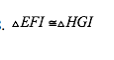
Use the congruency statement to answer the following: 
<F = ___
a)
<H
b)
<I
c)
<G
d)
not congruent to another angle
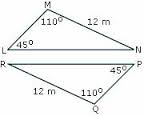
24.
Are these triangles congruent? If so, state the rule which you used to determine congruence.
a)
AAA
b)
AAS
c)
ASA
d)
Not necessarily congruent
25.

Fill in the missing proof statements.

a)

Transitive Property, SAS(Side-Angle-Side)

b)

Reflexive Property, SAS(Side-Angle-Side)

c)

Reflexive Property, Vertical Angles Thm.

d)

Transitive Property, SSS(Side-Side-Side)

26.

What postulate proves these triangles congruent?

a)

SAS

b)

SSA

c)

AAS

d)

Not enough information

27.
What postulate proves these triangles congruent?
a)
SAS
b)
HL
c)
AAS
d)
ASA
28.

Fill in the blank.

a)

Given

b)

Reflexive Property

c)

Transitive Property

d)

Symmetric Property

29.

What is the reason?

a)

Definition of an angle

b)

Definition of congruence

c)

Definition of a bisector

d)

Definition of a midpoint

30.
What additional information can we conclude?
a)
∠ADB and ∠ADC are right angles
b)
∠B≅∠C
c)
∠BAD≅∠CAD
d)
None of the above
31.
Which of the following statements are false?
a)
<A + <B + <C = 180º
b)
<C and <D are a linear pair
c)
<D = <A + <B
d)
<A + <B = <C + <D
32.

Find m∠O

a)

20o

b)

45°

c)

50°

d)

80°

33.

Find MO

a)

6

b)

11

c)

20

d)

50°

e)

80°

34.

The triangle formed by the coordinates (-1, 2), (7, 2), (3, 9) is...

a)

Scalene

b)

Isosceles

c)

Equilateral

d)

Cannot be determined

35.

In the diagram, CI = SI. What is the REASON for #2 in this proof?

a)

Definition of an angle bisector

b)

Base angles theorem

c)

Definition of a perpendicular bisector

d)

∠COI and ∠IOS are right angles

36.

Statement 5 will state the triangle CIO is congruent to triangle SII. What is the REASON for #5 in this proof?

a)

Given

b)

Definition of isosceles triangle

c)

HL

d)

SAS

e)

ASA

37.

The base angle of an isosceles triangle is 15 less than three times the vertex angle. What is the measure of the vertex angle?

a)

25°

b)

30°

c)

45°

d)

50°

e)

75°

38.

Find the value of x.

a)

50°

b)

60°

c)

80°

d)

Cannot be determined

39.

The vertex angle of an isosceles triangle measures 75 degrees more than three times the measure of one of its base angles. How many degrees are there in a base angle of this triangle?

a)

15°

b)

21°

c)

138°

d)

105°

40.

Find m∠L.

a)

20°

b)

50°

c)

80°

d)

100°

41.

Find m∠ABD.

a)

29°

b)

58°

c)

61°

d)

122°

42.

Find DF.

a)

20

b)

70

c)

90

d)

50

43.

Find m∠A.

a)

33°

b)

147°

c)

114°

d)

66°

44.

Find m∠MAT.

a)

67.5°

b)

71.5°

c)

139°

d)

49°

45.

∆DEF is isosceles with DE = EF. Which of the following statements is ALWAYS true?

a)

m∠F < m∠E

b)

m∠E = m∠D

c)

DF = DE

d)

m∠D = m∠F