
 Worksheets
chemical reactions and the periodic table
Total questions: 145
Worksheet time: 2hrs 1mins
C6H12O6

The student inferred that a chemical reaction occurred. What evidence supports this inference?
The zinc metal remained silver-colored and shiny


The student observed that the temperature changed from 25 •C to 23 •C when the solutions were combined and that a white substance rapidly formed and settled to the bottom of the container. What most likely happened to produce these results?

6
12
24
36

How many atoms in all are in a molecule of serotonin?
C10H12N2O

In a ___________change, a substance changes into a different substance.
Physical
Chemical
Which of these is NOT a sign that a chemical change has occurred?
A loss of transparency
An unexpected color change
A temperature change
The formation of a precipitate
The Law of Conservation of Mass states
that matter exists in all states and reacts the same
that matter can only be changed into new substances by introducing a catalyst
that matter exists in the same state throughout any chemical change
that matter cannot be created or destroyed and that the mass of the products must equal the mass of the reactants
How many F atoms are in this compound?
6MgF2
2
6
8
12

a copper penny turning greenish after a few years.
Physical change
Chemical change
___________________ are the elements or compounds that leave (are formed in) a chemical reaction.
Polymers
Bonds
Reactants
Products
What is the 2 located behind oxygen (O) called?


2Mg + O2 --> 2MgO
which are the reactants?
What must go in the blank space to balance the equation?
4Fe + ____O2 --> 2Fe2O3
1
2
3
4
2Ca + O2 > 2CaO
What is the 2 located in front of calcium (Ca) called?
Fe + O2 -> Fe2O3

NH3 + O2 ----> NO + H2O
_Al +_HCl --> _H2 +_AlCl3
Anything that has mass and takes up space
matter
mixtures
compounds
chemical reactions
Anything that has mass and takes up space
matter
mixtures
compounds
chemical reactions
A single, small piece of matter
molecule
compound
atom
space
Two or more atoms chemically bonded.
elements
atoms
molecules
matter
These are found on the periodic table and made of one type of atom
atoms
elements
electrons
mixtures
2 or more elements chemically bonded. For example, carbon dioxide (CO2 )
atom
molecule
compound
mixture
Texture, color, states of matter, flexibility, freezing & melting points
chemical properties
physical properties
states of matter
C6H12O11 is best described as a ...
Chemical mixture
Chemical formula
Chemical Equation

Which 2 words describe this image
atom & molecule
molecule & element
molecule & compound
atom & compound

Which 2 words describe this image
atom & molecule
molecule & element
molecule & compound
atom & compound

Which 2 words describe this image
atom & molecule
molecule & element
molecule & compound
atom & element
Which 2 kinds of particles make up the nucleus of an atom?
electrons & neutrons
protons & neutrons
protons & electrons
the core
Which particle carries a negative charge?
electron
proton
neutron
nuclues
A pure substance that cannot be broken down into any other substance by chemical or physical means. There are more than 100 of us shown in the Periodic Table
compound
molecule
element
mixture

How many protons are in one atom of Al?
13
Al
29.98
16.98
What is the atomic number for Al?
13
Al
29.98
16.98
What is the chemical symbol for Al?
13
Al
29.98
16.98

What is the atomic mass of Aluminum?
13
Al
26.98
16.98
breaking and forming bonds that changes reactants into products (making something new and different)
chemical reaction
physical reaction
emotional reaction
How do you find how many nuetrons are in an atom?
subtract the atomic number by the atomic mass
its the same as the protons
its the atomic mass
add the atomic number and the atomic mass
what element does not belong?
H
Ne
Na
K
what one describes a metaloid?
shiny, good conductors, malleable, ductile, and high density
dull, insulator, non- malleable
semi- conductor, shiny or dull, malleable or brittle
none of the above
how can you tell the number of energy shells an atom has?
the period number
the group number
the atomic mass
the valence electrons
What is an ion?
an atom with a positive or negative charge
an isotope
an atom with a different number of neutrons than others
change in number of protons on an atom
When an atom gains or loses an electron it becomes an _____.
isotope
oxygen
ion
neutron
Which of the following is a noble gas?
oxygen
iron
hydrogen
neon
Which element is an alkali metal?
lithium
cobalt
mercury
calcium
Which element is an alkaline earth metal?
lithium
vanadium
carbon
calcium
Which element is a halogen?
helium
hydrogen
flourine
oxygen
Which element would probably be a good conductor of electricity?
bromine
helium
gold
sulfur
number of protons in the nucleus of each atom of a given element; is the top number in the periodic table
atomic mass
mass number
atomic number
isotope
a substance produced when elements combine and whose properties are different from each of the elements in it
element
matter
mixture
compound
two or more atoms of the same element that have different numbers of neutrons in their nuclei
atom
compound
isotope
substance
states that matter is not created or destroyed but only changes form
substance
atomic number
mass number
law of conservation of matter
an uncharged particle located in the nucleus of an atom
electron
neutron
proton
nucleus

Elements that have the same number of valence electrons
are in the same group and are arranged in rows across
are in the same group and are arranged in vertical columns
are in the same period and are arranged in rows across
are in the same period and are arranged in vertical columns

Elements in the same period
have the same number of valence electrons
have the same number of energy levels
have similar properties
have the same number of protons

If an element is found in Group 17 it will have ____ valence electrons?
17
2
8
7

What is the atomic mass of the element shown?
79
196.967
118
275.967

How many neutrons are in found in an atom of gold?
79
196.967
118
295.967

Which element is found in Period 1, Group 18?
H
He
Ar
Ne

Which period would the element in the picture be in on the periodic table?
1
2
4
6
Group 1
Group 7
Group 0
Group 2
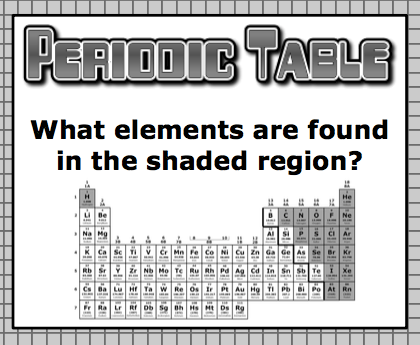
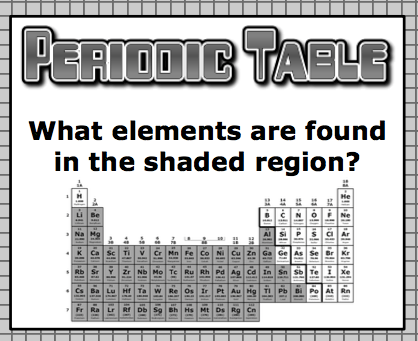
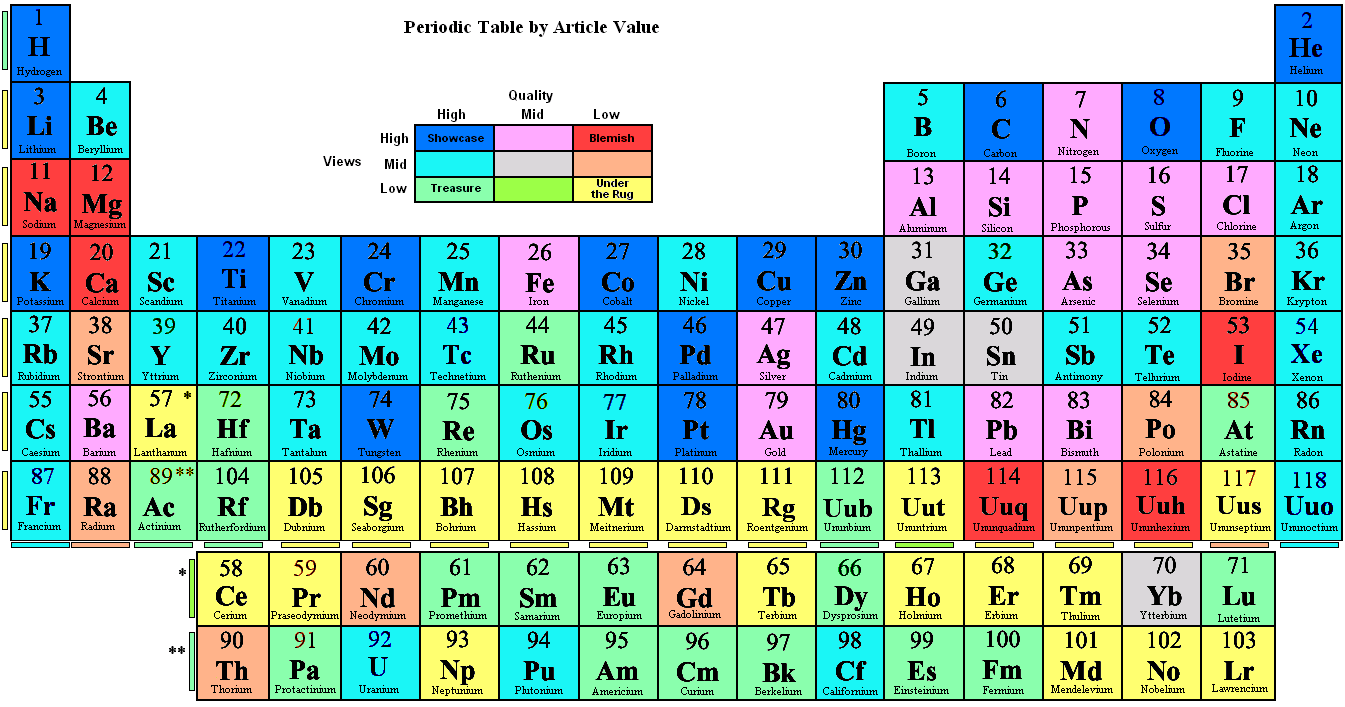
An Element
Contains one thing
Contains ONLY one type of atom
Contains two or more type of atoms - chemically bonded together
Contains two or more types of atoms - NOT chemically bonded together
Mixtures contain...
Two or more things
Two or more types of atom, chemically bonded together
Two or more types of atom, NOT chemically bonded together
ONLY one type of atom
CO2 contains how many Oxygen atoms?
1
2
3
4
CO2 contains how many Carbon atoms?
1
2
3
4
H2SO4 contains how many Hydrogen atoms?
1
2
3
4
H2SO4 contains how many Oxygen atoms?
1
2
3
4


Which of the following substances is a compound?
Co
CO2
O2
Li
The chemical formula of glucose is C6H12O6. Is glucose an element, compound, or mixture?
element
compound
mixture
Based on the Law of Conservation of Matter, describe the relationship between the mass of the reactants and the mass of the products.
The mass of the products is always greater than the mass of the reactants.
The mass of the reactants is less than the mass of the products.
The mass of the reactants equals the mass of the products.
The mass of the reactants is greater than the mass of the products.

Which section represents the reactants?
A
B
C
Which section represents the products?
A
B
C
Which section represents the yield sign?
A
B
C

Why does this picture demonstrate the Law of Conservation of Mass?
the number of atoms of each element are the same on both sides
they start out separate and end up combined
the same elements are used
it doesn't demonstrate the Law of Conservation of Mass
If a chemical reaction occurs in a closed system (no way for any part of the reaction to escape), how does the product mass compare to the reactant mass?
the mass would decrease
the mass would increase
the mass would stay the same
it depends on the type of reaction
If a chemical reaction occurs in an open system (not contained), what might happen to the measurable mass of the products when compared to the reactants?
the measurable mass might decrease because any gas produced can escape (the actual mass would stay the same)
the mass would increase because mass was created
the measurable mass would stay the same because nothing would be able to leave the system.
it depends on the type of reaction

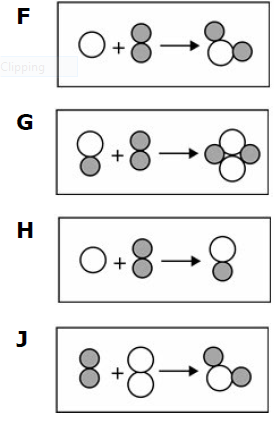
Which picture below would correctly demonstrate the Law of Conservation of Matter if this picture is the reactants?


Which of the following would represent an element?


What is the part of the chemical equation in green called?
Fe + S → FeS
products
reactants
yield
input
What is the right part of a chemical equation called...
2H2 + O2 --> 2H2O
Reactants
Products
Yields
Output
How many different elements are in C6H12O6?
1
2
3
4

This is used to represent the number of each atom being represented.
A Exponent
The Coefficient
A Molecule
The Subscript
A chemical reaction is balanced when
both sides have the same elements
both sides have the same number of atoms
both sides have the same subscripts
the molecules are the same on each side
Is the following equation balanced or unbalanced?
Fe + S2 → FeS2
balanced
unbalanced
H2 + O2 --> H2O
In a chemical reaction,
the atoms of the reactants always stay together.
the atoms of the reactants rearrange, to form new products.
new atoms are formed when combined to make the products
some atoms disappear & others multiply to form products
Students want to gather evidence for the claim that the number of atoms present before a chemical reaction is equal to the number of atoms present after the chemical reaction. They decide to react vinegar and baking soda in a sealed bag. Which of the following would provide the evidence the students need?
The mass of the plastic bag, baking soda, and vinegar before the reaction was equal to the mass after the reaction.
Bubbles were produced during the reaction, which meant that a gas was being produced.
The plastic bag did not change in any way, indicating that it was involved in the reaction.
The mass of the baking soda was exactly equal to the mass of the vinegar used to create the chemical reaction.

Is this balanced?
2HgO → 2Hg + O2
Yes
No
Al + O2 → 2Al2O3

