
Font size
 Worksheets
8th Grade U.S. History First Semester Exam
Total questions: 94
Worksheet time: 4hrs 31mins
How did geography influence the early economic development of New York, Boston, and Charleston?
Long coastlines offered abundant natural resources
Proximity to flooding rivers limited development.
Natural harbors provided access to markets.
Extreme climates limited productive activity.

Which reason best completes this list?
To spread democratic ideals
To improve efficiency in manufacturing
To lace potential military allies
To claim new territory
Which of the following was a primary reason France sought to colonize North America?
To reduce overpopulation in Europe
To create communities founded on religious tolerance
To profit from trading in furs and other goods
To create joint ventures with other European powers

Which colony correctly completes this diagram?
Marylan
Virginia
South Carolina
Georgia
Which statement accurately describes the reasons for establishing Plymouth and Jamestown?
Both colonies were established to bring wealth to stockholders.
Plymouth's founders intended to produce raw materials, while Jamestown's founders expected to discover gold.
Both colonies were established to limit the expansion of other European empires.
Plymouth was founded as a refuge from religious persecution, while Jamestown was founded for commercial profit.
- Distance from Great Britain
- Mayflower Compact
- Town hall meetings
The factors listed above contributed most to the --
creation of alliances between British colonists to Parliament
election of British colonists to Parliament
growth of representative government in the British colonies
expansion of British trade in the Americas
From 1690 to 1760, Parliament and the king of England allowed colonists in America to exercise a great deal of control over local and regional matters. Historians have described this practice as "salutary neglect."
Which of the following happened as a direct result of this policy?
The colonies developed a strong tradition of self-government.
Many proprietary colonies were converted to royal colonies.
The colonies refused to participate in a system of common defense.
Many colonies sought economic aid from other countries.
From 1690 to 1760, Parliament and the king of England allowed colonists in America to exercise a great deal of control over local and regional matters. Historians have described this practice as "salutary neglect."
Which of the following happened as a direct result of this policy?
The colonies developed a strong tradition of self-government.
Many proprietary colonies were converted to royal colonies.
The colonies refused to participate in a system of common defense.
Many colonies sought economic aid from other countries.

Which of the following best replaces the question mark in the diagram above?
Created a general council to manage the colonies
Experienced strict control by Parliament
Established their own representative institutions
Appointed governors who reported to the king
Which statement best explains the significance of the Mayflower Compact?
It limited the power of future colonial governments.
It weakened the influence of religion in government
It established a form of self-government based on a social contract
It guaranteed liberties for colonists through local government
Which of the following contributed most to the expansion of the transatlantic slave trade during the 1700's?
A lack of skilled labor in the American colonies
Demand for slaves in the American colonies that produced cash crops
A lack of protective tariffs in the American colonies
Demand for slaves in the industrialized American colonies

Which of the following was a major reason for the flow of the transatlantic slave trade shown on the map?
The economic demands of the plantation system
The construction needs of the railroad
Increased textile manufacturing
Increased western migration
Catholics immigrated to the Maryland colony in the seventeenth century primarily to --
profit from natural resources
avoid crop failures and famine
produce cash crops to pay off debts
escape persecution

The colonies in this list were founded primarily to offer settlers a greater degree of --
freedom from debts
religious freedom
economic freedom
freedom of speech

These below acts contributed to the start of the Revolutionary War by —
restricting colonial trade with American Indians.
imposing regulations on colonial agriculture.
angering colonists who believed that their civil liberties had been violated.
punishing colonists for resisting the authority of Parliament.

The excerpt below reflects the dissatisfaction of American colonists with the —
political debates that took place at the Albany Convention
interference of Great Britain in the slave trade
economic consequences of the Great Awakening.
economic policies imposed by Great Britain following the French and Indian War.

British colonists objected to the Proclamation of 1763 because they?
feared it would provoke attacks from American Indians.
did not want to share control of the fur trade with France.
resented the limits it imposed on westward expansion.
wanted to be able to trade freely with foreign nations.

The Continental Congress issued this commission to?
Benedict Arnold
Alexander Hamilton
John Hancock
George Washington

What was one result of the Treaty of Paris of 1783?
Great Britain recognized the United States as an independent country.
Competing Seminole and Spanish claims in West Florida were resolved.
The British navy agreed to stop pressing American sailors into service.
British territory in eastern Canada was ceded to France.

Which of the following best completes this excerpt below?
Saratoga
Concord
Trenton
Yorktown

Which excerpt from the Declaration of Independence best explains why colonists were unhappy about their lack of representation in the British parliament?
“He has refused to pass other Laws for the accommodation of large districts of people.”
“For imposing Taxes on us without our Consent.”
“He has refused his Assent to Laws, the most wholesome and necessary for the public good.”
“For transporting us beyond Seas to be tried for pretended offences.”

The rights listed below were —
established by a series of Supreme Court decisions.
defined by Thomas Jefferson in the Declaration of Independence.
established by the ratification of the U.S. Constitution.
defined by President George Washington in his Farewell Address.

Which of these completes this graphic organizer below?
Parliament repeals the Stamp and Sugar Acts.
King George III allows colonists to petition Parliament for tax relief.
Parliament passes the Intolerable Acts.
King George III appoints colonial representatives to Parliament.

In 1787, Congress awarded John Paul Jones the Congressional Gold Medal in honor of his “valor and brilliant services” during the Revolutionary War. Which accomplishment was Congress recognizing?
Leading the evacuation of Washington, D.C., during the British invasion.
Preparing the strategy for the American victory at Yorktown.
Persuading France to provide military assistance to the Continental army.
Commanding a victory at sea against the British navy.

How did mercantilism policies create tension Great Britain and the American colonies?
By introducing indentures servitude to the middle colonies.
Br requiring colonists to enlist in the military.
By limiting the amount of farmland each colonist could have.
By preventing colonists from trading with most other foreign countries.

Why is the Battle of Saratoga considered a turning point in the Revolutionary War?
The British victory extended the fighting for another year.
The American defeat led many soldiers to desert the Continental Army.
The British defeat marked the beginning of a steady decline in British military superiority.
The American victory convinced France to ally with the United States.

The list above includes rights that are considered?
Tranferable
Legislated
Unalienable
Inherited
*Quartering Act
*Stamp Act
These acts contributed to the start of the Revolutionary War by...
- The Sons of Liberty, address to the public, New York, December 15, 1773
The excerpt above reflects the dissatisfaction of American colonists with the...
"A Crucial American Victory," U.S. National Park Service,
Which of the following best competes this excerpt?
*Life
*Liberty
*Pursuit of Happiness
The rights listed above were -
- Thomas Paine, 1776
In this statement, Paine suggested that the American colonies should...


George Mason refused to sign the Constitution and opposed its ratification because he believed that it?
did not adequately protect individuals from potential government abuse.
B did not give the executive branch enough power to oversee the military.
prevented the legislative branch from effectively governing the states.
D prevented the judicial branch from using judicial review to overturn acts of the legislature.

Which amendment provides for the protections described in this list below?
First Amendment
Fourth Amendment
Fifth Amendment
Tenth Amendment

Which constitutional guarantee did this act violate?
Freedom of assembly
The right to due process
Freedom of the press
The right to a jury trial

The constitutional amendment excerpted below protects people in the United States from?
excessive fines for traffic violations.
imprisonment for life without a jury trial.
excessive surveillance by the government.
conscription by the armed forces.

When citizens report for jury duty, they are helping uphold a constitutional right guaranteed by the?
First Amendment
Second Amendment
Sixth Amendment
Ninth Amendment

Which document was most influenced by this statute below?
The Declaration of Independence
The Articles of Confederation
The Fundamental Orders of Connecticut
The Bill of Rights

A certain small town has many choices for people who want to attend religious services, including two churches, a synagogue, a cathedral, a mosque, and a temple. These choices are protected by the?
First Amendment
Third Amendment
Sixth Amendment
Eighth Amendment

Why were southern delegates to the Constitutional Convention willing to accept the Three-Fifths Compromise?
It increased the political influence in the South
It allowed indentured servants in the South to become citizens
It decreased the federal tax on property in the South
It allowed the South to expand its industrial output.

Which argument would a Federalist make to support ratification of the Constitution.
The Constitution will enable states to nullify laws that are harmful to citizens.
A strong federal government will be more stable than a loose confederation of states.
The Constitution will allow states to establish banks to stabilize the national economy.
A republican system of government will better represent large states.

In Marbury V. Madison, the Supreme Court first stated the principle that?
Only the courts may regulate interstate commerce.
The President can veto federal legislature
The courts can declare a federal law unconstitutional
Only the President can issue a executive order

In 1787 the United States was at a crossroads. Farmers in western Massachusetts had rebelled the year before over property taxes. The state struggled to end the rebellion. Events such as this one contributed to the decision to?
sign the Treaty of Paris
repeal the Intolerable Acts
declare an embargo on imported goods
restructure the federal government

Which of the following correctly describes the Three-Fifths Compromise?
A portion of the slave population was counted for legislative representation.
A federal law enforcing the return of fugitive slaves was passed.
The census bureau was established to help apportion representation.
The election of senators was delegated to state legislatures.

Which of the following should replace the question mark in this diagram below?
Direct democracy
Great Compromise
Checks and balances
Missouri Compromise

Which speaker below is in favor of ratifying the Constitution?
Speaker 1
Speaker 2
Speaker 3
Speaker 4

In the debate over the ratification of the U.S. Constitution, which point would have been made by a Federalist?
“The existing national government lacks the ability to add new states to the union.”
“The states are in danger of losing the ability to raise revenue.”
“The existing national government lacks the power to perform essential functions.”
“The states are unable to protect the rights of the people.”

Why did the Anti-Federalists demand that a bill of rights be added to the U.S. Constitution?
To strengthen the authority of the federal government.
To improve the organization of the judiciary.
To give each state an equal amount of power.
To protect individual freedoms from the federal government.

Patrick Henry opposed ratifying the U.S. Constitution because he believed that under it?
the states would surrender too much power to the federal government.
alliances could not be formed with other countries.
the courts would not be able to hold government officials accountable.
individuals would exercise too much power over the federal government.

With which of the following arguments would the authors of The Federalist Papers most likely have agreed?
A bill of rights should be included in the Constitution before it is ratified.
Having a stronger central government will make the country more stable and prosperous.
The Three-Fifths Compromise will result in fair and equal representation.
Universal suffrage should be constitutionally guaranteed.

Which excerpt from the U.S. Constitution best illustrates the principle of popular sovereignty?
“Each House shall be the Judge of the Elections, Returns and Qualifications of its own Members. . . .”
“The House of Representatives shall be composed of Members chosen every second Year by the People of the several States. . . .”
“The Senate shall chuse their other Officers, and also a President pro tempore. . . .”
“The Times, Places and Manner of holding Elections for Senators and Representatives, shall be prescribed in each State by the Legislature thereof.”

This excerpt below provides one example of which constitutional principle?
Federalism
Checks and balances
Popular sovereignty
Individual rights

Which principle of U.S. government is illustrated in the sequence shown below?
Judicial review
Checks and balances
Popular sovereignty
Federalism

The Constitution describes two ways to propose an amendment. Which of the following gives an example of one way?
The president officially requests that Congress propose the amendment.
Three-fourths of state governors sign a petition in favor of proposing the amendment.
A majority of citizens vote in favor of proposing the amendment.
Two-thirds of both congressional houses vote in favor of proposing the amendment.

Which of the following was a defining characteristic of the Era of Good Feelings?
The United States ceded territory to Great Britain in an attempt to avoid war.
There was a renewed sense of nationalism.
Evangelical revivalists challenged religious traditionalists.
Many states called for a restructuring of the federal government.

Which action completes this diagram below?
oversee state government agencies.
regulate the creation of new businesses.
establish a national bank.
eliminate protective tariffs.
Which action completes this diagram below?
oversee state government agencies.
regulate the creation of new businesses.
establish a national bank.
eliminate protective tariffs.

This list below provides examples of?
topics discussed during the Second Constitutional Convention.
domestic issues faced by the leaders of the new republic.
weaknesses of the government under the Articles of Confederation.
issues leading to the ratification of the first constitutional amendments.

According to Alexander Hamilton, which action was necessary to ensure the stability of the nation’s economy?
The passage of a trade embargo against Great Britain.
The abolition of consumption taxes.
The creation of a trade alliance with France.
The establishment of a national bank.

Which problem did George Washington encounter when he became president?
Southern states were threatening to secede from the Union.
The United States had large debts from the American Revolution.
Great Britain was refusing to trade with the United States.
The Articles of Confederation needed to be replaced with a stronger constitution.

Disagreements between these two cabinet members led to?
the creation of reservations for American Indians.
a struggle to ratify the Bill of Rights.
the establishment of the first U.S. political parties.
a compromise over slavery in western territories.

The first political parties in the United States were established in the 1790s largely because of political differences between?
John Adams and Benjamin Franklin
Alexander Hamilton and Thomas Paine
George Washington and James Madison
Thomas Jefferson and Alexander Hamilton

Which of the following best completes the diagram below?
Boston Tea Party
War of 1812
American Revolution
Civil War

Which phrase completes this excerpt below?
colonial Settlements
protective Tariffs
permanent Alliances
territorial Disputes

The U.S. foreign policy illustrated in this cartoon below was intended to?
prevent further European colonization in the Western Hemisphere.
deter Spain from inciting revolution in former U.S. colonies.
encourage European powers to invest in Latin America.
keep the war between France and Spain from spreading to Latin America.

Which of these best summarizes the Monroe Doctrine?
The immigration of Europeans to the United States must be discouraged.
International peace can be maintained without complicated alliances.
The power to nullify federal laws is necessary to preserve sovereignty.
Further colonization of the Americas by European countries is prohibited.

The Northwest Ordinance established guidelines for the orderly expansion of the United States by instituting a?
method to purchase territory from foreign powers.
procedure for military takeovers of existing countries.
process through which states could be added to the Union.
compromise line that prohibited slavery in the West.

The Northwest Ordinance is considered a historical milestone because it?
more than doubled the size of the United States.
established a method for admitting new states to the Union.
encouraged state legislatures to ratify the Constitution.
proposed treaties with American Indians to allow the peaceful settlement of new territories.

How did the War of 1812 most affect the U.S. economy?
Disruption in trade contributed to domestic industrial growth.
Small farmers benefited from higher export prices for grain crops.
The sale of treasury bonds to international companies was prohibited.
New trade alliances resulted in increased foreign investment.
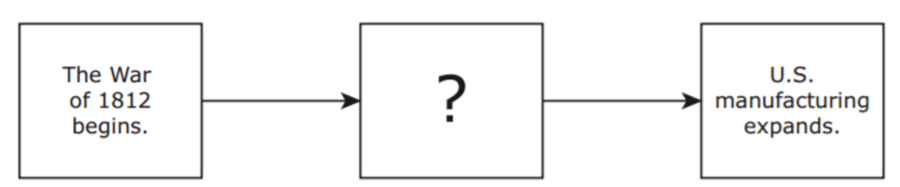
Which sentence best completes the diagram below?
The supply of British goods decreases.
Congress ends the European embargo.
Exports to Great Britain increase.
Congress reduces tariffs.

How did the War of 1812 affect the U.S. economy?
The use of federal paper currency increased.
Agricultural imports increased.
Imports of raw materials increased.
Manufacturing increased.

In Marbury v. Madison, the Supreme Court established a principle that would eventually be used by all courts to?
strike down any law that the court deems unconstitutional.
decide the outcome of contested election results.
overturn any impeachment that the court deems unsupported by evidence.
mediate disputes related to commerce between states.

The decision in Marbury v. Madison was significant in U.S. history because it?
reinforced federal authority over American Indian affairs.
confirmed the power of Congress to regulate interstate commerce.
established the practice of judicial review by the Supreme Court.
upheld the power of the Electoral College to choose the vice president.
The decision in Marbury v. Madison was significant in U.S. history because it?
reinforced federal authority over American Indian affairs.
confirmed the power of Congress to regulate interstate commerce.
established the practice of judicial review by the Supreme Court.
upheld the power of the Electoral College to choose the vice president.

Which action should be added to this list below?
Upheld the doctrine of states’ rights.
Supported the popular election of Supreme Court justices.
Allowed slavery to extend into western territories.
Wrote the Supreme Court decision that established the principle of judicial review.

The Whiskey Rebellion challenged the idea that?
The federal government had the power to pass and enforce tax laws.
A national military was needed for dealing with foreign threats.
The federal government could raise tariffs to protect industries.
A national court system was needed for resolving disputes between states.

Which of the following is the source of this statement on foreign policy above?
George Washington’s Farewell Address.
The Monroe Doctrine.
Abraham Lincoln’s first inaugural address.
The Federalist Papers.

How did the provisions of the Northwest ordinance affect U.S. expansion?
By funding a transportation network in uninhabited regions.
By establishing a process for territories to govern themselves.
By promoting the growth of southern plantation economies.
By creating a national bank to loan money to land investors.
In _____________________________(1819), the Court held that Congress does have implied powers and that states cannot tax the federal government.
McCulloch v. Maryland
Marbury v. Madison
Worcester v. Georgia
Gibbons v. Ogden
In ________________________________ (1824), the Court held that federal law overrules state law in matters affecting interstate (between states) commerce.
McCulloch v. Maryland
Marbury v. Madison
Worcester v. Georgia
Gibbons v. Ogden
In ____________________________ (1832), the Court decided that states could not regulate Native Americans. Only the federal government had that power.
McCulloch v. Maryland
Marbury v. Madison
Worcester v. Georgia
Gibbons v. Ogden
The area west of the Mississippi River, known as the ___________________, belonged to Spain. It was an enormous area of land, stretching south to the city of New Orleans and west to the Rocky Mountains. Its northern boundaries remained undefined.
Florida Territory
Canadian Territory
Louisiana Territory
Mexican Territory
The ______________________________ would provide plenty of cheap land for farmers for future generations. It would also give the United States control of the Mississippi River, which would protect domestic shipping interests.
Louisiana Territory
Florida Territory
Oregon Territory
Mexican Territory
The Senate approved the purchase in October 1803. The purchase of the Louisiana Territory ________________________ the size of the United States.
doubled
tripled
reduced in half
decreased
After 18 months and nearly 4,000 miles (6,437 km), Lewis and Clark reached the __________________Ocean. The explorers had collected valuable information about people, plants, animals, and the geography of the West. Perhaps most important, their journey inspired people to move westward.
Atlantic
Pacific
Indian
Arctic

