
 Worksheets
Our Solar System
Total questions: 24
Worksheet time: 24mins
Which is the largest object in our solar system?
Sun
Jupiter
Earth
Pluto
Which planet is closest to the sun?
Uranus
Mercury
Neptune
Earth
A ball of ice and dust with a tail of gas and dust pointing away from the sun.
Asteroid
Comet
Moon
Meteor
Which planet is the largest in the solar system?
Earth
Venus
Saturn
Jupiter
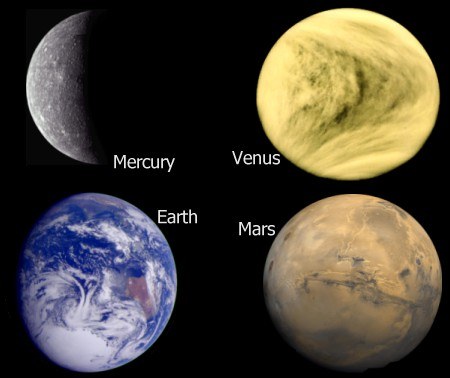
Earth and the other planets closest to the Sun are made mostly of _______
gas
metal
water
rock

Which planet is NOT one of the
"Gas Giants"?
Uranus
Venus
Neptune
Saturn

One full orbit of an object around another object is called a ________.
axis
rotation
revolution
satellite
Select the order from smallest to largest.
Sun, Milky Way, solar system, universe
Sun, Milky Way, universe, solar system
Sun, solar system, Milky Way, universe
Sun, solar system, universe, Milky Way
Which outer planets have rings?
Just Saturn
Saturn and Jupiter
Jupiter, Neptune, and Saturn
all 4 of the outer planets
How long ago was our solar system formed?
10 million years ago
4.6 million years ago
4.6 billion years ago
2 billion years ago

a small rocky body orbiting the sun, ranging from the size of a small house to dust particles
nebula
terrestrial planets
collision
asteroids

a large planet composed mostly of gases, with a relatively small core. The ___ ____ of our solar system are Jupiter, Saturn, Uranus and Neptune.
terrestrial planets
planetesimals
nebula
gas giants
The inner planets are:
Jupiter, Earth, Mars, Mercury
Saturn, Uranus, Mars, Earth
Earth, Pluto, Neptune, Mars
Mercury, Venus, Earth, Mars
How does changing the distance between objects affect the force of gravity?
Decreasing distance increases gravity
increasing distance increases gravity
Distance does not affect gravity
Which type of technology would you use to see far away objects?
computer
rover
satellite
telescope
which technology would you use to collect rock samples from a nearby planet?
computer
rover
satellite
telescope
which technology would you use to analyze data from a NASA mission
computer
rover
satellite
telescope
which of the following is the cause of Mercury having a shorter year than Jupiter
Mercury orbits closer to the sun
Mercurys orbit is more circular than Jupiter
Mercury rotates at a slower speed than Jupiter
Mercury has a more elliptical orbit than Jupiter
The farther from the sun a planet or object is, the _____________ the revolution (year).
shorter
longer
An interstellar gas cloud in which stars are born is called a
galaxy
black hole
nebula
system
The Gas Giants are much more dense than the terrestrial planets.
true
false
The rings of Saturn are made of...
Gases
Ice
Plasma
Rainbows
The length of a year on a planet is best explained by
The planet rotating on its axis
The Sun rotating on its axis
The revolution around the Sun
The seasons

