wayground logo

Free Printable Worksheets

NEW

Font size

S
M
L
XL
Worksheets

North and South America

Total questions: 62

Worksheet time: 55mins

Name
Class
Date
1.

Which two countries fought over Canada?

a)

Spain and Mexico

b)

Britain and Spain

c)

France and Spain

d)

Britain and France

2.

For what reasons do immigrants leave their home countries?

a)

Religious freedom.

b)

for job opportunities

c)

To flee from war or natural disasters

d)

All of the above.

3.

True or False: Canada has two official languages. English and French.

a)

True

b)

False

4.

Define: Bilingual

a)

the collective government of Canada

b)

Form of American music

c)

a partially self governing country

d)

having the ability to speak two languages.

5.

The __________ settled the Northeast area of America to be involved in fur trade.

a)

French

b)

Spanish

c)

Dutch

d)

British

6.

The 13 colonies were once part of ______________ .

a)

Spain

b)

France

c)

Ireland

d)

Britain

7.
Which of these is not one of the Great Lakes?
a)
Lake Ontario
b)
Lake Erie
c)
Lake Mississippi
d)
Lake Huron
8.
Which number on the map shows The Rocky Mountains ?
a)
1
b)
2
c)
3
d)
4
9.
Which number on the map shows The Great Lakes?
a)
1
b)
2
c)
3
d)
4
10.
Which number on the map shows The Atlantic Ocean ?
a)
4
b)
5
c)
6
d)
7
11.
Which number on the map shows The St. Lawrence River ?
a)
4
b)
5
c)
6
d)
7
12.
What body of water is an important shipping route for Canada? 
a)
Hudson Bay
b)
Arctic Ocean
c)
St. Lawrence Seaway
d)
Pacific Ocean
13.
What is the name of the mountain range on the Eastern side of the United States?
a)
Rocky Mountains
b)
Sierra Madre
c)
Appalachian Mountains
d)
Atlas Mountains
14.
Which physical feature is found in the central part of the United States?
a)
The Great Plains
b)
The Great Basin
c)
The Great Lakes
d)
The Great Valley
15.

The government of the United States can trace its democratic roots to which civilization?

a)

Spain

b)

France

c)

Greece

d)

Egypt

16.

Based on the above map, most cities in Canada are located near the---------

a)

St. Lawrence Seaway

b)

Atlantic Ocean

c)

United States

d)

Arctic Circle

17.

The province of Quebec has been the center of cultural conflict in Canada for several years. Which of the following cultural traits is the focus of this conflict?

a)

Dietary restrictions

b)

Religious traditions

c)

Language usuage

d)

Clothing styles

18.

Which of the following geographic factors has the greatest influence on where people live?

a)

Proximity to highways and roads

b)

Shared cultural traditions

c)

Access to public transportation

d)

Availability of water

19.

Which two physical features do the United States and Canada share?

a)

Appalachian Mountains and Mississippi River

b)

Rocky Mountains and the Great Lakes

c)

Mississippi River and the Great Lakes

d)

St. Lawrence Seaway and Rocky Mountains

20.

The United States and Canada are both considered to be multicultural societies because---

a)

The American Indian cultures in these societies did not mix with the European cultures

b)

Most of the people in these societies speak more that one language.

c)

A history of immigration has resulted in several cultures contributing to these societies.

d)

People living in these societies have economic and political freedoms.

21.

What produces electricity and creates recreational areas

a)

Dives

b)

Levees

c)

Dams

d)

Windmills

22.

The Mississippi River empties into which geographical feature?

a)

Lake Erie

b)

Gulf of Mexico

c)

Atlantic Ocean

d)

Pacific Ocean

23.

Which term refers to the outlying communities of a city?

a)

Suburbs

b)

Megalopolis

c)

Sunbelt

d)

Metropolitan area

24.

Which terms includes a city with a population of at least 50,000 and suburbs?

a)

Suburbs

b)

Megalopolis

c)

Sunbelt

d)

Metropolitan area

25.

Which term means a plan for government?

a)

Constitution

b)

Amendments

c)

Cabinent

d)

Parliament

26.

Where is Canada's population density highest?

a)

In cities along the Atlantic and Pacific Coasts

b)

In the cities in central Canada

c)

In the cities of Northern Canada

d)

In cities along the United States border

27.
If you were standing on this type of landform, water would be flowing in opposite directions.
a)
Great Lakes
b)
Appalachian Mountains
c)
Continental Divide
d)
Volcanic Eruption
28.
NAFTA is an agreement between all of the following countries EXCEPT
a)
United States
b)
Mexico
c)
Great Britain
d)
Canada
29.
What is the purpose of NAFTA?
a)
To increase trade between all countries
b)
To help Canada become a more independent nation
c)
To eliminate the environmental issues between the nations involved
30.

What document did the colonists write to share their concerns with England and to break away?

a)

Mayflower Compact

b)

Bill of Rights

c)

Magna Carta

d)

Declaration of Independence

31.
Which European Country controlled most of Central America in the 1700's?
a)
Great Britain
b)
Italy
c)
France
d)
Spain
32.
How was the transportation made during The Columbian Exchange?
a)
By ship across the Atlantic Ocean
b)
By train across the European continent
c)
By wagons across the African continent
d)
By boat across the Pacific Ocean
33.
What's the reason there are more earthquakes in West Central America than in  East Central America?
a)
There are more banana plantations
b)
It rains more in the West side
c)
The West side is closer to a tectonic plate
d)
The East side has more beaches
34.
A narrow strip connecting 2 large land areas
a)
Habitat
b)
Isthmus
c)
Infrastructure
d)
Intersection
35.
A heavily wooded forest that receives more than 100 inches of rain per year
a)
Deforestation
b)
Rain forest
c)
Poachers
d)
Seismic
36.
Patagonia region is located in which countries?
a)
Bolivia and Paraguay
b)
Colombia and Ecuador
c)
the Galapagos Islands
d)
Chile and Argentina
37.

Which two European groups were the first to colonize South America?

a)

British and Portuguese

b)

British and Spanish

c)

Spanish and Portuguese

d)

French and Spanish

38.
A large mountain range that goes along the western coast of South America
a)
Amazon
b)
Panama Canal
c)
Andes
d)
Pampas
39.
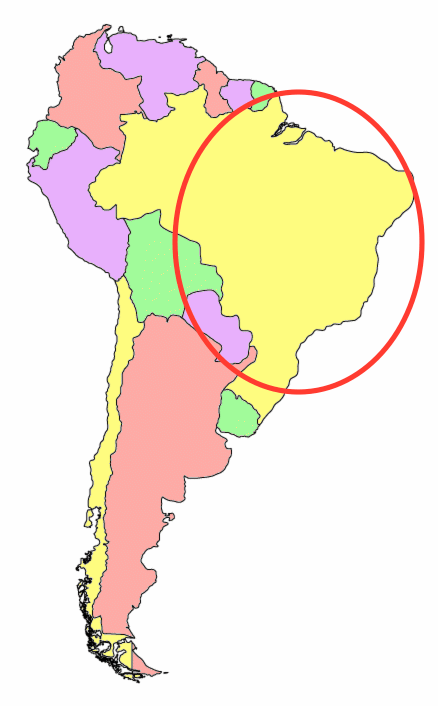
What country is this?
a)
Brazil
b)
Portugal
c)
Argentina
d)
Chile
40.
Where did the Inca live? 
a)
Peru
b)
Canada 
c)
Sioux Falls 
d)
Brookings 
41.
What nickname is the Amazon Rainforest known for? 
a)
"Lungs of the World" 
b)
" Jungle of Kings" 
c)
" Jungle of the gods"
d)
" Lungs of South America 
42.
What is significant about the Panama Canal?
a)
Major source of income for the people of Panama
b)
Provides a shorter trade route from the Atlantic to the Pacific
c)
Creates more jobs
d)
It was built and is owned by the U.S.
43.
Why do most of the citizens of South America speak Spanish?
a)
They brought football over
b)
The Portuguese settled South America
c)

The Spanish Conquistadors forced the natives to convert to Catholocism

d)
South America was mostly colonized by Spain
44.

__________ in South America affects people everywhere.

a)

cutting down the rainforest

b)

powerful military

c)

population growth

d)

farming overproduction

45.
What are the effects of deforestation ?
a)
loss of habitat
b)
increased green house gasses 
c)
soil erosion and flooding
d)
all of the above
46.
Which of the following is the main argument as to why cattle ranchers think they have the best claim to continue using the rainforest in the way they see fit?
a)
It's a sustainable activity
b)
It protects the wildlife of the Amazon Rainforest
c)
It helps Brazil's economy
d)
It helps the carbon-oxygen cycle
47.
Indigenous people are
a)
City-dwellers
b)
First natives of an area
c)
Country-dwellers
d)
Colonists
48.

What do trees produce that humans need?

a)

Water

b)

Radiation

c)

Carbon dioxide

d)

Oxygen

49.

Trees help "clean the air" by absorbing which of these?

a)

Carbon dioxide

b)

Oxygen

c)

Water

d)

Sunlight

50.
The removing or clearing away of forests, often for farming or ranching is called
a)
Biodiversity
b)
Carbon-Oxygen Cycle
c)
Deforestation
d)
Sustainable Development
51.

What did they create to make the canal more successful?

a)

locks

b)

bridges

c)

oceans

d)

trees

52.
How long does it take a ship to pass through the Panama Canal?
a)
1 hour
b)
9 hours
c)
2 days
d)
6 months
53.

The Columbian Exchange is best defined as

a)

Exchange of plants, animals, disease, and technology between the rest of the world following Columbus's voyage

b)

The relationship between people in different parts of the world

c)

The story of how Columbus came to North America

d)

Everything Columbus brought back to Spain after his first voyage

54.

Which three continents were part of the Columbian Exchange?

a)

France, Africa, the Americas

b)

The Americas, Europe, Africa

c)

Australia, Antartica, Africa

d)

Africa, Europe, Middle East

55.
What were the main negative consequences of the Columbian Exchange?
a)
many Native Americans died, diseases were spread, slavery began
b)
new foods and resources
c)
the Old World brought terrible music to the New World
d)
none - it was all good
56.

How would you describe Mexico' s economy?

a)

one of the least productive in the world

b)

buys the most things

c)

has the most college graduates

d)

one of the most productive in the world

57.
Patagonia region is located in which countries?
a)
Bolivia and Paraguay
b)
Colombia and Ecuador
c)
the Galapagos Islands
d)
Chile and Argentina
58.

Trade among Mexico, Canada, has been made easier by

a)

illegal border crossings by migrant workers.

b)

the North American Free Trade Agreement.

c)

the changeover in power to a new political party.

d)

the Mexican- American War.

59.

Where is the Rio Grande located?

a)

Along the northern border of Mexico

b)

Along the southern border of Mexico

c)

Along the eastern border of Mexico

d)

Along the western border of Mexico

60.

growing enough food to feed themselves and their families.

a)

Cash crop

b)

Subsistence Farming

c)

Deforestation

d)

Slash and Burn Agriculture

61.

a crop produced for its commercial value rather than for use by the grower.

a)

Eco-tourism

b)

Biodiversity

c)

Columbian Exchange

d)

Cash crop

62.
What cash crop is important to Central America's economy? 
a)
grapes
b)
oranges 
c)
apples 
d)
bananas