wayground logo

Free Printable Worksheets

NEW

Font size

S
M
L
XL
Worksheets

The solar system extra practice

Total questions: 22

Worksheet time: 20mins

Name
Class
Date
1.

What is an ellipse?

a)

a rocky object in space

b)

an oval shape

c)

when one object covers another

d)

a synonym for roatte

2.
The force that causes objects with mass to attract one another.
a)
Galilean Moons
b)
Moons of Saturn
c)
Orbital Path
d)
gravity
3.
A celestial body that revolves around a planet.
a)
moon
b)
star
c)
comet
d)
meteor
4.
Remains of meteoroids that strike the surface of Earth or the Moon.
a)
meteor
b)
meteorites
c)
meteoid
5.
The luminous celestial body around which Earth and other planets revolve and from which they receive heat and light.
a)
satellite
b)
planet
c)
sun
d)
star
6.
A celestial body of ice, dust, and rock with an elongated and elliptical orbit.
a)
coma
b)
comet
c)
moon
d)
planet
7.

A celestial body is

a)

a star

b)

a moon

c)

a planet

d)

an object in space

8.

The inner planets are small and _________ , whereas the larger, outer planets are __________.

a)

hard, liquid

b)

rocky, and gaseous

c)

liquid, rocky

d)

Gaseous, gaseous

9.

What misconception might this image/model give someone?

a)

The objects order from the sun

b)

the distance between objects are equal between every planet

c)

Jupiter is the largest planet

d)

Earth is the 3rd planet away from the sun

10.
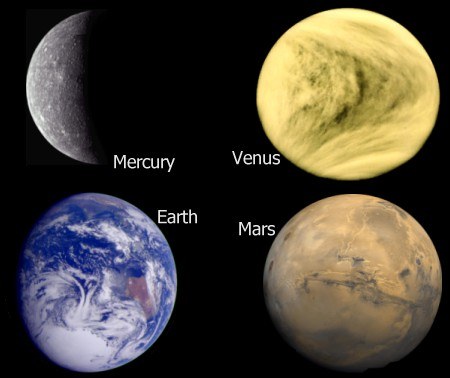
Which planet in our solar system is closest to the Sun?
a)
Earth
b)
Jupiter
c)
Mercury
d)
Saturn
11.
Which of the following is an accurate model of how the Sun, Earth, and Moon move?
a)
Sun and moon orbit Earth
b)
Earth and moon orbit Sun
c)
Earth orbit's the Sun and the moon orbits Earth
d)
Earth and sun orbit moon
12.
The moon is a natural  ______ of Earth.
a)
comet
b)
axis
c)
satellite
d)
space probe
13.
Earth and the other planets closest to the Sun are made mostly of _______
a)
gas
b)
metal
c)
water
d)
rock
14.
The __________ has planets, moons, comets, and asteroids.
a)
solar system
b)
earth
c)
rotation
d)
United States
15.
One of the main differences between the outer and inner planets is __________.
a)
The inner planets all have water
b)
the inner planets are much bigger than the outer planets
c)
the outer planets are gas planets
d)
the outer planets have rings, and the inner planets don't
16.

What is the largest planet in

our solar system?

a)

Neptune

b)

Jupiter

c)

Uranus

d)

Mars

17.

Which planet is NOT one of the

"Gas Giants"?

a)

Uranus

b)

Venus

c)

Neptune

d)

Saturn

18.
Which is the sixth planet from the sun?
a)
Earth
b)
Uranus
c)
Saturn
d)
Neptune
19.

A small rocky object orbiting the sun that is located in a belt between Jupiter and mars.

a)

Asteroid

b)

Comet

c)

Moon

d)

Meteor

20.

A student made a model of how the Earth, Moon, and Sun orbit. She used ping-pong balls to represent each one. She painted each one a different color. Then, she placed the Moon and Earth close together and the Sun much further away.

What is one limitation of the student's model?

a)

She used the same size balls.

b)

She made earth orbit the sun.

c)

She moved the Sun away from the Earth and Moon.

21.

A celestial body is __________________.

a)

a comet

b)

an asteroid

c)

the sun

d)

a planet

e)

any object in space

22.

Order the following from smallest to largest:

a)

universe, galaxy, solar system

b)

galaxy, universe, solar system

c)

galaxy, solar system, universe

d)

solar system, galaxy, universe