wayground logo

Free Printable Worksheets

NEW

Font size

S
M
L
XL
Worksheets

Prokaryote and Eukaryote Cells and Cell Theory

Total questions: 24

Worksheet time: 22mins

Name
Class
Date
1.
Which of the following is the smallest unit of life that can carry out all life functions?
a)
the mitochondria
b)
the vacuoles
c)
the nucleus
d)
the cell
2.
Which structures are found in every living cell?
a)
cell membrane and cytoplasm
b)
chloroplasts and mitochondria
c)
a cell wall and nucleus
d)
chloroplasts and cell wall
3.
Cells with a nucleus and membrane-bound organelles are called ____________________.
a)
prokaryotes
b)
eukaryotes
c)
bacteria
d)
protists
4.

Who was the first person to see cells under the microscope and give them the name "cell"?

a)

Mattias Schleiden

b)

Robert Hooke

c)

Theordor Schwann

d)

Anton van Leeuwenhoek

5.

The basic unit of structure and function in all living things.

a)

chloroplast

b)

nucleus

c)

cell

d)

cell membrane

6.
a type of prokaryotic cell
a)
mold
b)
mushrooms
c)
plants
d)
bacteria
7.
tiny membrane-bound structures inside a cell
a)
cell wall
b)
cell membrane
c)
organelle
d)
organ
8.

Which of the following is a characteristic of both Eukaryotic and Prokaryotic cells?

a)

ribosomes

b)

nucleus

c)

membrane bound organelles

d)

simple

9.

Which of the following is not a characteristic of a Prokaryotic cell?

a)

unicellular

b)

floating DNA in middle of cell

c)

very small

d)

complex

10.
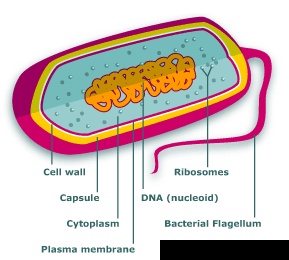
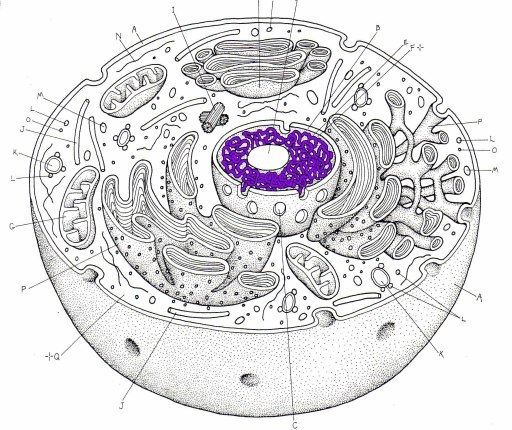
Which type of cell?
a)
Prokaryote
b)
Eukaryote
11.
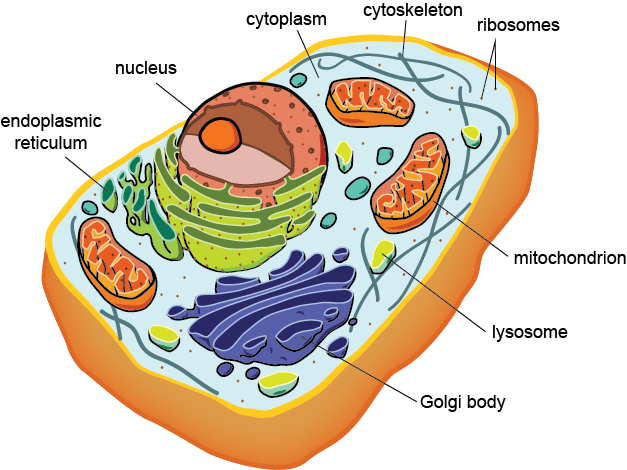
What kind of cell is this?
a)
Eukaryotic
b)
Prokaryotic
12.
Which of the following is found inside a prokaryote?
a)
cytoplasm
b)
DNA
c)
ribosomes
d)
all of these
13.
Prokaryote are?
a)
simple, mostly single-celled organism that lacks a nucleus, or any other membrane-bound organelle.
b)
have a peptidoglycan cell wall and many have polysaccharide capsules.
c)
have a true nucleus, which means the cell's DNA is surrounded by a membrane.
d)
contain membrane-bound organelles, such as the nucleus
14.
The main difference between prokaryotic and eukaryotic cells? 
a)
Prokaryotic cells have a cell membrane but eukaryotic cells do not.
b)
Eukaryotic cells contain DNA in a nucleus while prokaryotic cells do not.
c)
Eukaryotic cells have flagella but prokaryotic cells do not.
d)
Prokaryotic cells contain membrane-bound ribosomes while eukaryotic cells do not. 
15.
All living things are made of...
a)
atoms 
b)
cells 
c)
bacteria 
d)
plants 
16.
All cells come from other...
a)
cells 
b)
plants 
c)
nucleus 
d)
microscopes 
17.

Animal, fungi, plant, and protist cells are all examples of which type of cell?

a)

Eukaryotic

b)

Prokaryotic

c)

Both prokaryotic and eukaryotic

18.
Prokaryotic cells are older than Eukaryotic cells
a)
Flase
b)
True
19.
Which of the following statements is not part of the cell theory?
a)
Cells are the basic unit of structure and function in all living things.
b)
All cells are produced from other cells.
c)
Only animal cells are composed of cells.
d)
All living things are composed of cells.
20.
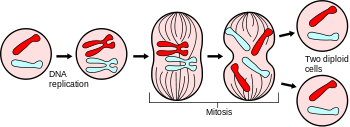
When cells are damaged, new cells are created by cell division. How does the cell theory support this fact?
a)
It states that all cells have a nucleus which divides.
b)
It states that all living things are made up of one or more cells.
c)
It states that cells come from previously existing cells.
d)
 It states that the basic units of structure and function are cells.
21.

Mainly unicellular

a)

Prokaryotic

b)

Eukaryotic

22.

Mainly multicellular

a)

Prokaryotic

b)

Eukaryotic

23.

simple cells

a)

prokaryote

b)

eukaryote

24.

complex cells

a)

prokaryote cells

b)

eukaryote cells