wayground logo

Free Printable Worksheets

Font size

S
M
L
XL
Worksheets

Wave properties and behaviors

Total questions: 40

Worksheet time: 38mins

Name
Class
Date
1.

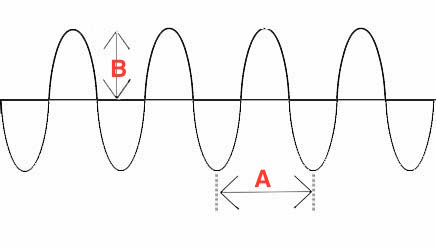
What property of this wave is represented by the letter "A"

a)

amplitude

b)

crest

c)

trough

d)

wavelength

2.
When the frequency of a wave increases, what happens to the wavelength?
a)
The wavelength is not directly affected by the frequency of a wave.
b)
The wavelength increases.
c)
The wavelength decreases.
d)
More specific information is needed to form a conclusion about the wavelength.
3.
When a wave strikes and object and bounces off. (example echo)
a)
medium
b)
refraction
c)
reflection
d)
interference
4.
When a wave bends as it passes through at an angle from one medium to another.(example: pencil in a glass of water-)
a)
medium
b)
refraction
c)
reflection
d)
interference
5.
A sound wave with a low frequency has a ______ wavelength than a sound wave with a higher frequency.
a)
slower
b)
longer
c)
shorter
d)
faster
6.
Which wave has a greater frequency?
a)
A
b)
B
7.
If a sound was has a big amplitude, it will be a ____ sound. 
a)
soft
b)
loud
c)
high frequency
d)
low frequency
8.

The distance a wave travels in a given amount of time is known as the wave's ______.

a)

frequency

b)

speed

c)

wavelength

d)

refraction

9.

When waves pass from one medium to another they are refracted due to a change in the _____ of the wave.

a)

speed

b)

density

c)

medium

d)

frequency

10.

Convex lenses ________ light waves by bending them as they pass into a new medium with a different density.

a)

opaque

b)

absorb

c)

reflect

d)

refract

11.
_____?______ materials do not allow light waves to pass through.
a)
Opaque
b)
Transparent
c)
Translucent
12.
_____?_____ materials allow some light to partially pass through, but not in a straight path.
a)
Opaque
b)
Transparent
c)
Translucent
13.
_____?_____ materials allow light waves to pass through easily.
a)
Opaque
b)
Transparent
c)
Translucent
14.
Smooth surfaces _______ a lot of light.
a)
reflect
b)
bend
c)
absorb
d)
twist
15.
_____ is a lens that is thicker in the middle and makes an object appear bigger.
a)
prism
b)
convex lens
c)
concave lens
d)
mirror
16.
The bending of waves as they pass from one substance into another.
a)
Reaction
b)
Reflection
c)
Refraction
d)
Repost
17.

The distance from the crest of one wave to the crest of the next wave is called:

a)

amplitude

b)

frequency

c)

wavelength

d)

medium

18.
What is happening to the light waves as they hit the black object in the middle? 
a)
They are being reflected.
b)
They are being absorbed.
c)
They are being refracted.
d)
They are being transmitted. 
19.
What do we call the top of the wave?
a)
crest
b)
trough
c)
amplitude
d)
frequency
20.
The orange line is measuring the _________________________.
a)
wavelength
b)
amplitude
c)
crest
d)
trough
21.
What is shown in diagram A?
a)
reflection
b)
refraction
c)
diffraction
22.
Light hitting a prism is an example of
a)
Absorption
b)
Reflection
c)
Yellow Light
d)
Refraction
23.

The image depicts which of the following wave behaviors?

a)

Resonance

b)

Doppler Effect

c)

Interference

d)

Polarization

24.

The image of the two waves depicts

a)

Constructive interference

b)

Destructive interference

25.

What type of interference is represented in this diagram?

a)

Constructive

b)

Destructive

26.

What type of interference do noise cancelling headphones use?

a)

Constructive Interference

b)

Destructive Interference

27.

Sound waves in musical instruments or tubes create standing waves that enhance which type of interference to make louder sounds?

a)

Constructive

b)

Destructive

28.

When a compression interferes with another compression, what occurs?

a)

They counteract and the wave stops.

b)

They combine to create a larger compression.

c)

They combine to create a rarefaction.

d)

None of the above.

29.

What is a general definition of wave interference?

a)

When a wave bounces off an object

b)

When more than on wave meet and interact in the same medium

c)

When a wave bends around a corner

d)

When a wave creates static

30.

What type of interference is occurring in the picture?

a)

Constructive

b)

Destructive

31.

When 2 waves meet and create a bigger wave

a)

Constructive Interference

b)

Destructive Interference

32.

Waves with a ​ (a)   frequency carry more ​ (b)   than waves with a ​ (c)   frequency.

Choose from the below words
higher
energy
lower
33.
Why would a wave change direction?
a)
Because it kept traveling through the same medium
b)
Because it went from one medium to another
c)
the amplitude was too large
d)
the frequency was too small
34.
What is the name of a material in which waves, like sound waves, seismic waves, and waves in a slinky 
a)
Vacuum
b)
Medium
c)
Mechanical
d)
Space
35.
Which letter represents wavelength?
a)
A
b)
B
c)
C
d)
D
36.

Refraction occurs when waves enter a new ​ (a)   and change ​ (b)   .

Choose from the below words
medium
speed
obstacle
air
solid
liquid
gas
37.
Which of the following represents refraction?
a)
A
b)
B
c)
C
d)
D
38.
Refraction occurs when _____________
a)
the wave's speed changes by entering a new medium
b)
a wave bounces off of a boundary
c)
waves parts meet each other
d)
waves bend around a barrier
39.

Two waves that undergo constructive interference must be...

a)

In phase

b)

Out of phase

40.

Two waves that undergo destructive interference must be...

a)

In phase

b)

Out of phase