
 Worksheets
CC2 Ch.4 Review & Practice
Total questions: 49
Worksheet time: 2hrs 0mins
Name
Class
Date
1.

Is the graph proportional or non proportional?
a)
Proportional because it is a straight line and passes through the origin (0,0).
b)
Non-Proportional because it doesn't pass through the origin (0,0).
2.

Is the graph proportional or non proportional?
a)
Proportional because it is a straight line.
b)
Non-Proportional because it doesn't pass through the origin.
3.

Why does this graph show a non-proportional relationship?
a)
Because it is proportional
b)
It goes through the origin
c)
It does not go through the origin
d)
It is a straight line
4.

REVIEW QUESTION
Is this table proportional or non-proportional?
Is this table proportional or non-proportional?
a)
Proportional
b)
Non-Proportional
5.

Which statement best describes the relationship of x and y in the table?
a)
Proportional
b)
Not Proportional
6.

Which statement best describes the relationship between x and y in the table?
a)
Proportional
b)
Not Proportional
7.

Does the table represent a proportional relationship?
a)
Yes.
b)
No.
8.
You spend $40 on 5 pounds of concrete. What is the unit rate in dollars per pound?
a)
$8 per pound
b)
$5 per pound
c)
$35 per pound
d)
0.125 pounds per dollar
9.
Elijah earn $200 for 8 hours of work. What is the unit rate (in dollars per hour)?
a)
$50 per hour
b)
$12 per hour
c)
$192 per hour
d)
$25 per hour
10.
Alycia earned $20.40 in 3 hours. What is her unit rate in dollars per hour?
a)
$7 per hour
b)
$6 per hour
c)
$6.80 per hour
d)
$17.40 per hour
11.
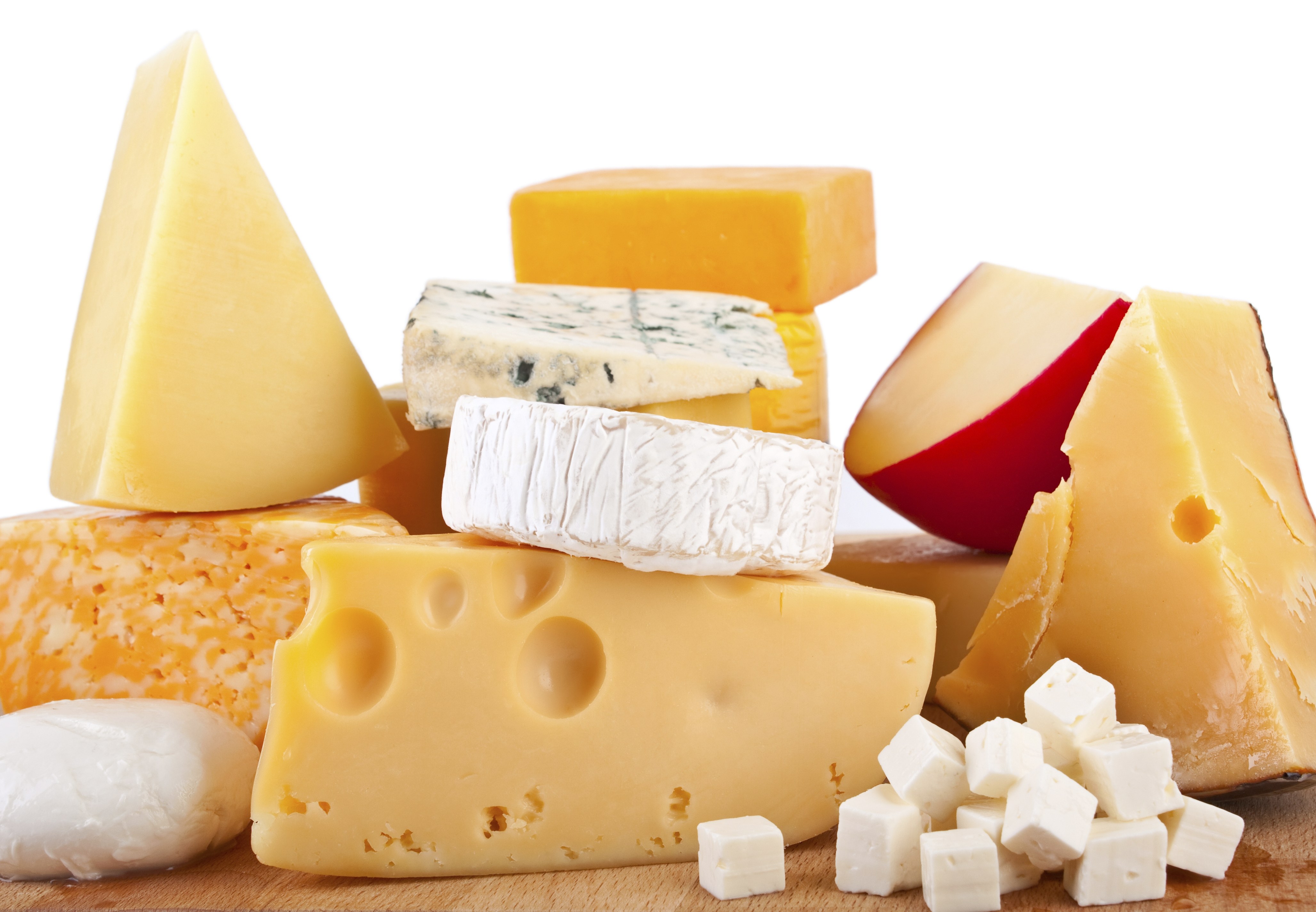
Sargento cheese slices $2.48 for 10 slices
or
Velveeta Cheese slices $3.18 for 12 slices
Find the unit price for each and choose the better deal.
or
Velveeta Cheese slices $3.18 for 12 slices
Find the unit price for each and choose the better deal.
a)
Sargento
b)
Velveeta
12.

Solve the proportion below
a)
21
b)
7
c)
8
d)
24
13.

Solve the proportion below:
a)
3
b)
24
c)
21
d)
12
14.

Solve the proportion below:
a)
5
b)
10
c)
15
d)
6
15.
There were 5 ice cream cones for every 3 brownies sold at the ice cream shop. If there were 24 brownies sold, how many ice cream cones were sold?
a)
8
b)
15
c)
40
d)
29
16.
A scale drawing of a billboard uses the scale 4 cm:9 ft. The length of the billboard in the drawing is 11 cm. How long is the actual billboard?
a)
13 ft
b)
20.75 ft
c)
24.75 ft
d)
22 ft
17.
In an animal shelter, the ratio of cats to dogs is 3 to 5. If there are a total of 25 dogs at the shelter, how many cats do they have?
a)
15
b)
18
c)
21
d)
32
18.
The distance that an automobile travels varies directly as the time it travels. If the car travels 280 miles in 7 hours, how far will it travel in 12 hours?
a)
480
b)
1960
c)
84
d)
25
19.
How do you write an ordered pair?
a)
(X,X)
b)
(Y,X)
c)
(X,Y)
d)
(Y,Y)
20.
The coordinates for the origin in the coordinate plane are________?
a)
(1,1)
b)
(0,0)
c)
(0,1)
d)
(1,0)
21.
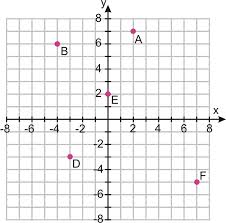
Where is point E located?
a)
( 2, 0 )
b)
( 2 , 2 )
c)
( 0 , 2 )
d)
( 0 , 0 )
22.

What letter is located at (8, 5)?
a)
A
b)
B
c)
C
d)
D
23.
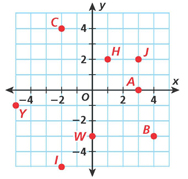
Give the coordinates for POINT I.
a)
(-2, 5)
b)
(-2, -5)
c)
(2, 5)
d)
(2, -5)
24.

What is Coordinate N?
a)
(7,6)
b)
(5,5)
c)
(6,6)
d)
(7,7)
25.
If you were to plot the point (4, -12) what would be the correct method?
a)
Up 4, left 12
b)
Right 4, up 12
c)
Down 4, left 12
d)
Right 4, down 12
26.
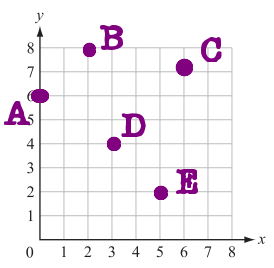
What is the ordered pair of point E?
a)
(2,5)
b)
(5,2)
c)
(-5,2)
d)
(5,-2)
27.
Which operation would you do first in the following equation?
10 - 4 ÷ 1 · 5
10 - 4 ÷ 1 · 5
a)
Subtraction
b)
Division
c)
Multiplication
d)
Addition
28.
Which operation would you do first?
( 12 + 10) ÷ 10 · 14 - 6
( 12 + 10) ÷ 10 · 14 - 6
a)
Division
b)
Multiplication
c)
Addition
d)
Subtraction
29.
Which operation would you do first?
10 - 7 + 8 ÷ 1
10 - 7 + 8 ÷ 1
a)
Subtraction
b)
Addition
c)
Division
d)
Multiplication
30.
1 + 5 · 6
a)
36
b)
31
c)
35
d)
34
31.
17 - 5 · 3
a)
2
b)
36
c)
3
d)
35
32.
10 + 10 ÷ 2
a)
15
b)
10
c)
16
d)
20
33.
What does 32 mean?
a)
3 x 2
b)
3 x 3
c)
2 x 2 x 2
34.
90 - 52 x 3
a)
15
b)
240
c)
195
35.
7 + (12-3)2
a)
256
b)
88
c)
10
d)
13
36.
18 + (6 – 2) × 2
a)
26
b)
29
c)
44
d)
40
37.
Do you multiply or add when you find the perimeter?
a)
Multiply
b)
Add
38.

Area = ?
a)
x2 + 2x + 2
b)
2x2 + 2x + 2
c)
3x2 + 2
d)
4x + 7
39.

Perimeter = ?
a)
4x + 8
b)
x2 + 2x + 2
c)
6x + 10
d)
4x + 10
40.

Determine the Perimeter of the figure.
a)
4x + 4
b)
x + 4
c)
2x + x
d)
x2 + 2x
41.

What is the Area?
a)
3x + 1
b)
2x + 9
c)
2x + 8
d)
3x2 + 1
42.

Determine the Perimeter of the figure.
a)
2x + 8
b)
2x
c)
2x + 4
d)
2x + 9
43.

Determine the Perimeter of the figure.
a)
4x + 4
b)
4x + x2
c)
4x + 1
44.

What is the area of this figure?
a)
x2 + 2x + 8
b)
x2 + 6x + 2
c)
x2 + 2x + 2
d)
4x + 2
45.

What is the perimeter of this figure?
a)
4x + 6
b)
4x + 8
c)
6x + 6
d)
6x + 10
46.
Simplify the following expression by combining like terms:
2x + 5 - 3x - x2 + 9
a)
x2 + 5x + 14
b)
-x2 + 5x + 14
c)
12
d)
-x2 - x + 14
47.

Find the area if x = 6
a)
49 units2
b)
19 units2
c)
39 units2
d)
48 units2
48.

Find the area if x = 3
a)
27 units2
b)
45 units2
c)
33 units2
d)
15 units2
49.

Find the perimeter if
x = 3
x = 3
a)
20 units
b)
25 units
c)
12 units
d)
19 units
100 %

