wayground logo

Free Printable Worksheets

Font size

S
M
L
XL
Worksheets

CEEC Honors Chemistry Mid-Term Review

Total questions: 185

Worksheet time: 4hrs 28mins

Name
Class
Date
1.

Which is related to the number of electrons in the outer main energy level of the elements from the alkali metals to the halogens?

I. Group number

II. Period number

a)

I only

b)

II only

c)

Both I and II

d)

Neither I nor II

2.

What is the electron configuration for an atom with Z = 22?

a)

1s22s22p63s23p63d4

b)

1s22s22p63s23p64s24p2

c)

1s22s22p63s23p63d24p2

d)

1s22s22p63s23p64s23d2

3.

What is the correct number of each particle in a fluoride ion, 19F?

a)

9 protons, 10 neutrons, 8 electrons

b)

9 protons, 10 neutrons, 9 electrons

c)

9 protons, 10 neutrons, 10 electrons

d)

9 protons, 19 neutrons, 10 electrons

4.
How many valence electrons are present in an atom of an element with atomic number 16?
a)
2
b)
4
c)
6
d)
8
5.
What is the total number of p orbitals containing one or more electrons in germanium (atomic number 32)?
a)
2
b)
3
c)
5
d)
8
6.

A certain sample of element Z contains 60% of 69Z and 40% of 71Z. What is the relative atomic mass of element Z in this sample?

a)

69.2

b)

69.8

c)

70.0

d)

70.2

7.
How many electrons are there in all the d orbitals in an atom of xenon?
a)
10
b)
18
c)
20
d)
36
8.

Which pair of elements reacts most readily?

a)

Li + Br2

b)

Li + Cl2

c)

K + Br2

d)

K + Cl2

9.

Which of the following properties of the halogens increase from F to I?

I. Atomic radius

II. Melting point

III. Electronegativity

a)

I only

b)

I and II only

c)

I and III only

d)

I, II and III

10.
Which properties of period 3 elements increase from sodium to argon? I. Nuclear charge II. Atomic radius III. Electronegativity
a)
I and II only
b)
I and III only
c)
II and III only
d)
I, II and III
11.
For which element are the group number and the period number the same?
a)
Li
b)
Be
c)
B
d)
Mg
12.

Which of the physical properties below decrease with increasing atomic number for both the alkali metals and the halogens?

I. Atomic radius

II. Ionization energy

III. Melting point

a)

I only

b)

II only

c)

III only

d)

I and III only

13.
Rubidium is an element in the same group of the periodic table as lithium and sodium. It is likely to be a metal which has a
a)
high melting point and reacts slowly with water.
b)
high melting point and reacts vigorously with water.
c)
low melting point and reacts vigorously with water.
d)
low melting point and reacts slowly with water.
14.

When the following species are arranged in order of increasing radius, what is the correct order?

a)

Cl, Ar, K+

b)

K+, Ar , Cl

c)

Cl, K+, Ar

d)

Ar, Cl, K+

15.
What increases in equal steps of one from left to right in the periodic table for the elements lithium to neon?
a)
the number of occupied electron energy levels
b)
the number of neutrons in the most common isotope
c)
the number of electrons in the atom
d)
the atomic mass
16.
Which property decreases down group 7 in the periodic table?
a)
atomic radius
b)
electronegativity
c)
ionic radius
d)
melting point
17.

How many protons, neutrons and electrons are there in the species 26Mg2+ ?

a)

10 protons, 14 neutrons, 12 electrons

b)

12 protons, 14 neutrons, 10 electrons

c)

12 protons, 26 neutrons, 10 electrons

d)

14 protons, 12 neutrons, 12 electrons

18.

The electron arrangement of sodium is 1s22s22p63s1. How many occupied main electron energy levels are there in an atom of sodium?

a)

1

b)

3

c)

10

d)

11

19.

What is the formula for the compound formed by calcium and nitrogen?

a)

CaN

b)

Ca2N

c)

Ca2N3

d)

Ca3N2

20.
Provide the number of protons, electrons, and neutrons for 19F-
a)
p = 19, e = 20, n = 19
b)
p = 9, e = 9, n = 10
c)
p = 9, e = 10, n = 10
d)
p = 9, e = 8, n = 10
21.
Which of the following is the contribution by Millikan to Atomic Theory?
a)
discovered the electron
b)
discovered the proton
c)
discovered the neutron
d)
charge of an electron
22.
Which of the following is name of the experiment and model by J. J. Thomson to Atomic Theory?
a)
canal ray; Nuclear Model
b)
cathode ray; Plum Pudding Model
c)
canal ray; Oil Drop Experiment
d)
cathode ray; Gold Foil Experiment
23.
Provide the element located in Period 4 and Group IIIA (or called 3A or 13).  
a)
Sc
b)
Al
c)
Y
d)
Ga
24.
Provide the number of protons, neutrons, and electrons in Molybdenum-86.  
a)
p = 86, n = 86, neutrons = 42
b)
p = 42, n = 42, e = 44
c)
p = 42, n = 44, e = 42
d)
p = 42, n = 42, e = 42
25.
An element has a charge of 2+ with 20 protons.  Predict the number of protons and electrons.
a)
p = 20, e = 22
b)
p = 20, e = 18
c)
p = 20, e = 20
d)
p = 18, e = 20
26.
What is the name of the Periodic Table family in which Argon is located?
a)
Alkali Metals
b)
Halogens
c)
Chalcogens
d)
Noble Gases
27.
What is the name of the experiment and contribution to Atomic Theory by Rutherford?
a)
Plum Pudding Model; discovered the electron
b)
Planetary Model; discovered electrons travel in orbits
c)
Gold Foil Experiment; discovered atom had a nucleus
d)
Oil Drop Experiment; discovered charge on an electron
28.
Provide the name of the Alkali Metal in Period 6.
a)
Strontium
b)
Barium
c)
Rubidium
d)
Cesium
29.
Which of the following is not in the same group or family:  Ca, Sn, Pb?
a)
Ca
b)
Sn
c)
Pb
d)
they are all in the same group/family
30.
Predict the number of protons, neutrons, and electrons for: 7533As
a)
p = 75, n = 33, e = 75
b)
p = 33, n = 33, e = 42
c)
p = 42, n = 33, e = 33
d)
p = 33, n = 42, e = 33
31.
Which subatomic particles contribute the most to the mass of an atom?
a)
Protons, Neutrons, Electrons
b)
Protons only
c)
Protons and Electrons
d)
Protons and Neutrons
32.
Protons and Electrons balance the charge of an atom.
a)
True
b)
False
33.
An atom has 10 protons, 15 neutrons and 10 electrons what is its mass number.
a)
20
b)
10
c)
5
d)
25
34.
What is an atom mostly made up of?
a)
protons
b)
electrons
c)
empty space
d)
neutrons
35.
An isotope has three forms.  30% have a mass of 4 amu, 20% have a mass of 5 amu and 50% have a mass of 3 amu.  Average atomic mass will be closest to
a)
2 amu
b)
3 amu
c)
4 amu
d)
5 amu
36.
Which particle has a positive charge?
a)
electron
b)
orbital
c)
proton
d)
neutron
37.
Choose the particle that has no charge.
a)
nucleus
b)
neutron
c)
proton
d)
electron
38.
This particle determines what element you have - the elements identity.
a)
electron
b)
proton
c)
neutron
d)
valence shell
39.
This causes the mass of the nucleus to increase.
a)
adding an electron
b)
adding a neutron
c)
more orbitals
d)
adding negatively charged particles
40.
An electron has a _____ charge.
a)
negative
b)
positive
c)
neutral
41.
Describe an Electron Cloud?
a)
the mist outside of an atom
b)
home of the protons
c)
where electrons are located
d)
nucleus
42.
What are the maximum number of electrons that go on the first 3 energy levels?
a)
2,4,16
b)
2,8,18
c)
4,8,12
d)
3,4,6
43.
What are valence electrons?
a)
electrons on the first orbital always
b)
nucleus
c)
the outermost shell
d)
the number of electrons on the outermost orbital
44.

which of the following is NOT a metal

a)

Sodium (Na)

b)

Chlorine (Cl)

c)

Potassium (K)

d)

Calcium (Ca)

45.

which of the following is a Metal

a)

Magnesium (Mg)

b)

Sulfur (S)

c)

Krypton (Kr)

d)

Oxygen (O)

46.
Electronegativity is...
a)
the ability of an atom to attract/ accept electrons
b)
the ability of an atom to lose electrons
c)
the energy required to remove an electron from a specific atom
d)
how easy it is to make friends. 
47.

The atom with the largest atomic radius in Group 8 is

a)

Ar

b)

He

c)

Kr

d)

Rn

48.

Which element is the most electronegative

a)

Selenium (Se)

b)

Phosphorus (P)

c)

Fluorine (F)

d)

Iodine (I)

49.
Which statement correctly and completely identifies a trend?
a)
Atomic radius decreases across a period and increases down a group.
b)
Electronegativity decreases across a period and decreases down a group.
c)
Ionization energy increases across a period and increases down a group.
d)
Ionic radius increases across a period and increases down a group.
50.
Electronegativity __________ from left to right within a period and __________ from top to bottom within a group.
a)
decreases, increases 
b)
increases, increases
c)
increases, decreases 
d)
stays the same, increases
51.
Which section are the metals in? 
a)
dark blue
b)
light blue
c)
purple
d)
pink
52.

Of the following transitions in the Bohr hydrogen atom, the __________ transition results in the emission of the highest-energy photon.

a)

n = 6 ¬ n = 1

b)

n = 1 ¬ n = 6

c)

n = 3 ¬ n = 6

d)

n = 6 ¬ n = 3

53.

The lines in the emission spectrum of hydrogen result from __________.

a)

electrons given off by hydrogen as it cools

b)

decomposing hydrogen atoms

c)

electrons given off by hydrogen when it burns

d)

energy given off in the form of visible light when an electron moves from a higher energy state to a lower energy state

54.

An example of an electron configuration of a transition metal is __________.

a)

1s2 2s2 2p6 3s2 3p6 4s2 3d10 4p6 5s1

b)

1s2 2s2 2p6 3s2 3p5

c)

1s2 2s2 2p6 3s2 3p6 4s2 3d8

d)

1s2 2s2 2p6 3s2 3p6 4s2 3d10 4p6

e)

1s2 2s2 2p4 3s1

55.

An example of an excited state electron configuration for fluorine is _________

a)

1s2 2s2 2p6 3s2 3p6 4s2 3d10 4p6 5s1

b)

1s2 2s2 2p6 3s2 3p5

c)

1s2 2s2 2p6 3s2 3p6 4s2 3d8

d)

1s2 2s2 2p6 3s2 3p6 4s2 3d10 4p6

e)

1s2 2s2 2p4 3s1

56.

Of the elements below, __________ is the most metallic.

a)

sodium

b)

barium

c)

calcium

d)

cesium

e)

magnesium

57.
What atom matches this electron configuration?
1s22s22p63s23p64s23d10
a)
Zinc
b)
Copper
c)
Nickel
d)
Germanium
58.
What is the noble gas shorthand electron for Sulfur atom?
a)
[Ar] 3p4
b)
[He] 3s23p4
c)
[Ne] 3s23p4
d)
[Na] 3s23p4
59.
What atom matches this electron configuration?
[Xe] 6s25d9
a)
Mercury
b)
Gold
c)
Platinum
d)
Thallium
60.
How many electrons can the first energy level hold?
a)
1
b)
2
c)
8
d)
0
61.
An orbital can at most hold how many electrons?
a)
1 electron
b)
2 electrons
c)
3 electrons
d)
4 electrons
62.
Electrons occupy orbitals of lowest energy first is part of what electron configuration rule?
a)
Hund’s Rule
b)
Aufbau Principle
c)
Pauli Exclusion Principle
63.
Electron arrangement that uses arrows
a)
Electron configuration
b)
Shorthand configuration
c)
Lewis dot structure
d)
Orbital diagram
64.
Which of the following is a p block element?
a)
Ca
b)
Ar
c)
Re
d)
Au
65.
What is the electron configuration of Ag?
a)
1s2 2s2 2p6 3s2 3p6 4s2 3d10 4p6 5s1 4d10
b)
[Kr] 5s2 4d9
c)
1s2 2s2 2p6 3s2 3p6 4s2 4p6 5s2 4d9
d)
1s2 2s2 2p6 3s2 3p6 3d10 4s2 4d10 4p6 5d10 5s2 4d9
66.
Electrons are paired based on their spin directions, clockwise and counterclockwise, is what electron configuration rule?
a)
Hund’s Rule
b)
Aufbau Principle
c)
Pauli Exclusion Principle
67.
Which orbital shows a violation of Hund's Rule?
a)
A
b)
B
c)
C
d)
D
68.
Which orbital shows a violation of the Pauli Exclusion Principle?
a)
A
b)
B
c)
C
d)
D
69.
Which orbital shows a violation of the Aufbau Principle?
a)
A
b)
B
c)
C
d)
D
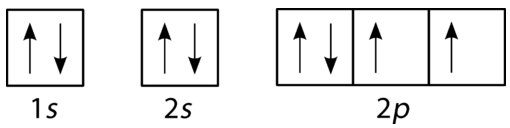
70.
Which element is pictured?
a)
neon
b)
fluorine
c)
magnesium
d)
argon
71.
Which of the following rules requires that each of the p orbitals at a particular energy level receive one electron before any of them can have two electrons?
a)
the Pauli exclusion principle
b)
Hund's rule.
c)
the Aufbau principle.
d)
the quantum rule.
72.
For the f sublevel, the number of orbitals is
a)
18.
b)
9.
c)
5.
d)
7.
73.
The total number of orbitals that can exist in a p sublevel is 
a)
5
b)
3
c)
1
d)
7
74.
Which color has the highest energy?
a)
red
b)
orange
c)
green
d)
purple
75.
Which sub-shells can be present in the fourth energy level?
a)
s
b)
s,p
c)
s,p,d
d)
s,p,d,f
76.
How many half-filled orbitals would silicon contain?
a)
0
b)
2
c)
1
d)
3
77.
How many unpaired electrons would lithium have?
a)
1
b)
2
c)
3
d)
0
78.
Which element would have zero half-filled orbitals?
a)
potassium
b)
copper
c)
magnesium
d)
oxygen
79.
How many p electrons are in bromine?
a)
5
b)
12
c)
17
d)
6
80.
What is the correct configuration for uranium?
a)
[Xe] 6s2 4d 3
b)
[Rn] 7s2 5f3
c)
[Rn] 7s2 6d1 5f3
d)
[Rn] 7s2 6d1 6f3
81.
What is the correct configuration for lead?
a)
[Rn] 6s2 5d10 4f14 6p2
b)
[Xe] 6s2 6d10 6p2
c)
[Xe] 6s2 5d10 6p2
d)
[Xe] 6s2 5d10 4f14 6p2
82.
This orbital diagram represents:  
a)
C
b)
B
c)
N
d)
O
83.
What is incorrect about this orbital diagram?
a)
Both arrows in the 2p box should be pointing up
b)
There is nothing incorrect with this diagram
c)
In the 2p box there should only be 1 electron in the first 2p box and one in the 2nd 2p box
d)
All the arrows should be pointing up.
84.
The orbital diagram of this element has 9 electrons in 4d.
a)
Silver
b)
Palladium
c)
Cobalt
d)
Copper
85.

Which of the following is a polyatomic ions?

a)

sulfate

b)

sulfur

c)

nitrate

d)

nitride

86.

Which of the following is a polyatomic ions?

a)

hydroxide

b)

hydrogen ion

c)

carbonate

d)

carbon

e)

Ammonium

87.

What is the chemical formula of sulfate?

a)

SO42-

b)

SO4

c)

S2-

88.

What is the chemical formula of nitrate?

a)

NO3-

b)

NO3-

c)

NO3

89.

What is the chemical formula of ammonium?

a)

NH4+

b)

NH4+

c)

NH4

90.
An element P (atomic number 20) reacts with an element Q (atomic number 17). Which of the following statements about the compound formed is correct?
a)
A covalent compound of formula PQ2 is formed.
b)
A covalent compound of formula P2Q is formed.
c)
An ionic compound of formula PQ2 is formed.
d)
An ionic compound of formula P2Q is formed.
91.
Which of the following does not have the same number of electrons as an atom of argon?
a)
S2-
b)
Cl-
c)
Na+
d)
Ca2+
92.

What is the chemical formula of Magnesium chloride?

a)

MgCl

b)

MgCl2

c)

Mg2Cl

93.

What is the chemical formula of Magnesium oxide?

a)

MgO

b)

MgO2

c)

Mg2O

94.

What is the chemical formula of Magnesium nitrate?

a)

MgNO

b)

MgNO3

c)

Mg3NO3

d)

Mg(NO3)2

95.

What is the chemical formula of Magnesium sulfate?

a)

MgSO

b)

MgSO4

c)

Mg2SO4

d)

Mg(SO4)2

96.

What is the chemical formula of Magnesium hydroxide?

a)

MgOH

b)

Mg2OH

c)

MgOH2

d)

Mg(OH)2

97.

What is the chemical formula of Calcium hydroxide?

a)

CaOH

b)

Ca2OH

c)

CaOH2

d)

Ca(OH)2

98.
How do covalent bonds form?
a)
Donating & receiving valence e- between atoms.
b)
Opposite slight charges attract each other between compounds.
c)
Scientists are still not sure how they form.
d)
Sharing valence e- between atoms.
99.

What two types of atoms make a covalent bond?

a)

2 Nonmetals

b)

1 Nonmetal and 1 Metal

c)

2 Metals

d)

2 Noble Gases

100.

Which of the following is NOT formed by a covalent bond?

a)

K2S

b)

H2O

c)

I2

d)

CO2

101.
What is the proper name for S2O2?
a)
Sulfur oxide
b)
Sulfur dioxide
c)
sulfur (II) oxide
d)
disulfur dioxide
102.
Compared to ionic compounds, molecular compounds generally have...
a)
good conductivity
b)
greater densities
c)
more chemical bonds
d)
a low boiling point
103.
Compared to ionic compounds, molecular compounds generally have...
a)
stronger chemical bonds
b)
poor conductivity
c)
a high melting point
d)
lower densities
104.
NO
a)
Mononitrogen monoxide
b)
nitrogen oxide
c)
nitrogen monoxide
d)
nitrate monoxide
105.
SO3
a)
Monosilicon Trioxide
b)
Sulfate trioxide
c)
Sulfur trioxide
d)
Monosulfate oxide
106.
Phosphorus tribromide
a)
PBr
b)
PBr7
c)
P4Br4
d)
PBr3
107.
What is the proper name for CaCl2?
a)
Calcium dichloride
b)
Monocalcium dichloride
c)
Calcium chloride
d)
Calcium chlorine
108.

Each of the following are joined by a covalent bond EXCEPT? (hint: think about what type of elements can make covalent bonds)

a)

K and O

b)

C and S

c)

B and F

d)

N and Cl

109.

Phosphorous trichloride

a)

PCl3

b)

P3Cl

c)

P3Cl3

d)

PCL

110.
Disulfur trioxide
a)
S3O2
b)
SO
c)
S2O3
d)
S2O
111.
P2O5
a)
Phosphorus Oxide
b)
Pentaphosphorus Dioxide
c)
Diphosphorous pentoxide
d)
Phosphoric Oxygen
112.

N2O5

a)

Nitrogen Oxide

b)

Dinitrogen pentaoxide

c)

Nitrate pentaoxide

d)

Dinitrate pentaoxide

113.
Tribromine nonoxide
a)
Br3O9
b)
Br3O10
c)
Br3O6
d)
Br3O4
114.

Dihydrogen monoxide

a)

H3O2

b)

water

c)

H2O

d)

HO2

115.
SeF4
a)
Tetraselenium fluoride
b)
Selenium Fluoride
c)
Selenium tetraflouride
d)
Selenium (IV) Fluoride
116.
PBr5
a)
Phosphorus Bromide
b)
Phosphorus Pentabromide
c)
Pentaphosphorus bromide
d)
Phosphorus Bromine
117.
Ionic bonds are between...
a)
Metal and Non-metal
b)
Non-metal and Non-metal
c)
Metal and Metal
118.
How are ionic bonds formed?
a)
Transfer of electrons
b)
Sharing of electrons
119.
Is hydrogen considered a metal or a non-metal?
a)
A metal
b)
Nonmetal
c)
Metalloid
120.
Why do elements bond?
a)
To be friends
b)
To create a new element
c)
To become stable
121.

A ______bond is surrounded by many electrons.

a)

ionic

b)

covalent

c)

metallic

122.

If two Fe atoms bonded together, which type of bond would it most likely be? (remember Fe is iron)

a)

ionic

b)

covalent

c)

metallic

123.

When atoms share electrons, the bond type is:

a)

ionic

b)

covalent

c)

metallic

124.

What is the charge for Boron?

a)

-5

b)

-6

c)

+2

d)

+3

125.

What is the charge for fluorine?

a)

+7

b)

-1

126.

What is the charge of Beryllium?

a)

+2

b)

-5

127.

What is the charge of Nitrogen?

a)

+3

b)

-3

c)

+4

d)

-5

128.

Which of the following would be considered a diatomic molecule?

a)

H2

b)

H2O

c)

O2

d)

F2

129.

Ag and AG (Silver and Silver) is what kind of bond?

a)

ionic

b)

covalent

c)

metallic

130.
Phosphorous trichloride
a)
PCl3
b)
P3Cl
c)
P3Cl3
d)
PCL
131.

What is the name of the compound HgCl2

a)

mercury (II) chloride

b)

mercury chlorite

c)

Monomercury dichloride

d)

mercury dichloride

132.
+  and  N-3
a)
KN
b)
KN3
c)
K3N3
d)
K3N
133.
Name this formula: 
KNO3
a)
Potassium Nitrogen Oxide
b)
Potassium Nitride
c)
Potassium Nitrate
d)
Potassium (I) Nitrite
134.
The proper formula for magnesium hydroxide:
a)
MgOH
b)
Mg2OH
c)
Mg(OH)2
d)
Mg2OH2
135.
What is the correct formula for barium phosphate?
a)
BaPO4
b)
Ba2(PO4)3
c)
Ba3(PO4)2
d)
BaP
136.
Name Al2S3
a)
Aluminum sulfide
b)
Dialuminum trisulfide
c)
ammonium sulfide
d)
aluminum (II) sulfice
137.

Name the compound NO3

a)

nitrogen trioxide

b)

nitrate

c)

nitrite

d)

dinitrogen pentoxide

138.
What is the name of the compound CoCl2
a)
cobalt (II) chloride
b)
monocobalt dichloride
c)
Chlorous cobalt
139.
What is the formula for iron (III) chloride
a)
FeCl
b)
FeCl3
c)
FeClO3
d)
Fe3Cl
140.
Write the formula for copper (I) phosphide?
a)
Cu3P
b)
CuP
c)
Cu1P
d)
CuP3
141.
NH4Cl
a)
ammonium chloride
b)
ammonium chlorine
c)
nitrogen hydrogen chloride
d)
nitrogen chloride
142.
What is the name of the compound HgCl2
a)
mercury (II) chloride
b)
mercury chlorite
c)
Monomercury dichloride
143.
Naming a compound that starts with a transition metal requires us to use...
a)
Prefixes
b)
Roman Numeral
c)
Nothing, just name it
144.
Naming a compound of two non-metals requires us to use..
a)
Prefixes
b)
Roman Numerals
c)
Nothing, just name it
145.
Which of these is covalent?
a)
NaCl
b)
Pb(NO3)2
c)
CO2
d)
AlCl3
146.
What does the prefix Mono mean?
a)
4
b)
6
c)
3
d)
1
147.
Bromine monoflouride
a)
Br1F1
b)
BrF
c)
Br2F
d)
BrF2
148.
Ionic or covalent?
Na  F
a)
Ionic
b)
Covalent
149.
Which of these compounds is ionic? 
a)
Carbon dioxide
b)
Dinitrogen trioxide
c)
Silicon tetrachloride
d)
Lithium bromide
150.
Name this formula: 
Fe3PO4
a)
Iron Phosphide
b)
Iron (III) Phosphide
c)
Iron (I) Phosphate
d)
Iron Phosphate
151.
Name the following ionic compound: LiNO3
a)
lithium nitrate
b)
lithium III nitrate
c)
lithium nitride
d)
lithium oxide
152.
When naming ionic compounds with transition metals you need to include roman numerals to show the _____ of the metal..
a)
atomic number
b)
mass number
c)
charge
d)
ionization energy
153.
What is the correct formula for barium phosphate?
a)
BaPO4
b)
Ba2(PO4)3
c)
Ba3(PO4)2
d)
BaP
154.

What is the electron configuration for copper?

a)

1s2 2s2 2p6 3s2 3p6 4s13d10

b)

1s2 2s2 2p6 3s2 3p6 4s23d7

c)

1s2 2s2 2p6 3s2 3p6 4s23d6

d)

1s2 2s2 2p6 3s2 3p6 4s23d9

155.
What atom matches this electron configuration?
1s22s22p63s23p64s23d10
a)
Zinc
b)
Copper
c)
Nickel
d)
Germanium
156.

What is precision?

a)

Significant figures, the number of digits that carry real information about a measurement.

b)

how many digits after the decimal your calculator tells you

c)

how close to the correct answer you are

d)

how repeatable your answer is

157.

What is accuracy?

a)

Significant figures, the number of digits that carry real information about a measurement.

b)

how many digits after the decimal your calculator tells you

c)

how close to the correct answer you are

d)

how repeatable your answer is

158.

Put 0.00345 in scientific notation

a)

345

b)

it's already correct

c)

3.45 x 10³

d)

3.45 x 10⁻³

159.

Put 345000 in scientific notation

a)

345

b)

it's already correct

c)

3.45 x 10⁵

d)

3.45 x 10⁻⁵

160.

Round 0.004567 to 4 significant digits

a)

it's already correct

b)

0.0045

c)

0.0046

d)

4.6 x 10⁻³

161.

Round 4567 to 2 significant digits

a)

it's already correct

b)

4500

c)

46

d)

4.6 x 10³

162.

The graduated cylinder reads

a)

20mL

b)

25mL

c)

24mL

d)

100mL

163.

An element is defined by the number of _____________ it has.

a)

protons

b)

neutrons

c)

electrons

d)

quarks

164.

ions differ in the number of

a)

protons

b)

neutrons

c)

electrons

d)

nucleus

165.

isotopes differ in the number of

a)

protons

b)

neutrons

c)

electrons

d)

nucleus

166.

14C

a)

is elemental Carbon

b)

is an isotope of Carbon

c)

is an ion of Carbon

d)

is an isotope of Calcium

167.

Na+1

a)

is a sodium isoptope

b)

is a sodium ion

c)

is a sodium atom

d)

is a sodium molecule

168.

Na+1

a)

has lost an electron

b)

has gained an electron

c)

is neutrally charged

d)

has gained a proton

169.

An example of a physical change is

a)

melting

b)

gas producing

c)

a change in pH

d)

heat being produced

170.

An example of a chemical change is

a)

melting

b)

gas producing

c)

a change in pH

d)

boiling

171.

An example of a homogenous mixture is

a)

ocean water

b)

a jar of coins

c)

a bowl of candy

d)

milk

172.

An example of a heterogenous mixture is

a)

ocean water

b)

a jar of coins

c)

a bowl of candy

d)

all of these

173.

What subatomic particles are found in the nucleus?

a)

protons

b)

neutrons

c)

electrons

d)

alpha particles

174.

electrons exist in

a)

orbits around the nucleus

b)

orbitals around the nucleus

c)

inside the nucleus

d)

nowhere in the atom

175.

Group 7 elements have

a)

1 valence electron

b)

5 valence electrons

c)

3 valence electrons

d)

7 valence electrons

176.

Group 1 elements make

a)

positive ions

b)

negative ions

c)

can make both positive and negative ions

d)

do not make ions

177.

Noble gasses make

a)

positive ions

b)

negative ions

c)

can make both positive and negative ions

d)

do not make ions

178.

The correct name for MgCl2 is

a)

Magnesium chloride

b)

Magnesium (II) chloride

c)

Magnesium dichloride

d)

Monomagnesium dichloride

179.

The correct name of P4O10 is

a)

Phosphorous oxide

b)

Diphosphorous decaoxide

c)

Tetraphosphorous decaoxide

d)

Phosphate

180.

The correct name for CuCl2 is

a)

Copper chloride

b)

Copper (II) chloride

c)

Cuperic dichloride

d)

Monocuperous dichloride

181.

Choose the ionic compounds

a)

NaCl

b)

CuI2

c)

CCl4

d)

PO4

182.

In a covalent bond, atoms

a)

share electrons equally

b)

share electrons unequally

c)

transfers electrons to form ions

d)

causes dipoles

183.

In a polar covalent bond, atoms

a)

share electrons equally

b)

share electrons unequally

c)

transfers electrons to form ions

d)

causes dipoles

184.

In an ionic bond, atoms

a)

share electrons equally

b)

share electrons unequally

c)

transfers electrons to form ions

d)

causes dipoles

185.

Lewis dot diagrams

a)

show all the electrons in an element

b)

show only the valence electrons

c)

show only bonded electrons in a compound

d)

show only lone pairs of electrons