
 Worksheets
6.6-6.9 Plate Tectonics-Ancient Lands
Total questions: 54
Worksheet time: 43mins
Name
Class
Date
1.
The type of plate boundary where two plates come together is a .....
a)
Convergent Boundary
b)
Divergent Boundary
c)
Transform Boundary
d)
Plate Boundary
2.
Which of the following causes Earth's tectonic plates to move?
a)
Energy from the Sun
b)
Magnetic Pole Reversal
c)
Convection currents in the mantle
d)
Faults in Mountain Ranges
3.
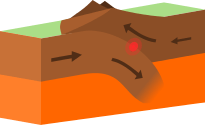
What type of plate boundary is this?
a)
Plate
b)
Divergent
c)
Convergent
d)
Transform
4.

What type of event will occur at this boundary?
a)
Earthquake
b)
Volcano Eruption
c)
Tornado
d)
Mountain Building
5.
A divergent boundary occurs when plates ....
a)
Pull apart
b)
Come together
c)
Slide past each other
d)
subducting
6.
Which of the following is the name of the ancient supercontinent formed 28 Million Years ago.
a)
Pangea
b)
Gondwanda
c)
Laurasia
d)
Neverland
7.
Which of the following is NOT evidence to support the theory of plate tectonics?
a)
Fossils
b)
Mountains
c)
Glaciers
d)
Sand Erosion
8.
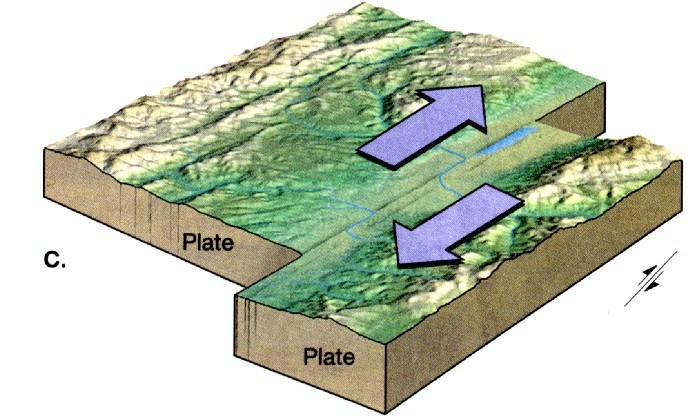
What type of plate boundary is this?
a)
Transform
b)
Convergent
c)
Divergent
d)
Plate
9.
A fault is formed by the movement of a __________ plate boundary
a)
Transform
b)
Convergent
c)
Divergent
10.
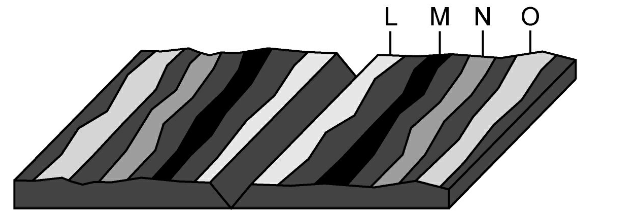
Where would the oldest rock be found?
a)
L
b)
M
c)
N
d)
O
11.
How is it possible for new crust to be formed without increasing the surface area of the Earth?
a)
Crust is destroyed at the same time it is created
b)
New crust is underwater where it sinks
c)
New crust breaks more easily than old crust
12.
This layer of Earth is solid Iron and Nickel
a)
Outer Core
b)
Mantle
c)
Inner Core
d)
Crust
13.
The Great Rift Valley in Africa and the Mid-Ocean Ridge were all created by this boundary
a)
Divergent
b)
Convergent
c)
Reform
d)
Transform
14.
This layer of Earth is the thickest part
a)
crust
b)
outer core
c)
mantle
d)
inner core
15.
What are the two types of crust
a)
continental and oceanic
b)
ocean and upper
c)
lower and upper
d)
pizza and subway
16.
Which layer has convection currents?
a)
Inner Core
b)
Outer Core
c)
Mantle
d)
Crust
17.
subduction zones in the ocean can create which features?
a)
islands
b)
volcanoes
c)
earthquakes
d)
all of the above
18.
Earthquakes and volcanoes are most likely found in which locations?
a)
At plate boundaries
b)
in oceans
c)
in the middle of continents
d)
in the middle of plates
19.
When an oceanic plate and a continental plate collide, which one will subduct?
a)
oceanic
b)
continental
c)
neither
20.
Which of the following is NOT a tectonic boundary?
a)
Convergent
b)
Divergent
c)
Sedergent
d)
Transform
21.
The area where two tectonic plates meet.
a)
mantle
b)
focus
c)
plate boundary
d)
convection
22.

What type of boundary is the SAN ANDREAS FAULT on?
a)
Covergent
b)
Transformers
c)
Divergent
d)
Transform
23.
A mid-ocean ridge occurs at a ________ plate boundary.
a)
transform
b)
convergent
c)
divergent
24.

What is the name of the plate boundary that slides past each other?
a)
Divergent
b)
Convergent
c)
Transform
d)
Mr. C the Slide Man
25.

The youngest material of the ocean floor is found at mid-ocean _________.
a)
ridges
b)
trenches
c)
basins
d)
rifts
26.

The presence of the same ________ on several continents supports the idea of continental drift.
a)
rocks
b)
fossils
c)
both fossils and rocks
d)
neither fossils nor rocks
27.

A lack of evidence for continental drift prevented many scientists from believing a single supercontinent called _________ existed.
a)
Glossopteris
b)
Pangaea
c)
Gondwanaland
d)
Mesosaurus
28.

The theory of _______ states that Earth’s crust and upper mantle are broken into sections that are in constant, slow motion.
a)
plate tectonics
b)
continental drift
c)
seafloor spreading
d)
divergent boundaries
29.

_______ are formed when two continental plates collide.
a)
Mountain ranges
b)
Transform faults
c)
Rift valleys
d)
Volcanoes
30.

The _________ is so hot that the metals in it are all in the liquid state.
a)
crust
b)
mantle
c)
outer core
d)
inner core
31.

_________ currents carry heat from the hot inner core to the cooler outer mantle and back again.
a)
River
b)
Radiation
c)
Convection
d)
Conduction
32.

Plates move apart at _________ boundaries.
a)
volcanic
b)
divergent
c)
convergent
d)
transform
33.

Name this plate boundary.
a)
divergent
b)
convergent
c)
transform
d)
allegiant
34.

Name this plate boundary.
a)
divergent
b)
convergent
c)
transform
d)
insurgent
35.
What are the deepest places on Earth formed by pushing oceanic crust under continental crust?
a)
mid-ocean ridges
b)
rift valleys
c)
trenches
d)
mountain ranges
36.
This theory states that Earth's plates move on top of the mantle at a slow and constant rate due to convection currents
a)
plate tectonics
b)
continental drift
c)
seafloor spreading
d)
pangaea
37.
Large pieces of Earth's lithosphere that move around are called?
a)
sections
b)
plates
c)
land masses
d)
faults
38.
What occurs when two plates come together and the denser one is forced under back into the mantle?
a)
reduction
b)
conduction
c)
subduction
d)
convection
39.
According to Wegener's hypothesis of continental drift,
a)
Earth's surface is made up of seven major landmasses
b)
the continents DO NOT move
c)
Earth is slowly cooling and shrinking
d)
the continents were once joined together in a single landmass
40.
The San Andreas Fault is a crack in the Earth's crust that runs the length of California. What plate boundary feature caused this?
a)
an inactive convergent boundary
b)
an active convergent boundary
c)
an active transform boundary
d)
a volcanic eruption
41.
What geologic feature is most likely to form at a divergent boundary?
a)
delta
b)
rift valley
c)
trench
d)
plateau
42.
Rising magma that results from subduction may produce...
a)
fossil layers
b)
volcanic island arcs
c)
deep-sea sediment
d)
seafloor spreading
43.
When magma is cooled, it changes into which of the following?
a)
Lava
b)
Igneous Rock
c)
Metamorphic Rock
d)
Sedimentary Rock
44.
Hot matter is _________ dense and ___________
a)
less, sinks
b)
less, rises
c)
more, sinks
d)
more, rises
45.
What does the theory of continental drift state?
a)
The continents were once joined in a super-continent and have moved over time
b)
Continents are stationary and do not move
c)
The Earth is broken into lithospheric plates that move due to convection currents
d)
none of the above
46.
A major area in the Pacific Ocean where a large number of earthquakes and volcanic eruptions occur.
a)
Ring of Fire
b)
Continental Drift
c)
Transform
d)
Plates
47.
The process by which molten material adds new oceanic crust to the ocean floor.
a)
Sea-Floor Spreading
b)
Deep-Ocean Trench
c)
Mid-Ocean Ridge
d)
Subduction
48.
An undersea mountain chain where new ocean floor is produced.
a)
Sea-Floor Spreading
b)
Deep-Ocean Trench
c)
Mid-Ocean Ridge
d)
Subduction
49.
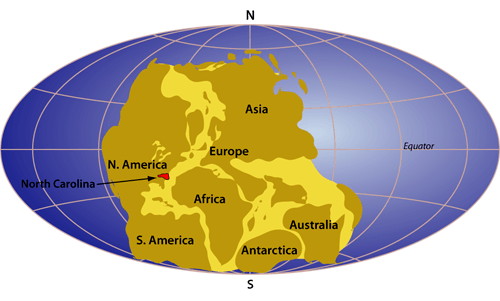
What is this a picture of?
a)
plate tectonics
b)
continental drift
c)
pangea
d)
glacier scaring
50.
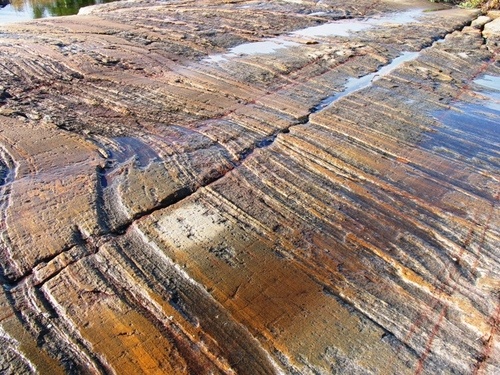
This is a picture of glacier scars found in Africa. What are these evidence for?
a)
Africa has always been near the equator
b)
Africa was once in an area of the Earth that had a very cold climate
c)
The continents have not moved
d)
sea floor spreading
51.
Tectonic plate movement is best measured in
a)
kilometers per year.
b)
centimeters per year.
c)
meters per year.
d)
millimeters per year.
52.

What do plates float on?
a)
lithosphere
b)
upper mantle
c)
asthenospere
53.
What drives tectonic plate movement?
a)
gravity
b)
coriolis effect
c)
convection currents
d)
the earth's magnetic core
54.
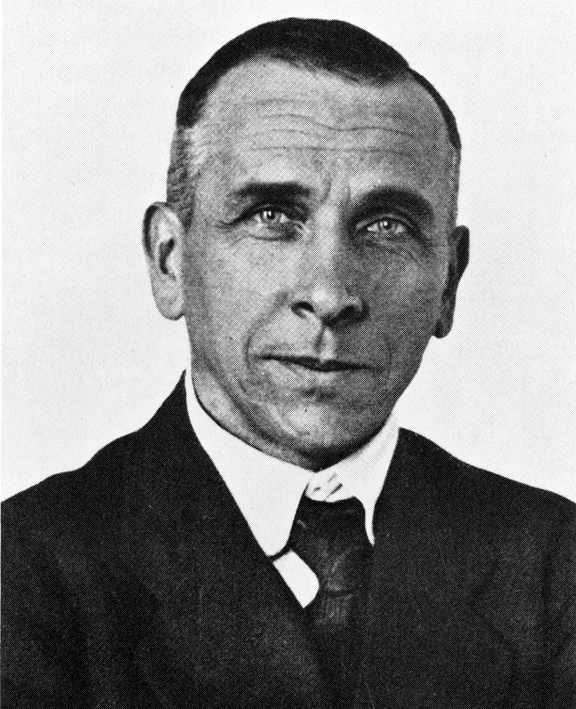
Who is the person credited with developing the theory of continental drift?
a)
Harry Hess
b)
Galileo
c)
Alfred Wegener
d)
Newton
100 %

