
NEW
Font size
S
M
L
XL
 Worksheets
thermochemistry
Total questions: 20
Worksheet time: 48mins
Name
Class
Date
1.
Heat flows from _______ to ______ objects
a)
cooler to warmer
b)
warmer to warmer
c)
warmer to cooler
d)
cooler to cooler
2.
Heat is measured in
a)
joules
b)
grams
c)
degrees celcius
3.
Energy can not be created or destroyed, it can only be transferred refers to the....
a)
law of conservation of energy
b)
law of conservation of mass
c)
life facts
d)
law of conservation of chemistry
4.
The specific heat(c) of copper is 0.39 J/g °C. What is the temperature change(∆t) when 100 Joules of heat(Q) is added to 20 grams?
a)
12.82 °C
b)
24.12°C
c)
351 °C
5.
A(n) _____________ is a device for measuring temperature.
a)
thermometer
b)
barometer
c)
anemometer
d)
psychrometer
6.

A slower particle has a lower energy than an identical, faster particle.
a)
True
b)
False
7.
The transfer of thermal energy between objects of different temperatures is called...
a)
temperature
b)
heat
c)
internal energy
d)
none of these
8.

When thermal energy is added to a substance, the substance's particles move:
a)
More rapidly at an increased diestance from each other.
b)
More rapidly with less distance between each other.
c)
More slowly with a greater distance between each other.
d)
More slowly with a reduced distance between each other.
9.
Heat transfer by conduction occurs when...
a)
particles bump into each other
b)
large numbers of atoms move from place to place
c)
atoms give off heat in the form of electromagnetic waves
d)
electromagnetic waves travel from place to place through a vacuum
10.
Heat transfer by convection occurs when...
a)
electrons bump into other electrons
b)
large numbers of atoms move from place to place
c)
atoms give off heat in the form of electromagnetic waves
d)
electromagnetic waves travel from place to place through a vacuum
11.
Heat travels from the sun to the earth by the process of...
a)
conduction
b)
convection
c)
radiation
d)
insulation
12.

Thermal energy always moves:
a)
From a high temperature object to a lower temperature object.
b)
From a lower temperature object to a higher temperature object.
c)
From an object with lower kinetic energy to an object with higher kinetic energy.
d)
From an object of higher mass to an object of lower mass.
13.
The second law of thermodynamics states that entropy of a system tends to ______________.
a)
increase
b)
decrease
c)
stay constant
d)
fluctuate wildly
14.
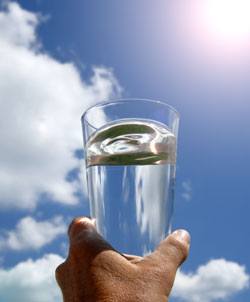
The temperature of a glass of cold water will eventually...
a)
Match the temperature of the surrounding environment.
b)
Always be colder than the surrounding environment.
c)
Become warmer than the surrounding environment.
d)
Never change temperature.
15.
The first law of thermodynamics states that energy is
a)
created
b)
destroyed
c)
conserved
d)
created and destroyed
16.
Which law of thermodynamics states that absolute zero cannot be reached?
a)
1st
b)
2nd
c)
3rd
17.
H2 + 2 C + N2 + 270.3 kJ --> 2 HCN
Is this reaction endothermic or exothermic?
Is this reaction endothermic or exothermic?
a)
Endothermic
b)
Exothermic
18.
A chemical reaction that absorbs heat from the surroundings is said to be __________ and has a __________ ΔH at constant pressure.
a)
endothermic; positive
b)
endothermic; negative
c)
exothermic; negative
d)
exothermic; positive
19.

What kind of graph is this?
a)
endothermic
b)
exothermic
20.
Enthalpy is energy absorbed or relased during a chemical reaction as
a)
light.
b)
heat.
c)
sound.
d)
pressure.
Reset

