
 Worksheets
DNA
Total questions: 25
Worksheet time: 45mins
Name
Class
Date
1.
What are the nucleotides made of?
a)
Sugar, Phosphate, nitrogen base
b)
Phosphate, Adenine, nitrogen base
c)
Thymine, Adenine, Cytomine
d)
Phosphate, Nitrogen, Adenine
2.

Which of the following best describes a DNA molecule?
a)
double helix
b)
contains ribose
c)
made of amino acids
d)
contains Uracil
3.
Which of the following units are repeatedly joined together to form a strand of DNA? (This is the MONOMER of DNA.)
a)
amino acids
b)
nucleotides
c)
fatty acids
d)
polysaccharides
4.
Adenine bonds with ______________.
a)
Guanine
b)
Thymine
c)
Cytosine
d)
Adenine
5.
Guanine bonds with ______________.
a)
Adenine
b)
Guanine
c)
Cytosine
d)
Thymine
6.
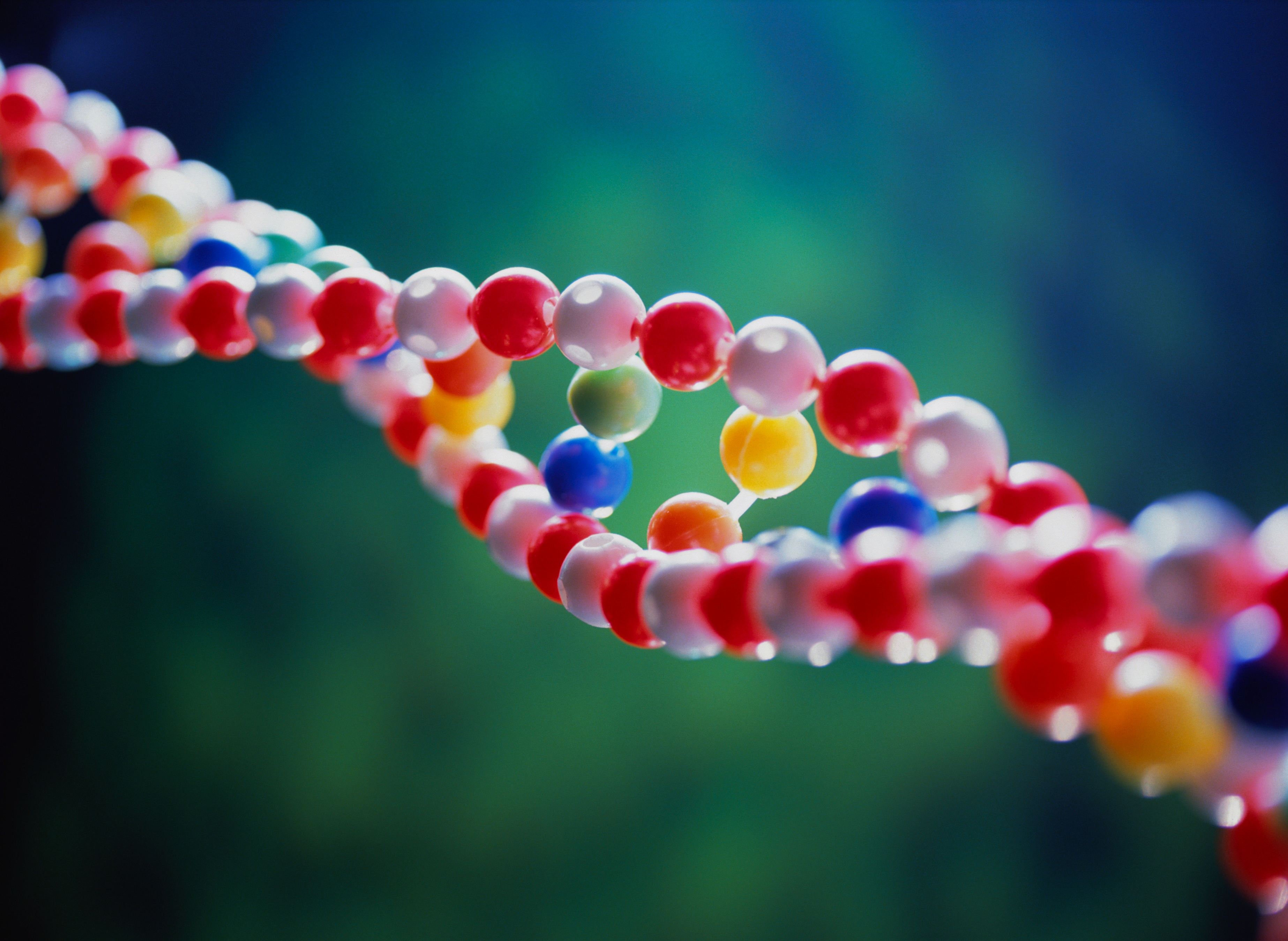
Why is DNA important?
a)
it is very small and very complicated
b)
it's in everything
c)
it serves as the blueprint for traits of all living things
d)
because we eat it every day for energy
7.
What are the 4 nitrogen bases?
a)
adenine, thymine, cytoplasm, and guanine
b)
adenine, thymine cytosine, and guanine
c)
adenine, thymine, cytosine, and gylcerol
d)
adenine, thymine, cytosine, and glucose
8.
Which 2 molecules forms the sides (backbone) of the DNA ladder?
a)
deoxyribose and adenine
b)
deoxyribose and a hydrogen bond
c)
sugar and the nucleus
d)
deoxyribose (sugar) and phosphate
9.
Which organelle is DNA usually found in?
a)
cell membrane
b)
vacuole
c)
chloroplast
d)
nucleus
10.
Which sequence of DNA bases would pair with this partial strand
ATG TGA CAG
ATG TGA CAG
a)
ATG TGA CAG
b)
TAC ACT GTC
c)
GTA AGT GAC
d)
CAT TCA CTG
11.
A nucleotide includes...?
a)
pentose sugar
b)
nitrogenous base
c)
phosphate group
d)
all of the above
12.
Which shows the correct complementary base pairing for DNA?
a)
C-A, T-G
b)
A-G, C-T
c)
C-G, U-A
d)
T-A, G-C
13.
What does DNA stand for?
a)
Deoxyribonucleic acid
b)
Denitrogenous acid
c)
Deribonucleic acid
d)
Diribonucleic acid
14.
What is responsible for holding the two strands of the DNA double helix together?
a)
hydrogen bonds
b)
alleles
c)
London dispersion forces
d)
deoxyribose sugars
15.
What is the complementary strand of ATT GGC?
a)
TAA CCG
b)
UAA CCG
c)
ATT GGC
d)
TUU CCG
16.
How are DNA, proteins, and traits related?
a)
DNA makes proteins, which expresses your traits
b)
proteins make DNA, which shows your traits
c)
traits decide your DNA and your proteins
d)
they aren't related
17.

Watson and Crick were the first to suggest that DNA is _____
a)
a short molecule
b)
the shape of a double helix
c)
a protein molecule
d)
the genetic material
18.
If Chargaff found that a sample of DNA has 20% ADENINE, how much GUANINE would he have determined to be there?
a)
30%
b)
20%
c)
80%
d)
60%
19.
Which is the mRNA molecule that would be transcribed from this DNA template:
TGGCAAGTACGT
TGGCAAGTACGT
a)
ACCGTTCATGCA
b)
UGGCAAGUACGU
c)
UCCGUUCUUGCU
d)
ACCGUUCAUGCA
20.
What is the monomer of DNA?
a)
Nucleotide
b)
Lipid
c)
Carb
d)
Protein
21.
What is the monomer of proteins?
a)
DNA
b)
RNA
c)
Amino Acid
d)
Carbs
22.
Chargaff's experiments showed that the amount of A, T, G and C is the same from species to species
a)
True
b)
False
23.
If a section of DNA has 13% thymine, then there is _____ adenine
a)
13%
b)
26%
c)
37%
d)
74%
24.
If there is 29% guanine in a section of DNA, then there is _____ thymine
a)
21%
b)
29%
c)
42%
d)
58%
25.
The rule stating that the bases in a nucleic acid always pairs up in the same way: A=T and G=C.
a)
Replication
b)
Translation
c)
Transcription
d)
Chargaff's Rule
100 %

