
 Worksheets
DNA, RNA and Structure
Total questions: 54
Worksheet time: 1hrs 14mins
Name
Class
Date
1.

Which of the following best describes a DNA molecule?
a)
double helix
b)
contains ribose
c)
made of amino acids
d)
contains Uracil
2.
A nucleotide includes...?
a)
pentose sugar
b)
nitrogenous base
c)
phosphate group
d)
all of the above
3.
In DNA, Adenine bonds with ______________.
a)
Guanine
b)
Thymine
c)
Cytosine
d)
Adenine
4.

Why is DNA important?
a)
it is very small and very complicated
b)
it's in everything
c)
it serves as the blueprint for making proteins
d)
because we eat it every day for energy
5.
Which 2 molecules forms the sides (backbone) of the DNA ladder?
a)
deoxyribose and adenine
b)
deoxyribose and a hydrogen bond
c)
sugar and the nucleus
d)
deoxyribose (sugar) and phosphate
6.
Which shows the correct complementary base pairing for DNA?
a)
C-A, T-G
b)
A-G, C-T
c)
C-G, U-A
d)
T-A, G-C
7.
What does DNA stand for?
a)
Deoxyribonucleic acid
b)
Denitrogenous acid
c)
Deribonucleic acid
d)
Diribonucleic acid
8.

Name this structure
a)
double helix
b)
nucelotide
c)
twisted ladder
d)
hydrogen bond
9.
Which sequence of DNA bases would pair with this partial strand
ATG TGA CAG
ATG TGA CAG
a)
ATG TGA CAG
b)
TAC ACT GTC
c)
GTA AGT GAC
d)
CAT TCA CTG
10.
Which sequence of DNA bases would pair with this partial strand
ATG TGA CAG
ATG TGA CAG
a)
ATG TGA CAG
b)
TAC ACT GTC
c)
GTA AGT GAC
d)
CAT TCA CTG
11.
Which biomolecule contain your genetics?
a)
Carbohydrate
b)
Lipid
c)
Nucleic Acid
d)
Protein
12.
The instructions for inherited traits
a)
Avery
b)
Hershey
c)
Griffiths
d)
Genes
13.
material that causes recognizable, inheritable characteristics in related groups of organisms
a)
Griffiths
b)
DNA
c)
Phosphate
d)
Carbohydrate
14.
subunits of DNA made of three parts
a)
Phosphate
b)
Carbohydrate
c)
Nucleotide
d)
Nitrogenous Base
15.
is a three-nucleotide sequence along the DNA and RNA molecules
a)
Nucleotides
b)
Purines
c)
Genes
d)
Codons
16.
Being analogous, this can be thought of as a sentence
a)
DNA
b)
Gene
c)
Codon
d)
Nucleotide
17.
Which organelle is DNA usually found in?
a)
cell membrane
b)
vacuole
c)
chloroplast
d)
nucleus
18.
What are the three components of a nucleotide?
a)
sugar, hydrogen, nitrogen base
b)
sugar, oxygen, nitrogen base
c)
sugar, phosphate, nitrogen base
d)
sugar, phosphate, protein
19.
The enzyme that unzips or unwinds DNA to prepare for replication is
a)
helicase
b)
replicase
c)
polymerase
d)
synthase
20.
DNA replication results in two DNA molecules,
a)
each one with two original strands
b)
each one with two new strands
c)
each one with one new strand and one original strand
d)
one with two new strands and the other with two original strands
21.
If Chargaff found that a sample of DNA has 20% ADENINE (A), how much GUANINE (G) would he have determined to be there?
a)
30%
b)
20%
c)
80%
d)
60%
22.

What would be the complementary DNA sequence to:
AATCATGGA
a)
AATCATGGA
b)
TTAGTACCT
c)
UUAGUACCU
d)
GGATAUCUA
23.
What is DNA polymerase?
a)
An enzyme that builds the new DNA strand by pairing bases
b)
An enzyme that unzips DNA
c)
An enzyme that builds mRNA
d)
A long molecule that stores genetic material
24.
The processes in which parental strands of DNA separate, serve as templates, and produce DNA molecules that have one strand of parental DNA and one strand of new DNA.
a)
Translation
b)
Replication
c)
Semiconservation Replication
d)
Transcription
25.
This Y shaped region where DNA is unwound to start replication is called...
a)
replication fork
b)
Leading strand
c)
Lagging strands
d)
replication splicing
26.
Okazaki fragments form on the:
a)
lagging strand
b)
leading strand
c)
base-pairs
d)
5' end
27.

The term used to describe DNA Replication is:
a)
Semi-Conservative
b)
Conservative
c)
AntiParallel
d)
Dispersive
28.
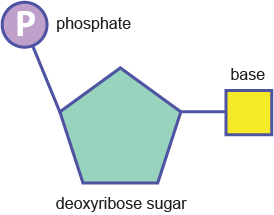
Nucleotides are made up of a sugar, phosphate, and..?
a)
nitrogenous base
b)
nucleic acid
c)
cholesterol
d)
fatty acid
29.
What does DNA stand for?
a)
Deoxyribonucleic acid
b)
Denitrogenous acid
c)
Deribonucleic acid
d)
Diribonucleic acid
30.
Which 2 molecules form the sides (backbone) of the DNA ladder?
a)
deoxyribose sugar and adenine
b)
deoxyribose sugar and a hydrogen bond
c)
deoxyribose sugar and the nucleus
d)
deoxyribose sugar and phosphate
31.
Which of the following is the correct order of molecules?
a)
DNA -> RNA -> Proteins
b)
Proteins -> DNA -> RNA
c)
RNA -> DNA -> Proteins
d)
There is no specific order of these molecules
32.

DNA codes for...
a)
cholesterol
b)
proteins
c)
fatty acids
d)
a sandwich
33.
Which of the following is the sugar found in RNA?
a)
Ribose
b)
Maltose
c)
Deoxyribose
d)
Amylose
34.
Which of the following is a correct difference between RNA and DNA?
a)
RNA is single stranded and DNA is double stranded
b)
RNA is double stranded and DNA is single stranded
c)
DNA uses Uracil and RNA uses Thymine
d)
RNA has deoxyribose and DNA has ribose
35.
Which organelle is DNA usually found in?
a)
cell membrane
b)
vacuole
c)
chloroplast
d)
nucleus
36.
Which of the following is the sugar found in RNA?
a)
Ribose
b)
Maltose
c)
Deoxyribose
d)
Amylose
37.
What process involves in making another copy of DNA?
a)
Replication
b)
Transcription
c)
Translation
38.
Which statement is TRUE regarding DNA and RNA?
a)
DNA's sugar is ribose; RNA's sugar is deoxyribose
b)
DNA is single stranded; RNA is double stranded
c)
DNA contains thymine; RNA contains uracil
d)
DNA is in cytoplasm; RNA is in nucleus
39.
Which type of RNA takes the amino acids to the ribosome?
a)
tRNA
b)
Models enable scientists to visualize mRNA
c)
Models can be adapted and changed rRNA
40.
Which type of RNA is made in the nucleus?
a)
mRNA
b)
rRNA
c)
tRNA
41.
The monomer of DNA is called a(n)
a)
Monosaccharide
b)
Amino Acid
c)
Triglyceride
d)
Nucleotide
42.
Which of the following is not a nitrogen base in DNA?
a)
Adenine
b)
Cytosine
c)
Uracil
d)
Thymine
43.
What determines genetic traits?
a)
DNA
b)
Chromosome
c)
Alleles
d)
Phenotype
44.
I am a single strand.
a)
DNA
b)
RNA
45.
Which two processes are involved in protein synthesis?
a)
Replication and Transcription
b)
Replication and Translation
c)
Transcription and Translation
46.
Which of the following bases is found only in RNA?
a)
Adenine
b)
Guanine
c)
Thymine
d)
Uracil
47.
Which form of RNA carries amino acids from the cytoplasm to the ribosome?
a)
amino RNA
b)
ribosomal RNA
c)
transfer RNA
d)
messenger RNA
48.
What are the three base segments of mRNA called?
a)
anticodons
b)
codons
c)
triplets
49.
Transcribe the following sequence of DNA into RNA:
AAG CTT TGC
AAG CTT TGC
a)
TTC GAA ACG
b)
UUC GAA ACG
c)
TTC GUU UCG
d)
UUC GUU UCG
50.
Which correctly outlined the central dogma
a)
DNA --> mRNA --> rRNA
b)
DNA --> tRNA --> protein
c)
DNA --> mRNA --> protein
d)
DNA --> amino acid --> protein
51.
What is the difference between DNA and RNA
a)
DNA has uracil and RNA has thymine
b)
DNA is involved in transcription and RNA is involved in translation
c)
DNA contains thymine and RNA contains uracil
d)
DNA is made of nucleotides and RNA is not
52.
DNA has a ______ strand; RNA has a ______ strand.
a)
double/double
b)
double/triple
c)
double/single
d)
single/single
53.
What is the transcribed mRNA strand for CATTAA
a)
GUAAUU
b)
GTAATT
c)
AUGGUU
d)
CATTAA
54.
The process of making mRNA from DNA is called.
a)
Replication
b)
Transcription
c)
Translation
d)
Protein synthesis
100 %

