

wayground logo

Free Printable Worksheets

Font size

S
M
L
XL
Worksheets

Math Analysis First Semester Review 2018-19

Total questions: 140

Worksheet time: 5hrs 11mins
Name
Class
Date
1.
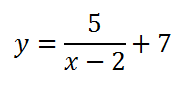
What is the horizontal asymptote? 
a)
x = 2
b)
x = 7
c)
y = 2
d)
y = 7
2.
Which conic is given by (x-4)2 = 8(y - 3)?
a)
Hyperbola
b)
Ellipse
c)
Circle
d)
Parabola
3.
What are the coordinates of the center and the radius of the circle with equation:
(x - 4)2 + (y - 3)2 = 25 ?
a)
Center (4,3)
Radius = 5 units
b)
Center (4,3)
Radius = 25 units
c)
Center (-4,-3)
Radius = 25 units
d)
Center (-4,-3)
Radius = 5 units
4.
Classify the conic section.
a)
Circle
b)
Ellipse
c)
Line
d)
None of these
5.
What is the vertex of the parabola?
a)
(-3, -1)
b)
(3, 1)
c)
(1, 3)
d)
(-1, -3)
6.
-6x2 + 4y2 + 9x + y = -7
a)
Circle
b)
Parabola
c)
Ellipse
d)
Hyperbola
7.
Identify the conic:  
25x2 + 5y2 + 6x + 4y +2 = 0
a)
Circle
b)
Ellipse
c)
Hyperbola
d)
Parabola
8.

Factor using completing the square: 3x2 + 6x +28 = 0

a)

3(x+1)2 + 25 =0

b)

(3x+3)2 + 19 = 1

c)

3(x+1)2 + 31 = 0

d)

(3x+6)2 - 8 = 1

9.
Which of these is not a conic section?
a)
Ellipse
b)
Hyperbola
c)
Rectangle
d)
Parabola
10.
True or False?
When the x-part is squared, the parabola opens up or down.
a)
True
b)
False
11.
Is the hyperbola vertical or horizontal? 
a)
Vertical
b)
Horizontal
12.
Which conic is given by (x-4)2 = 8(y - 3)?
a)
Hyperbola
b)
Ellipse
c)
Circle
d)
Parabola
13.
Which conic's equation has only 1 squared term?
a)
Parabola
b)
Circle
c)
Ellipse
d)
Hyperbola
14.
Which is the equation to find c on an ellipse?
a)
c2 = a2 + b2
b)
c2 = a2 - b2
c)
1/4d
d)
(x-h)2 + (y-k)2 = r2
15.
What are the vertices of the hyperbola?
a)
(0, 3) and (0, -3)
b)
(-4, 3) and (-4, -3)
c)
(0, 1) and (0, -1)
d)
(4, 0) and (-4, 0)
16.
What are the vertices of the hyperbola?
a)
(0, 5) and (0, -5)
b)
(5, 0) and (-5, 0)
c)
(0, 25) and (-25, 0)
d)
(0, 0) and (0, 5)
17.
Identify the end behavior:
a)
The end behavior of the graph is x →∞, y→∞ and x→∞, y→⁻∞
b)
The end behavior of the graph is x →∞, y→∞ and x→⁻∞, y→∞
c)
The end behavior of the graph is x →∞, y→∞ and x→⁻∞, y→-∞
d)
The end behavior of the graph is The end behavior of the graph is x →∞,y→⁻∞ and x→∞, y→⁻∞
18.

Identify the end behavior:

a)

The end behavior of the graph is x → pos infinity, y→ pos infinity and x→ neg infinity, y→ neg infinity

b)

The end behavior of the graph is x →pos infinity, y→pos infinity and x→neg infinity, y→ pos infinity

c)

The end behavior of the graph is x →pos infinity, y→pos infinity and x→neg infinity, y→0

d)

The end behavior of the graph is x →pos infinity, y→ pos infinity, and x→neg infinity, y→ neg infinity.

19.
Identify the x-intercepts:
a)
No x-intercpts
b)
x = -2, x = 3, x = -8
c)
x = -2, x = 3
d)
x = -2, x = 3, x = 8
20.
Identify the increasing interval:
a)
(-∞, 1) U (3, ∞)
b)
(-∞, 4) U (3, ∞)
c)
(-∞, 1) U (0, ∞)
d)
(-5, 4) U (3, 5)
21.
Identify the decreasing interval:
a)
(-∞, 1) U (3, ∞)
b)
(1, 3)
c)
(-∞, 1) U (0, ∞)
d)
(1,4) U (3,0)
22.
Solve
a)
-9
b)
-2,3
c)
5
d)
0
23.
Solve
a)
8
b)
38
c)
34
d)
14
24.
Solve and check for extraneous solutions
a)
x=5
b)
x= -5
c)
No Solution
25.
Solve.  3x- 27x = 0 
a)
x = 3,    x = -3
b)
x = 0,    x = 9
c)
x = -27
d)
x = 0,    x = 3
26.
|v + 8| − 5 = 2 
a)
{-1,-15}
b)
{-1,-5}
c)
{-15,15}
d)
No Solution
27.
 |−2n| + 10 = −50
a)
{30, -30}
b)
{20,-20}
c)
{-5,5}
d)
No Solution
28.
What type of function is shown?
a)
cube root
b)
square root
c)
logarithm
d)
exponential
29.
What are the transformations to the graph compared to the parent function?
a)
Shifted right 2, shifted up 3, and reflected over the y-axis
b)
Shifted left 2, shifted up 3, and reflected over the y-axis
c)
Shifted left 2, shifted up 3, and reflected over the x-axis
d)
Shifted right 2, shifted up 3, and reflected over the x-axis
30.
What type of function is shown?
a)
Exponential 
b)
square root
c)
quadratic
d)
cube root
31.
Identify the Transformations. 
a)
Vertical stretch by 2 and down 4
b)
Horizontal compression by ½ and down 4
c)
Vertical stretch by 2 and up 4
d)
Horizontal compression by ½ and right 4
32.
What is the name of the following function?
a)
Cubic
b)
Constant
c)
Exponential
d)
Quadratic 
33.
What is the equation of this graph?
a)
f(x) = -(x + 1)2 + 3
b)
f(x) = -(x - 1)2 + 3
c)
f(x) = -(x + 1)2 - 3
d)
f(x) = -(x + 1)2 - 3
34.
What is the domain of the graph?
a)
-7 ≤ x < 5
b)
-3 ≤ x < 1
c)
-3 ≤ y < 1
d)
-7 ≤ y < 5
35.
What is the range of the graph?
a)
-7 ≤ x < 5
b)
-3 ≤ x < 1
c)
-3 ≤ y < 1
d)
-7 ≤ y < 5
36.

What is the domain?

a)

All real numbers

b)

All real numbers except 4

c)

All real numbers except 2

d)

All real numbers except 2 and -2

37.
Find (fg)(x)
f(x)=3
g(x)=5x-3
a)
15x-9
b)
9-15x
c)
9x+15
d)
9-5x
38.

Where is f(x) = -2

a)

0

b)

1

c)

-1,1,-7, 5

d)

-2, 3, -6

39.
Over what interval is this function constant?
a)
-5 < x < ∞
b)
-3 < x < 4
c)
4 < x < ∞
d)
-5
40.
What is the increasing interval for this function? (There are NO arrows)
a)
(-6, -2)
b)
(-∞, ∞)
c)
(-2, 6)
d)
(-1, 3)
41.
What is the interval of increase of this function?
a)
(1, ∞)
b)
(-∞, ∞)
c)
(2, ∞)
d)
None
42.
What are the x-intercept(s) for the function
f(x) = (4x + 12)/(x - 6)
a)
(-3,0)
b)
(6,0)
c)
(0,-2)
d)
(4,0)
43.
g(x)=-f(x)
Describe the transformation to f(x) that results in g(x).
a)
f(x) has been reflected over the x-axis.
b)
f(x) has been reflected over the y-axis.
44.
The function in the graph is:
a)
even
b)
odd
c)
neither even nor odd
d)
both even and odd
45.
Is the graph an even, odd, or neither function
a)
Even
b)
Odd
c)
Neither
46.
Even, odd, or neither?
a)
Even
b)
Odd
c)
Neither
d)
Please explain this to me.
47.
Reflecting over the y-axis changes the ____-_____________. 
a)
x-axis
b)
x-coordinate
c)
y-coordinate
d)
none of the above
48.
Find the vertex of 
f(x) = -x- 4x + 12.
a)
(-2, 16)
b)
(2, 0)
c)
(2, 4)
d)
(-2, 4)
49.

If given the equation y = 3(x + 5)2 - 4, what is the vertex of the parabola?

a)

(5, -4)

b)

(-5, -4)

c)

(-15, -4)

d)

(15, -4)

50.

Identify a, b, and c:

x2 + 2x - 8 = 0

a)

a = 1, b = 2, c = -8

b)

a = 1, b = 2, c = 0

c)

a = x2, b = 2x, c = 8

d)

a = 1, b = -2, c = 8

51.
If we have the equation y=ax2+bx+c, how can we can find the x-coordinate of the vertex?
a)
-a
b)
-b/a
c)
b/2a
d)
-b/2a
52.
Which is the parent function of a parabola?
a)
y = x2
b)
y = 2x2 + 3
c)
y = -x2 -4
d)
y = -x2
53.
The graph of a quadratic function is called a
a)
Parabola
b)
Vertex
c)
Axis of Symmetry 
d)
Vertex Form
54.
Which variable, when negative, can cause the parent function to reflect across the x-axis (face downwards)?
a)
a
b)
h
c)
k
55.
What are the roots of the function
f(x)= (x - 2)(x + 3)?
a)
x = - 2 or x = 3
b)
x = 2 or x = -3
c)
The are no real roots
d)
x = 2 or x = 3
56.
a)

y = (x-2)2

b)

y = (x+2)2

c)

y = x2 + 2

d)

y = x2-2

57.

-

a)

y = (x-2)3

b)

y = (x+2)3

c)

y = x3 + 2

d)

y = x3 - 2

58.
Find the inverse of
f(x) = -3x + 3
a)
f-1(x) = -3x + 1
b)
f-1(x) = -1/3x + 1
c)
f-1(x) = -1/3x - 1
d)
f-1(x) = 1/3x + 1
59.
Find the inverse 
f(x)=-2x3+2
a)
³√(-x+2)/2
b)
³√(x+2)+1
c)
³√(x+2)/2
d)
³√(x-2)/-2
60.
What is the Vertical Asymptote?
a)
x= 0
b)
x= 4
c)
x= 5
d)
x= -5
61.
State the horizontal asymptote:  (2x2-5x +1)/(x2-x)
a)
y = 2
b)
y = 1
c)
y = 0
d)
There is no HA
62.
Find both asymptotes.
x+2
______
2x-6
a)
x=-3 and y=1/2
b)
x=1/2 and y=3
c)
x=3 and y =-1/2
d)
x=3 and y=1/2
63.
State the vertical asymptotes:  f(x) = 2 / (2x2+3x - 5)
a)
x = 1 , x = -5
b)
x = 1, x = -5/2
c)
x = -1/2, x = 5
d)
x = 0 , x = -5/2
64.
Find the horizontal asymptote.
f(x) = (4x-16)/(x2-16)
a)
x = 4, x = -4
b)
y=1
c)
y=0
d)
none
65.
Determine whether lines L1 and L2 passing through the pair of points are parallel, perpendicular, or neither.
L1: (3,6), (-6,0)
L2: (0,-1), (5,7/3)
a)
Parallel
b)
Perpendicular
c)
Neither
66.
Determine whether lines L1 and L2 passing through the pair of points are parallel, perpendicular, or neither.
L1: (0,-1), (5,9)
L2: (0,3), (4,1)
a)
Parallel
b)
Perpendicular
c)
Neither
67.
Find the solutions:
2x3-x2-18x+9=0
a)
0, 3, 1/2
b)
-3, 3, 0
c)
1/2, -3, 3
68.
State solutions in interval notation.
2x2 + 5x > 12
a)
[-4, 2/3]
b)
(-4, 2/3)
c)
(- infinity, -4) and (2/3, infinity)
69.
State solutions in interval notation.
x2 - x - 6 < 0
a)
(-2, 3)
b)
(- infinity, infinity)
c)
(- infinity, -2) and (3, infinity)
70.
State solutions in interval notation.
(2x-7)/(x-5) < 3
a)
(- infinity, 5) and (8, infinity)
b)
(5, 8)
c)
(-infinity, 5) and (5, infinity)
71.
How many relative maximums does this function have?
a)
1
b)
2
c)
3
d)
4
72.
How many relative minimums does this function have?
a)
1
b)
2
c)
3
d)
4
73.
(x4+12x3+37x2+14x)/(x2+7x)
a)
x2+5x+2
b)
x2-5x-2
c)
x2-5x+2
d)
x2-5x-2
74.
What is the proper way to write the answer for the following problem? 
a)
2x3-x2-25x-12
b)
2x4-x3-25x2-12x+0
75.
a)

a

b)

b

c)

c

d)

d

76.
Decide if (x-3) is a factor of 3x3+10x2-x-12
a)
Yes, it is a factor!
b)
No, it is not a factor!
77.
Is (x-4) a factor of (x3 +x2 -16x-16)?
a)
YES
b)
NO
78.
If f(x) = 3x2 -9x -20, find the value of f(5) using synthetic division.
a)
0
b)
10
c)
15
d)
-7
79.

Solve by graphing:

2x - y = 0

4x - y = 0

a)

(1,2)

b)

(0,0)

c)

No Solutions

d)

Infinite Solutions

80.
Solve the following system by graphing.  What is the solution?
a)
(3, -2)
b)
(3, -3)
c)
(-3, 2)
d)
(-3, -2)
81.
Solve the system of equations:
3x + 2y = 16
7x + y = 19
a)
(-2, 5)
b)
(-2, -5)
c)
(2, -5)
d)
(2, 5)
82.
(5-2i) + (-7+8i)
a)
-2+6i
b)
12+6i
c)
-35-16i2
d)
-35 -16i
83.
(10+3i) - (2-9i)
a)
20-27i
b)
12-7i
c)
8+12i
d)
20-27i2
84.
Identify the complex number on the graph
a)
4 - 3i
b)
-4 - 3i
c)
4 + 3i
d)
-4 + 3i
85.
(4x+1)(5x−2)
a)
20x2 + 3x − 2
b)
20x2 − 11x + 5
c)
20x2 − 18x + 2
d)
20x2 − 3x − 2
86.
Multiply  7x2y3 (2x4y5+6xy3)
a)
14x8y15+42x2y9
b)
9x6y8+13x3y6
c)
14x6y8+42x3y6
d)
14x6y8+42x2y6
87.
Factor x2-14x+24
a)
(x-8)(x+3)
b)
(x+12)(x-2)
c)
(x+8)(x+3)
d)
(x-12)(x-2)
88.
Factor Completely: 5x2-11x+6
a)
(5x+6)(x-1)
b)
(5x-6)(x-1)
c)
(2x-7)(x-3)
d)
(5x-6)(x+1)
89.
SIMPLIFY
a)
A
b)
B
c)
C
d)
D
90.
Simplify
     15x2/5x3
a)
3x
b)
3/x
c)
x/3
d)
5/x
91.

In the above graph, which root has a multiplicity of 2?


Remember to look at your roots, multiplicity, and end behavior!!

Use your notes!

a)

-1

b)

-3

c)

-120

d)

4

92.

Which equation MOST LIKELY matches the graph?


Remember to look at your roots, multiplicity, and end behavior!!

Use your notes!

a)

y = x4 - x3 + 3x2 + 2

b)

y = -x4 + x3 + 5x + 2

c)

y = x3 - 2x2 + 1x + 3

d)

y = -x3 - 2x2 + 1x + 3

93.
Which graph is NOT a function?
a)
Graph 1
b)
Graph 2
c)
Graph 3
d)
Graph 4
94.
The x-intercepts of a quadratic equation are known as the _____.
a)
Vertices
b)
Roots
c)
Squares
d)
Formulas
95.
Solve by factoring.
c2 - 4c = 0
a)
c = 0 or c = -4
b)
c = 0 or c = 2
c)
c = 0 or c = 4
d)
c = 1 or c = -2
96.
What inequality does the number line graph represent?
a)
x ≤ 4
b)
x ≥ -4
c)
x < -4
d)
x < 4
97.
-3y + 2 > 11
a)
y < -3
b)
y > -3
c)
y < 3
d)
y > 3
98.
What does i2 = ?
a)
-1
b)
√-1
c)
1
d)
-√1
99.
(1-3i)(2+5i)
a)
22-i
b)
16-i
c)
17-i
100.
i76
a)
a.)  i
b)
b.)  -i
c)
c.)  -1
d)
d.)  1
101.

Simplify.

a)
b)
c)
d)
102.

Simplify.

a)
b)
c)
d)
103.
When f(x) = 2x and g(x) = x2+3 , find f(g(x)).
a)
x+ 2x + 3
b)
4x+ 3
c)
2x+ 3x
d)
2x+ 6
104.
f(x) = 3x + 10
g(x) = x - 2
Find f(g(5))
a)
19
b)
28
c)
23
d)
75
105.

Given f(x) = √(x) and g(x) = x2 - 3. What is the domain of g(f(x))?

a)

(-∞,∞)

b)

(-∞,0)U(0,∞)

c)

[0,∞)

d)

[3,∞)

106.

Given g(x)=√x and h(x)= x + 2. Find the domain of g(h(x)).

a)

(-∞,∞)

b)

[0,∞)

c)

[-2,∞)

d)

(-∞, 0)U(0,∞)

107.
g(f(0)) = 
a)
10
b)
4
c)
7
d)
8
108.
f(f(4)) = 
a)
9
b)
7
c)
4
d)
0
109.
Line segment that has one endpoint and extends indefinitely in one direction.   
a)
Ray
b)
Vertex
c)
Angle
110.
The starting point of a ray
a)
Ray
b)
Vertex
c)
Angle
111.
Two rays with a common vertex
a)
Ray
b)
Vertex
c)
Angle
112.
a)

A

b)

B

c)

C

d)

D

113.
a)

A

b)

B

c)

C

d)

D

114.
a)

A

b)

B

c)

C

d)

D

115.
a)

A

b)

B

c)

C

d)

D

116.
a)

A

b)

B

c)

C

d)

D

117.
a)
0
b)
0/0
c)
1/4
d)
DNE
118.
Find the domain of f(x):
a)
(-∞, +∞)
b)
(-∞, 1) U (1, ∞)
c)
(-∞, -1) U (1, ∞)
d)
(1, ∞)
119.
Find the domain of h(x):
a)
(-∞, +∞)
b)
(-∞, -2) U (-2, ∞)
c)
(2, ∞)
d)
[-2, ∞)
120.
Find the domain of j(x):
a)
(-∞, ∞)
b)
(-∞, -2] U [2, ∞)
c)
[-2, 2]
d)
(-∞, 2]
121.
Find the Domain.
a)
[-4,∞)
b)
(-4,∞)
c)
(-∞,-4)U(-4,∞)
d)
(-4,0)U(0,∞)
122.

What is the equation used to find slope?

a)

y=mx+b

b)

y-y1=m(x-x1)

c)

y1-y2

−−−−−

x1-x2

123.

What is the equation for Point-Slope?

a)

y=mx=b

b)

y-y1=m(x-x1)

c)

y1-y2

----------

x1-x2

124.

What is the equation for Slope-Intercept Form?

a)

y=mx+b

b)

y-y1=m(x-x1)

c)

y1-y2

−−−−−−−−

X1-X2

125.

Write the equation of the line in point-slope form.

(4, -7); m = -1/4

a)

y +7 = -1/4(x - 4)

b)

y - 4 = -1/4(x + 7)

c)

y+ 7 = 4(x - 4)

d)

y - 7 = -1/4(x - 4)

126.
Parallel lines have __________ slopes
a)
Equal
b)
Opposite
c)
Reciprocal 
d)
Total
127.
What slope is parallel to:  
m = 3/4
a)
4/3
b)
3/4
c)
-3/4
d)
-4/3
128.
Slopes of perpendicular lines are...
a)
opposite reciprocals.
b)
opposites.
c)
identical.
d)
always 7.
129.
A line is perpendicular to    y = 2x - 7.
What is the slope of this line? 
a)
-2
b)
1/2
c)
-1/2
d)
2
130.
y = -2/3x + 2
y = 3/2x + 9
These lines are...
a)
Parallel
b)
Perpendicular
c)
Neither
131.
Is the graph pictured a function?
a)
Yes
b)
No
132.
Give the x-intercept
3x + 8y = 24
a)
(8, 0)
b)
(0, 8)
c)
(3, 0)
d)
(0, 3)
133.

For what intervals of x does f(x) have a negative slope?

a)

(-1,4)

b)

(4,∞)

c)

(-6, -1)

d)

(-∞, -6)

134.

Which equation is true when p = 2?

a)
b)

G -4p + 19 = 11

c)

H 2(p+10) = 40

d)

J -2p + 15 = 20

135.

Evaluate the expression 23 x 42

a)

A. 48

b)

B. 144

c)

C. 64

d)

D. 128

136.
In a direct variation, y=39 when x=3.  Find the value of y when x=2.
a)
26
b)
3
c)
58.5
d)
2
137.
Write the equation for the table given.
a)
y = 1/3x
b)
y = 3x
c)
y = 1/2x
138.
What is the correlation?
a)
Negative correlation
b)
No correlation
c)
Positive correlation
d)
All of the above
139.
What type of association (correlation) does this graph have?
a)
positive
b)
negative
c)
none
d)
all of the above
140.
What type of association does this scatter plot show?
a)
positive linear association
b)
negative linear association
c)
no association
d)
nonlinear association
