wayground logo

Free Printable Worksheets

Font size

S
M
L
XL
Worksheets

Waves Properties/Behavior

Total questions: 28

Worksheet time: 18mins

Name
Class
Date
1.
Which wave has a greater frequency?
a)
A
b)
B
2.

What is amplitude?

a)

How fast the wave goes

b)

The distance between a point on one wave and the same point on the next wave. It is usually measured in metres (m).

c)

The number of waves produced by a source each second. It is measured in Hertz (Hz).

d)

“how high” the wave is. It is the maximum distance the air particles travel from undisturbed position.

3.

What is the definition of wavelength?

a)

the distance between a point on one wave and the same point on the next wave. It is usually measured in metres (m).

b)

How fast the wave goes

c)

The number of waves created by the source per second.

d)

“how high” the wave is. It is the maximum distance the air particles travel from undisturbed position.

4.

What is the definition of frequency?

a)

“how high” the wave is. It is the maximum distance the air particles travel from undisturbed position.

b)

The distance between one wave and the same point on the next wave usually measured in metres (m).

c)

The number of waves produced by a source each second. It is measured in Hertz (Hz).

5.

What is the arrow on this picture of a wave showing?

a)

Wavelength

b)

Amplitude

c)

Frequency

d)

Longitudinal

6.

What is the arrow on this picture of a wave showing?

a)

Frequency

b)

Amplitude

c)

Pitch

d)

Wavelength

7.

As the wavelength increases the frequency...

a)

decreases

b)

increases

c)

stays the same (no effect)

8.
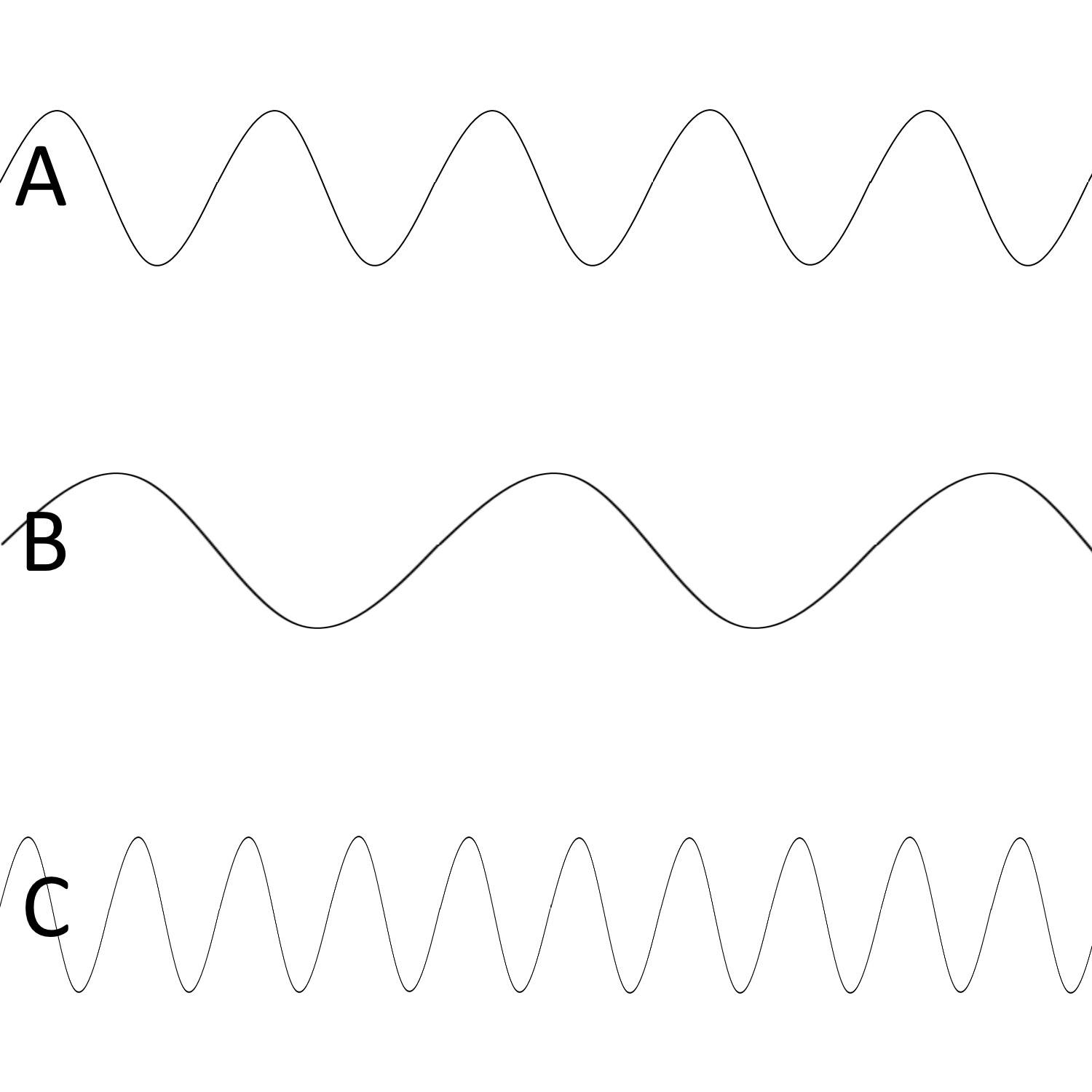
Which wave has the largest wavelength?
a)
A
b)
B
c)
C
d)
None (same wavelength)
9.
Which wave has the largest frequency?
a)
A
b)
B
c)
C
d)
None (same frequency)
10.
Which type of light has the lowest energy of this group?
a)
Radio
b)
Microwave
c)
Infrared
d)
Ultraviolet
11.
Which type of light has the highest energy of this group?
a)
red
b)
yellow
c)
green
d)
blue
12.
Which type of light has the smallest frequency of this group?
a)
red
b)
yellow
c)
green
d)
blue
13.
Which wave has a greater frequency?
a)
A
b)
B
14.
What letter demonstrates the amplitude of this wave?
a)
A
b)
B
c)
C
d)
D
15.
____________occurs when a wave bounces off a surface that it cannot pass through.
a)
Reflection
b)
Refraction
c)
Constructive Interference
d)
Destructive Interference
16.
__________ is number of waves in a give time.
a)
Wavelength
b)
Mechanical Waves
c)
Transverse
d)
Frequency
17.

When a wave strikes an object and bounces off of it

a)

Absorption

b)

Diffraction

c)

Refraction

d)

Reflection

18.
a)

absorption

b)

diffraction

c)

reflection

d)

refraction

e)

transmission

19.
a)

absorption

b)

diffraction

c)

reflection

d)

refraction

e)

transmission

20.
What are the units of frequency?
a)
m/s
b)
s
c)
Hz
d)
m
21.
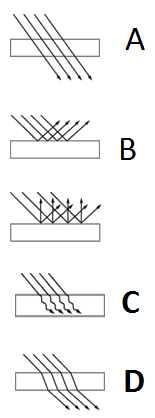
Which of the figures represents reflection?
a)
A
b)
B
c)
C
d)
D
22.
Prisms separate light into the colors of the rainbow using what behavior of waves?
a)
Reflection
b)
Refraction
c)
Absorption
d)
Transmission
23.
Which of the following represents refraction?
a)
A
b)
B
c)
C
d)
D
24.
Which has the LONGEST wavelength and, therefore, the lowest frequency/energy
a)
Gamma Rays
b)
Radio Waves
c)
Visible Light
d)
Infrared rays
25.
Put the visible light colors in order from longest wavelength to shortest wavelength
a)
Violet, Indigo, Blue, Green, Orange, Yellow, Red
b)
Red, Yellow, Green, Orange, Violet, Blue, Indigo
c)
Red, Orange, Yellow, Green, Blue, Indigo, Violet
26.
What is the longest wavelength in the spectrum?
a)
Red
b)
Gamma Waves
c)
Radio waves
d)
X-Ray
27.
Digital Communication is
a)
any information exchanged through tablet or smartphone/iphone
b)
any information exchanged through an electronic system or internet
28.

The use of digital technology to communicate

a)

Database

b)

Digital divide

c)

Telecommunications

d)

Digital citizenship