
 Worksheets
Fall Final Review
Total questions: 73
Worksheet time: 2hrs 9mins
Name
Class
Date
1.
(2x + 5y - z) + (-6x - 4y + 7z)
a)
-4x +6y + 6z
b)
4x + y + 6z
c)
-4x - y + 6z
d)
-4x + y + 6z
2.
(4x3-5x2+3x)+(-2x3-x2+6x)
a)
2x3-6x2-9x
b)
2x3+6x2+9x
c)
-2x3-6x2+9x
d)
2x3-6x2+9x
3.
Add the polynomials (x-2) and (x2+3)
a)
x2+x+1
b)
x3+5
c)
x3+1
d)
x3-1
4.
Simplify the expression.
(4a3 - 8a - 4a2) + (7a3 - 7 - 6a)
(4a3 - 8a - 4a2) + (7a3 - 7 - 6a)
a)
11a3 - 4a2 - 14a - 7
b)
5a3 - 4a2 - 14a - 7
c)
5a3 - 4a2 - 20a - 7
d)
5a3 - 9a2 - 20a - 7
5.
Simplify each expression.
(6x + 4x4 - 3x2) + (7x4 + 5x2 + 8x)
(6x + 4x4 - 3x2) + (7x4 + 5x2 + 8x)
a)
11x4 + 2x2 + 14x
b)
16x4 + x2 + 14x
c)
11x4 + x2 + 14x
d)
11x4 + 2x2 + 10x
6.
Add or Subtract to Simplify:
(4x - 2x3) + (5x3 - 4x + 5)
(4x - 2x3) + (5x3 - 4x + 5)
a)
3x3 + 5
b)
3x3 + 8x + 5
c)
3x2 + 5
d)
7x3 + 8x + 5
7.
A rectangle has width (2x + 3) and length (2x - 4). What is the perimeter of the rectangle?
a)
4x - 12
b)
4x - 1
c)
8x - 2
d)
4x2 - 2x - 12
8.
What is the degree of the polynomial?
9x5 - x4 + 2x
9x5 - x4 + 2x
a)
9
b)
5
c)
4
d)
2
9.
What is the leading coefficient of the polynomial?
7x5 - 9x2 + 6x
7x5 - 9x2 + 6x
a)
7
b)
5
c)
9
d)
2
10.
Classify the polynomial by the number of terms.
9x5 + 15x3 + 2x2
9x5 + 15x3 + 2x2
a)
monomial
b)
binomial
c)
trinomial
d)
Oh-nomial
11.
Classify the polynomial by the highest degree.
-3x + 1
-3x + 1
a)
constant
b)
linear
c)
quadratic
d)
cubic
12.
Classify the polynomial by the highest degree.
x3 - 2x2 + 4x + 15
x3 - 2x2 + 4x + 15
a)
constant
b)
linear
c)
quadratic
d)
cubic
13.
What is the degree of the polynomial?
9x5 + 2x4 - x3 + 9x2 - 2
9x5 + 2x4 - x3 + 9x2 - 2
a)
9
b)
5
c)
2
d)
4
14.
What is the leading coefficient of the polynomial?
9x5 + 2x4 - x3 + 9x2 - 2
9x5 + 2x4 - x3 + 9x2 - 2
a)
5
b)
9
c)
2
d)
4
15.
Simplify:
(x - 7)(x + 7)
(x - 7)(x + 7)
a)
x2 + 7x - 49
b)
x2 - 7x + 49
c)
x2 - 49
d)
x2 + 49
16.
Find the product:
(x + 12)(x - 12)
(x + 12)(x - 12)
a)
x2 - 144
b)
x2 + 144
c)
x2 + 12x - 144
d)
x2 - 12x + 144
17.
Multiply:
(3x – 1)(x + 5)
(3x – 1)(x + 5)
a)
3x2 + 4x + 5
b)
3x2 + 4x - 5
c)
3x2 + 14x + 5
d)
3x2 + 14x - 5
18.
Find the product:
(3x + 2)(2x + 4)
(3x + 2)(2x + 4)
a)
6x2 + 16x + 8
b)
5x2 +11x + 6
c)
5x2 + 16x + 6
d)
6x2 + 11x + 8
19.
Simplify:
(x - 9)(x - 7)
(x - 9)(x - 7)
a)
x2 - 2x - 63
b)
x2 - 16x - 63
c)
x2 - 2x + 63
d)
x2 - 16x + 63
20.
Find the product:
(x + 5)(x - 4)
(x + 5)(x - 4)
a)
x2 + 9x + 20
b)
x2 + 9x - 20
c)
x2 + 1x - 20
d)
x2 - 1x - 20
21.
Find the product:
(3x – 1)(x + 5)
(3x – 1)(x + 5)
a)
3x2 + 4x + 5
b)
3x2 + 4x - 5
c)
3x2 + 14x + 5
d)
3x2 + 14x - 5
22.
Simplify
(p − 8)2
Hint: (p − 8)2 = (p − 8)(p − 8)
(p − 8)2
Hint: (p − 8)2 = (p − 8)(p − 8)
a)
p 2 − 16p − 64
b)
p 2 + 16p + 64
c)
p 2 − 16p − 8
d)
p 2 − 16p + 64
23.
Find the product:
(y - 3)(y + 7)
(y - 3)(y + 7)
a)
y2 - 21
b)
y2 + 10x - 21
c)
y2 + 4y - 21
d)
2y - 10
24.
Find the product:
(y - 3)(y + 7)
(y - 3)(y + 7)
a)
y2 - 21
b)
y2 + 10x - 21
c)
y2 + 4y - 21
d)
2y - 10
25.
Find the difference.
(3- 2x + 2x2) - (4x -5 +3x2)
(3- 2x + 2x2) - (4x -5 +3x2)
a)
x2 + 6x + 8
b)
2x2 + 5x - 7
c)
-x2 -6x + 8
d)
-2x2 + 11x - 4
26.
Simplify the expression.
(4n4 - 8n + 4) - (8n2 + 4n4 + 1)
(4n4 - 8n + 4) - (8n2 + 4n4 + 1)
a)
-8n2 - 8n + 3
b)
-7n2 - 8n + 3
c)
-6n2 - 8n + 3
d)
-7n2 - 4n + 3
27.
1.) Simplify
(2a2b4z)(6a3b2z5)
(2a2b4z)(6a3b2z5)
a)
8a5b6z6
b)
12a6b8z5
c)
12a5b6z6
d)
8a6b8z5
28.
2.) Simplify
(3x3y5)4
(3x3y5)4
a)
3x12y20
b)
81x12y20
c)
12x12y20
d)
81x7y9
29.
4.) Simplify
(16x4y-5)/(8a3b-8)
(16x4y-5)/(8a3b-8)
a)
(a3y5)/(2x4b8)
b)
(2x4b8)/(a3y5)
c)
(8x4b8)/(a3y5)
d)
2x4b8a3y5
30.
(53x2y4)0
a)
5xy
b)
1
c)
0
d)
5
31.
Simplify (-4r5)(2r8)
a)
-8r13
b)
-2r13
c)
-8r40
d)
-2y40
32.
(3y⁴)²
a)
9y⁸
b)
9y⁶
c)
6y⁸
d)
6y⁶
33.

Simplify the exponential expression.
a)
2x6y12
b)
2x5y7
c)
8x6y12
d)
8x5y7
34.
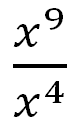
Evaluate the expression using the quotient rule.
a)
x13
b)
x5
c)
x36
d)
x-5
35.
Which is equivalent to 7 x 7 x 7 x 7 x 7 x 7
?
?
a)
75
b)
76
c)
67
d)
77
36.
Simplify:
(x3)2
(x3)2
a)
x5
b)
x
c)
x6
d)
3x2
37.
Simplify:
(xy2)4
(xy2)4
a)
x4y2
b)
x4y8
c)
x3y2
d)
x5y6
38.
(2⁸)²
a)
2¹⁶
b)
2¹⁰
c)
2⁶
d)
2⁴
39.
(r4)6
a)
10r
b)
r10
c)
24r
d)
r24
40.
Simplify: (3x2)3
a)
27x6
b)
9x6
c)
3x6
d)
9x5
41.

Is the relation a function? Why.
a)
Yes, because the x-value 11 has two y-values pair with it.
b)
Yes, because each x-value has only one y-value paired with it.
c)
No, because the x-value 11 has two y-values pair with it.
d)
No, because each x-value has only one y-value paired with it.
42.

Is this a function?
a)
Function
b)
Not a Function
43.
Which set of values is a function?
a)
(9,5) (10,5) (9,-5) (10,-5)
b)
(3,4) (4,-3) (7,4) (3, 8)
c)
(6,-5) (7, -3) (8, -1) (9, 1)
d)
(2, -2) (5, 9) (5, -7) (1, 4)
44.

a)
Function
b)
Not a Function
45.

Is this table a function or not a function?
a)
Function
b)
Not a Function
46.

Is this mapping a function or not a function?
a)
Function
b)
Not a Function
47.

Is this table a function or not a function?
a)
Function
b)
Not a Function
48.
What is the definition of function?
a)
Has inputs and outputs
b)
Every input has only ONE output
c)
Inputs have different outputs every time
d)
x-values and y-values
49.

Does the graph represent a function?
a)
Yes, because the vertical line test shows there are no repeating input values
b)
No, because the vertical line test shows there are repeating input values
50.

What is the domain of the graph?
a)
y≥1
b)
x ≥ 1
c)
All real numbers
d)
none of these
51.

What is the range of the graph?
a)
y≥1
b)
x≥1
c)
All real numbers
d)
none of these
52.

What is the domain?
a)
x = 2
b)
−∞ < x < ∞
c)
y = 2
d)
none of these
53.

What is the range?
a)
x = 2
b)
−∞ < x < ∞
c)
y = 2
d)
none of these
54.

What is the domain of the graph?
a)
-7 ≤ x < 5
b)
-3 ≤ x < 1
c)
-3 ≤ y < 1
d)
-7 ≤ y < 5
55.

What is the range of the graph?
a)
-7 ≤ x < 5
b)
-3 ≤ x < 1
c)
-3 ≤ y < 1
d)
-7 ≤ y < 5
56.
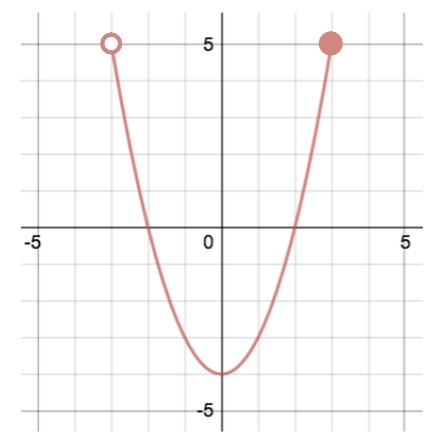
What is the domain?
a)
-3 < y ≤ 3
b)
-4 ≤ y ≤ 5
c)
-4 ≤ x ≤ 5
d)
-3 < x ≤ 3
57.

What is the range?
a)
-3 < y ≤ 3
b)
-4 ≤ y < 5
c)
-4 ≤ y ≤ 5
d)
-3 < y ≤ 3
58.

What is the domain?
a)
-4 < x ≤ 5
b)
-4 ≤ x < 5
c)
-3 < y < 3
d)
-3 ≤ y ≤ 3
59.

Lesly graphed two lines in order to find the solution to a given system of equations.
What is the solution?
What is the solution?
a)
(-3,-8)
b)
(-8,-3)
c)
(3,-8)
d)
(8,3)
60.
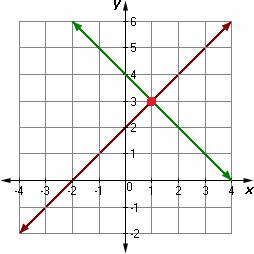
What is the solution to the system?
a)
(0, 3)
b)
(1, -1)
c)
(-3, 1)
d)
(1, 3)
61.

What is the solution?
a)
(6, 3)
b)
(3, 6)
c)
(-6, 3)
d)
No solution
62.

What is the solution?
a)
1
b)
-2
c)
(1, 2)
d)
(1, -1)
63.
Solve:
y = -1x - 5
4x - 8y = 4
y = -1x - 5
4x - 8y = 4
a)
(-3, -2)
b)
(5, -7)
c)
(3, 9)
d)
(-5, 4)
64.
Solve:
x = -3y - 17
2x + 3y = -7
x = -3y - 17
2x + 3y = -7
a)
(1, -20)
b)
(3, 0)
c)
(-5, -2)
d)
(10 , -9)
65.
Solve the system of equations using substitution:
2x + 3y = -5
x = y + 5
2x + 3y = -5
x = y + 5
a)
(-4, 1)
b)
(2, -3)
c)
(6, 1)
d)
(8, 3)
66.
Solve the system of equations:
y=2x
x + y = 9
y=2x
x + y = 9
a)
(6, 3)
b)
(3, 6)
c)
(-3, -6)
d)
no solution
67.
Solve the system by substitution.
y = 2x − 11
2x − 8y = 4
y = 2x − 11
2x − 8y = 4
a)
(6, 1)
b)
(6, −4)
c)
(6, −1)
d)
Infinite number of solutions
68.
Solve using Elimination.
4x + 8y = 20
-4x + 2y = -30
4x + 8y = 20
-4x + 2y = -30
a)
(-7,1)
b)
(2,-5)
c)
(-2,5)
d)
(7,-1)
69.
Solve using elimination.
7x + 2y = 24
8x + 2y = 30
7x + 2y = 24
8x + 2y = 30
a)
(6,-9)
b)
(-9,6)
c)
No solution
d)
Infinite number of solutions
70.
If two lines are parallel, how many solutions do they have?
a)
1
b)
2
c)
infinite
d)
none
71.
Solve by elimination:
3x + 7y = 23
-3x - 7y = -17
3x + 7y = 23
-3x - 7y = -17
a)
No solution
b)
Infinite number of solutions
c)
(-3,3)
d)
(3,3)
72.
The solution (x, y) to a system of equations is the point where they...?
a)
Run off the graph
b)
Don't touch
c)
Intersect
d)
Exist
73.

How many Solutions?
a)
One Solution
b)
No solution
c)
Infinitely Many Solutions
d)
(0, -1)
100 %

