wayground logo

Free Printable Worksheets

Font size

S
M
L
XL
Worksheets

Unit 4: Functions From a Calc Perspective

Total questions: 86

Worksheet time: 3hrs 33mins

Name
Class
Date
1.
What is the domain of the graph?
a)
y≥1
b)
x ≥ 1
c)
All real numbers
d)
none of these
2.
What is the proper domain?
a)
x≥0
b)
y≥0
c)
All real numbers
d)
{0, 1, 2, 3, 4,...}
3.
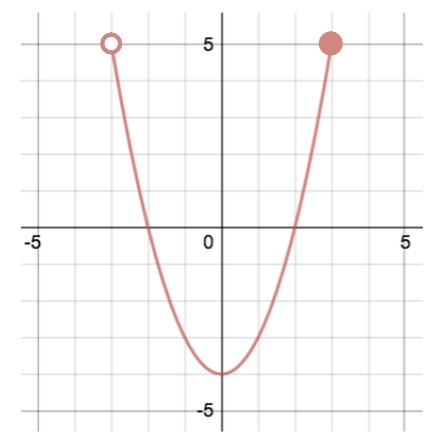
What is the domain?
a)
-3 < y ≤ 3
b)
-4 ≤ y ≤ 5
c)
-4 ≤ x ≤ 5
d)
-3 < x ≤ 3
4.
What is the range?
a)
-3 < y ≤ 3
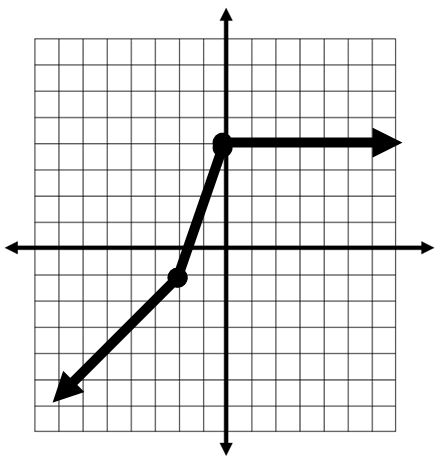
b)
-4 ≤ y < 5
c)
-4 ≤ y ≤ 5
d)
-3 < y ≤ 3
5.
What is the domain?
a)
-4 < x ≤ 5
b)
-4 ≤ x < 5
c)
-3 < y < 3
d)
-3 ≤ y ≤ 3
6.
What is the range?
a)
-4 < x ≤ 5
b)
-4 ≤ x < 5
c)
-3 < y < 3
d)
-3 ≤ y ≤ 3
7.

State the domain:

a)

(-oo, -4) U (-4, oo)

b)

[-4, oo)

c)

(-oo, -4]

d)

(-oo, oo)

8.

State the domain

a)

(-oo, -1) U (-1, oo)

b)

[-1, oo)

c)

(-oo, -1]

d)

(-1, oo)

9.

State the domain:

a)

(-oo, 7) U (7, oo)

b)

(-oo, -7) U (7, oo)

c)

(7, oo)

d)

[7, oo)

10.

State the domain:

a)

(-oo, 4)

b)

(-oo, 2]

c)

[2, oo)

d)

[4, oo)

11.

State the domain:

a)

(-oo, 1) U (1, oo)

b)

(-oo, -1) U (-1, 1) U (1, oo)

c)

(-oo, oo)

d)

(-oo, -1] U [-1, 1] U [1, oo)

12.

State the domain:

a)

(-oo, 3) U (3, oo)

b)

(-oo, 3]

c)

(-oo, 3)

d)

(3, oo)

13.
Given 
f(x)= 2x2 + 5x - 17, find f(-1). 
a)
f(-1) = -20
b)
f(-1) = -24
14.
What is the value of f(0)?
a)
-2
b)
2
c)
4
d)
0
15.
What is f(-2)?
a)
4
b)
1
c)
1
d)
DNE
16.
Pick the correct graph
a)
A
b)
B
c)
C
d)
D
17.
What is the RANGE of the function?
a)
(-∞, +∞)
b)
(-∞, 4]
c)
(-∞, 4)
d)
[0, 4]
18.
Which graph matches the function:
y = -2|x - 3| + 5
a)
A
b)
B
c)
C
d)
D
19.

Match the graph with the correct equation.

a)
b)
c)
d)
20.

Match the graph with the correct equation.

a)
b)
c)
d)
21.
Solve for r.
−2|−2r − 4| = -12
a)
{5,1}
b)
{-5,-1}
c)
{-5,1}
d)
No Solution
22.
a)
0
b)
2
c)
3
d)
4
23.
a)
0
b)
2
c)
3
d)
4
24.
a)
0
b)
3
c)
4
d)
DNE
25.
a)
0
b)
1
c)
2
d)
DNE
26.
a)
0
b)
1
c)
2
d)
DNE
27.
a)
0
b)
1
c)
-1
d)
DNE
28.
a)
-1
b)
0
c)
1
d)
DNE
29.
a)
0
b)
c)
- ∞
d)
DNE
30.
a)
3
b)
1
c)
Infinity
d)
Does not exist
31.
a)
Does not exist
b)
6
c)
4
d)
3
32.
What is the limit of the function as x approaches -4 from the left?
a)
2
b)
-4
c)
DNE
d)
-2
33.
Given this table, what limits are most accurate?
a)
As x goes to 3, f(x) goes to infinity
b)
As x goes to 3, f(x) goes to -infinity
c)
As x goes to 3 from the left, f(x) goes to -infinity and as x goes to 3 from the right, f(x) goes to infinity
d)
As x goes to 3 from the left, f(x) goes to infinity and as x goes to 3 from the right, f(x) goes to -infinity
34.

This table is finding a limit as x approaches what value?

a)

2

b)

3

c)

-2

d)

-30000

35.

What is the limit of f(x) as x approaches 5?

a)

5

b)

75

c)

4.9

d)

5.1

e)

Undefined

36.

As x approaches zero from the right, what is the function approaching?

a)

0

b)

Positive Infinity

c)

Negative Infinity

d)

10000

37.

As x approaches zero from the left, what is the function approaching?

a)

0

b)

Positive Infinity

c)

Negative Infinity

d)

10000

38.
Which of the following best describes the continuity at x = 1?
a)
Continuous
b)
Removable Point Discontinuity
c)
Non-removable Infinite Discontinuity
d)
Non-removable Jump Discontinuity
39.
Which of the following best describes the continuity at x = 3?
a)
Continuous
b)
Removable Point Discontinuity
c)
Non-removable Infinite Discontinuity
d)
Non-removable Jump Discontinuity
40.
Which of the following best describes the continuity at x = 1?
a)
Continuous
b)
Removable Point Discontinuity
c)
Non-removable Infinite Discontinuity
d)
Non-removable Jump Discontinuity
41.
Which of the following best describes the continuity at x = 5?
a)
Continuous
b)
Removable Point Discontinuity
c)
Non-removable Infinite Discontinuity
d)
Non-removable Jump Discontinuity
42.
Find where the function is continuous
a)
(-∞,-1)(-1,3)(3,∞)
b)
(-∞,∞)
c)
(-∞,-3)(-3,1)(1,∞)
d)
(-∞,-2)(-2,3)(3,∞)
43.

Select all statements that are TRUE.

a)
b)
c)
d)
44.

Which of the following statements are false?

a)

f(a) exists

b)

the limit as x approaches a exists

c)

f is continuous at a

d)

None, all statements are true

45.
A function is ________ if there is a break in the function's graph.
a)
continuous
b)
open
c)
closed
d)
discontinuous
46.
a)
Yes because there is a sign change between x =  -5 and x = 5
b)
No because there is a discontinuity between x = -5 and x = 5
c)
Yes because the Intermediate Value theorem applies
d)
No because there is no sign change between x = 5 and x = -5
47.
TRUE OR FALSE?  If f is continuous on [-1,1], f(-1)=4 and f(1)= -2, then there is a zero between -1 and 1.
a)
TRUE
b)
FALSE
c)
CANNOT BE DETERMINED
48.
#7 - List the types of intervals that the graph demonstrates in order.
a)
decreasing, constant, increasing, constant
b)
increasing, decreasing, constant
c)
increasing, constant, increasing, constant
d)
increasing, constant, decreasing, constant
49.
Which statement is true about this graph?
a)
This function is always constant
b)
This function is always increasing
c)
This function is never increasing
d)
This function is both increasing and decreasing
50.

Where is the decreasing?

a)

( −∞, −2.55] and [0, 2.55]

b)

(∞, −6.25] and [36, −6.25]

c)

(−∞, ∞)

d)

(−∞, 0]

51.

Where is the function increasing?

a)

[4, ∞)

b)

[−4, ∞)

c)

[6, ∞)

d)

4 < x < 6

52.

For what intervals of x is f(x) decreasing?

a)

(-∞,-1)

b)

(-1,∞)

c)

(6,∞)

d)

(-∞,6)

53.
Describe the end behavior of the graph.
a)
x → ∞, y→ ∞ and x→∞, y→⁻∞
b)
x → ∞, y→ ∞ and x→⁻∞, y→∞
c)
x → ∞, y→ ∞ and x→⁻∞, y→ 0
d)
x → ∞,y→ ∞and x→ ⁻∞, y→ ⁻∞
54.
Describe the end behavior of the graph.
a)
x → ∞, y→ ∞ and
x→ ∞, y→⁻∞
b)
x → ∞, y→ ∞ and
x→⁻∞, y→∞
c)
None of these
d)
x →∞,y→⁻∞ and
x→∞, y→⁻∞
55.
Is this  graph a function?
a)
Function
b)
Not a Function
56.
Over what interval is this function constant?
a)
-5 < x < ∞
b)
-3 < x < 4
c)
4 < x < ∞
d)
-5
57.

Over what interval is the graph increasing?

a)

-2 < x < -1

b)

-1 < x < 2

c)

x > 4

d)

-4 < x < -2

58.

Use the given function or the graph to find the average rate of change

a)

3

b)

-3

c)

3/2

d)

-1/3

59.

Use the given function or the graph to find the average rate of change

a)

5

b)

-1/5

c)

-5

d)

15

60.
f(x) = 2x2 + 12x + 16
What is the average rate of change of f(x) on the interval [-3, -2].
a)
2
b)
1/2
c)
-2
d)
-1/2
61.

Find the average rate of change of f(x)=2x2+3x-1 from 1 to 2.

a)

18

b)

-9

c)

9

d)

3

62.
If the blue function is f(x)=x2, then the red function must be
a)
g(x)=x2-5
b)
g(x)=x2+5
c)
g(x)=(x-5)2
d)
g(x)=(x+5)2
63.
If the blue function is f(x)=√x, the red function must be
a)
g(x)=√(-x)
b)
g(x)=√(x-1)
c)
g(x)=√x-1
d)
g(x)=-√x
64.
Match the equation to its description.
a)
Right 2 and up 2
b)
Left 2 and up 2
c)
Right 2 and down 2
d)
Left 2 and down 2
65.
g(x)=-f(x)
Describe the transformation to f(x) that results in g(x).
a)
f(x) has been reflected over the x-axis.
b)
f(x) has been reflected over the y-axis.
66.
g(x)=f(x-1)-5
Describe the transformation to f(x) that results in g(x).
a)
f(x) has been translated to the left one and down five.
b)
f(x) has been translated to the right one and down five.
c)
f(x) has been translated to the left one and up five.
d)
f(x) has been translated to the right one and up five.
67.
  The blue function is the parent function f(x) = x3.  Which of the following is the correct equation for the red function, g(x)?
a)
g(x)=x3+1
b)
g(x)=x3-1
c)
g(x)=(x-1)3
d)
g(x)=(x+1)3
68.
f(x) = ⅔(x - 7)2 
a)
Shrink of ⅔
Right 7
b)
Shrink of ⅔
Left 7
c)
Stretch of ⅔
Right 7
d)
Stretch of ⅔
Left 7
69.
Describe the transformations that maps
y = g(x) to y = - g(x + 6) - 10
a)
Reflect over y-axis
Shifted down 10 units
Shifted left 6 units
b)
Reflect over x-axis
Shifted up 10 units
Shifted left 6 units
c)
Reflect over y-axis
Shifted up 10 units
Shifted right 6 units
d)
Reflect over x-axis
Shifted down 10 units
Shifted left 6 units
70.
What type of function is shown?
a)
linear
b)
quadratic
c)
square root
d)
absolute value
71.
What is the equation of the graph below?
a)
f(x) = I x + 2 I 
b)
f(x) = I x + 2 I +2
c)
f(x) = I x - 2 I +2
d)
f(x) = I x - 2 I 
72.
Given f(x) = 2x and g(x) = x2+3 , find f(g(x)).
a)
x2+2x+3
b)
4x2+3
c)
2x2+3
d)
2x2+6
73.
f(x) = 3x + 10
g(x) = x - 2
Find g(f(-10))
a)
-42
b)
-26
c)
-18
d)
None of these.
74.
f(x)=x3-3x
g(x)=-4x+1
Find f(x)*g(x)
a)
-4x3-5x2-3
b)
-4x3+2x2-3x
c)
-4x4+x3+12x2-3x
d)
-4x4-x3+12x2+3x
75.
f(n)=n2+4n
g(n)=-n-5
Find f(n)+g(n)
a)
n2+3n-5
b)
-n3+2n-7
c)
n3+3n-3n
d)
n2-3n-5
76.
f(x) = x2+9
g(x) = x-9
Find f(x)-g(x). 
a)
x2+x+9
b)
x2-x+9
c)
x2-x
d)
x2-x+18
77.
p(x) = 3x + 4
q(x) = 2x2
Find p(q(x))
a)
10x2
b)
18x2 + 4
c)
6x2 + 4
78.
g(x)=3x+4
h(x)=3x-1
Find g(h(x))
a)
-9x+11
b)
4x2+4x
c)
9x+1
d)
9x+11
79.
Given
f(x) = 3x2 + 7x and g(x) = 2x2 - x - 1, find (f + g)(x).
a)
11x2 - 1
b)
5x4 + 6x2 - 1
c)
5x2 + 6x - 1
d)
5x2 + 8x - 1
80.
Find the inverse of f(x) = -4x - 12
a)
f-1(x) = 4x - 3
b)
f-1(x) = -1/4x - 3
c)
f-1(x) = 1/4x + 3
d)
f-1(x) = -4x - 3
81.
are these inverse functions?
a)
no
b)
yes
c)
no way to tell
82.
Are the following inverses of each other?
a)
True
b)
False
83.
What does it mean to find the inverse of a function?
a)
the x's and y's are switched
b)
the x's and y's are divided by 2
c)
the x's and y's are made negative
d)
the x's and y's are the same
84.

During what season was Ms.Leary born?

a)

Winter

b)

Spring

c)

Summer

d)

Fall

85.

What was Ms. Leary's first car?

a)

Jeep

b)

Toyota

c)

BMW

d)

Honda

86.

Where does Ms.Leary have a metal plate, screws, and wires?

a)

in her garage

b)

in her foot

c)

in her shoulder

d)

she doesn't