
 Worksheets
Oligopoly and Monopolistic Competition Review
Total questions: 13
Worksheet time: 15mins
Which of the following best describes an oligopistic market?
Many sellers with identical barriers to entry
Many sellers, each with a clearly differentiated product, and no barriers to entry
A few competing sellers with similar products and high barriers to entry
A few competing sellers of identical products and no barriers to entry
No competition among sellers and high barriers to entry

Neither company has a dominant strategy
Both companies have an incentive to reduce production by %10
Both companies have an incentive to reduce production by %20
Only UA have an incentive to reduce production by %20
Only UB have an incentive to reduce production by %20
Game theory is used to explain
why firms price discriminate
how monopolies evolve into oligopolies
strategic behavior of firms in oligopoly
profit maximization in monopoly
price leadership of monopolistic competition
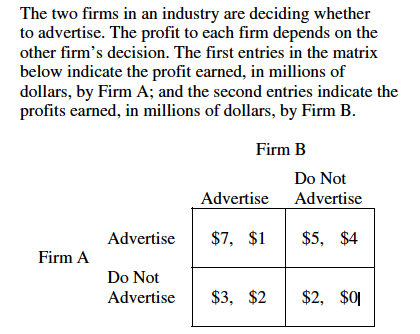
Based on the payoff matrix, which of the following is correct?
Firm A always gets a smaller share of the industry profits.
Firm A’s dominant strategy is to advertise.
Firm B’s dominant strategy is not to advertise.
The dominant strategy for both firms is not to advertise.
Neither firm has a dominant strategy.

The combination where Firm A advertises and Firm B does not advertise is Nash equilibrium because
it is best for each firm given what the other firm has chosen
the total industry profits are maximized
Firm A has an incentive to change its strategy and chooses not to advertise
it is the best outcome for Firm B regardless of what firm A does
advertising is always the best strategy for Firm A
Monopolistically competitive product markets are inefficient because
price equals the marginal value to the buyer of the last item produced
price is greater than marginal cost
excessive competition prevents other firms from entering the market
homogeneous goods are usually overpriced
short-run economic profit-making opportunities exist
A monopolistically competitive firm is currently producing the profit-maximizing level of output. If the price of a variable input increases, which of the following will occur?
The firm will increase its output to increase its revenue.
The firm will increase the price of its output by the same amount.
The firm’s average total cost and marginal cost curves will shift upward.
The firm’s average fixed cost will decrease as it decreases production.
The firm’s fixed cost will increase, but its output level will be unaffected.
One difference between oligopolies and monopolistically competitive markets is that
there is no deadweight loss in monopolistically competitive markets, but there is in oligopolies
the products sold in monopolistically competitive markets are identical
oligopolies have fewer barriers to entry
firms maximize profits in monopolistically competitive markets but not in oligopolies
there are fewer firms in oligopolistic markets than in monopolistically competitive ones
Which of the following must be true if a profit-maximizing monopolistically competitive firm continues to operate in the short run while incurring a loss?
Marginal revenue equals marginal cost and price is greater than average total cost.
Marginal revenue equals marginal cost and price is greater than average variable cost.
Marginal revenue equals marginal cost and price is less than average variable cost.
Price equals both marginal cost and marginal revenue.
Price is less than marginal revenue, but greater than average variable cost.

What is the profit-maximizing price and quantity?
P1, Q1
P2, Q4
P3, Q3
P4, Q2
P5, Q1

Is the firm in short-run or long-run equilibrium?
Short run, because price is greater than marginal cost
Short run, because the firm is earning a positive economic profit
Long run, because price is greater than average total cost
Long run, because marginal revenue is not equal to zero
Either short run or long run, because the firm is producing where marginal revenue equals marginal cost
The demand curve for a monopolistically competitive firm is downward sloping because
there are a large number of firms
the product is produced by using scarce resources
the products produced by different firms are not identical
it is easy for firms to enter or exit the market
the marginal cost rises as output produced increases
Which of the following is true of a monopolistically competitive firm in long-run equilibrium?
It produces where price equals marginal cost, and it earns zero economic profits.
It produces where marginal revenue exceeds marginal cost, and it earns positive economic profits.
It produces where marginal cost equals marginal revenue, the price is equal to average total cost, and the price is greater than marginal cost.
It produces at the minimum average total cost, and it utilizes all excess capacity.
It produces more than the allocatively efficient quantity, and the price is greater than marginal cost.

