wayground logo

Free Printable Worksheets

Font size

S
M
L
XL
Worksheets

Fall Semester Final Exam Practice

Total questions: 110

Worksheet time: 1hrs 19mins

Name
Class
Date
1.
Which was traded from the Old World to the New World?
a)
horses and major diseases
b)
squash, pumpkins, and turkeys
c)
cocoa and horses
d)
cocoa and llamas
2.
Which was traded from the New World to the Old World?
a)
major diseases
b)
horses
c)
potatoes and corn
d)
slaves
3.
When did the Columbian Exchange take place?
a)
Before 1492
b)
During the European Dark Ages
c)
After WW2
d)
After 1492
4.
How did diseases impact the New World?
a)
They didn't
b)
They wiped out 75-90% of the Europeans
c)
They wiped out 75-90% of the indigenous people
d)
They helped the natives beat the Spanish
5.
The unintentional mixing of crops, animals, diseases, and more between the Old and New World
a)
Columbian Exchange
b)
Triangular Trade
6.
The Columbian Exchange. was a movement of _______, between the Eastern and Western hemispheres. 
a)
people/cultures 
b)
disease
c)
animals/plants
d)
all of the above
7.
Epidemic is __________
a)
a word the Native Americans used to describe the Europeans
b)
a joining of cultures
c)
an outbreak of disease that spreads quickly and affects many people 
8.
As native populations decreased in the Americas from sickness and overwork, Europeans looked for new sources of labor by enslaving the ____________.
a)
Africans
b)
Spanish
c)
Portuguese
9.
Horses transformed the way these Native Americans lived. Now, they could _____________. 
a)
win the battle against the Europeans
b)
get their work done much faster
c)
travel farther in search of food and hunt their prey more easily 
10.
What animal changed life for American Indians?
a)
pigs
b)
chickens
c)
horses
d)
cows
11.
How did sugar-cane contribute to the formation of the Atlantic slave trade?
a)
Slave trading ships were made out of sugarcane stalks
b)
Only african slaves knew how to grow sugarcane
c)
African slaves were needed to work on sugarcane plantations
d)
Sugarcane was the main currency used in the Atlantic slave trade
12.
Which statement accurately describes the reasons for establishing Plymouth
and Jamestown?
a)
Both colonies were established to bring wealth to stockholders.
b)
Plymouth's founders intended to produce raw materials, while Jamestown's founders expected to discover gold.
c)
Both colonies were established to limit the expansion of other European empires.
d)
Plymouth was founded as a refuge from religious persecution, while Jamestown wasfounded for commercial profit.
13.
Which group was among the first to call for an end to slavery?
a)
American Indians, because they viewed the plight of slaves as similar to their own
b)
Quakers, because slavery contradicted their religious beliefs
c)
British loyalists, because Great Britain had ended the slave trade
d)
Puritans, because the New England economy did not rely on slavery
14.
The excerpt above reflects the dissatisfaction of American colonists with the -
a)
political debates that took place at the Albany Convention
b)
interference of Great Britain in the slave trade
c)
economic consequences of the Great Awakening
d)
economic policies imposed by Great Britain following the French and Indian War
15.
From 1690 to 1760, Parliament and the king of England allowed colonists in America to exercise a great deal of control over local and regional matters.Historians have described this practice as "salutary neglect."Which of the following happened as a direct result of this policy?
a)
The colonies developed a strong tradition of self-government.
b)
Many proprietary colonies were converted to royal colonies.
c)
The colonies refused to participate in a system of common defense. 
d)
Many colonies sought economic aid from other countries.
16.
Which of the following was a primary reason France sought to colonize North
America?
a)
To reduce overpopulation in Europe
b)
To create communities founded on religious tolerance
c)
To profit from trading in furs and other goods
d)
To create joint ventures with other European powers
17.
How did geography influence the early economic development of New York,
Boston, and Charleston?
a)
Long coastlines offered abundant natural resources.
b)
Proximity to flooding rivers limited development.
c)
Natural harbors provided access to markets.
d)
Extreme climates limited productive activity.
18.
British colonists objected to the Proclamation of 1763 because they -
a)
feared it would provoke attacks from American Indians
b)
did not want to share control of the fur trade with France
c)
resented the limits it imposed on westward expansion
d)
wanted to be able to trade freely with foreign nations
19.
Catholics immigrated to the Maryland colony in the seventeenth century primarily to - 
a)
profit from natural resources
b)
avoid crop failures and famine
c)
produce cash crops to pay off debts
d)
escape persecution
20.
Which statement best explains the significance of the Mayflower Compact?
a)
It limited the power of future colonial governments.
b)
It weakened the influence of religion in government.
c)
It established a form of self-government based on a social contract.
d)
It guaranteed liberties for colonists through local government.
21.
What were the colonies of Rhode Island, Connecticut, Massachusetts, and New Hampshire referred to as?
a)
13 Colonies
b)
New England Colonies
c)
Middle Colonies
d)
Southern Colonies
22.
Which settlement was the first permanent English settlement?
a)
Plymouth, Massachusetts
b)
Roanoke Island
c)
Jamestown, Va
d)
Fort Augustine, Fl
23.
What are the "breadbasket colonies"?
a)
Southern
b)
Middle
c)
New England
d)
Eastern
24.
Which colonies have large plantations?
a)
Middle
b)
Southern
c)
New England
d)
Northeast
25.
What was the Virginia House of Burgesses?
a)

It was the first legislative (elected lawmakers) assembly in the New World.
b)
1st Constitution of the New World
26.
Name England’s first attempt at a settlement. It failed!
a)
Jamestown, VA
b)
Roanoke
c)
Maryland
27.
Why did James Oglethorpe start Georgia colony?
a)

As a place for Quakers and it stands for Penn’s Woods.
b)

As a second chance for debtors and as a buffer between the English and Spanish colonies.
28.
What crop cultivated by John Rolfe helped save Jamestown (Virginia)?
a)
corn
b)
rice
c)
tobacco
29.
What is an indentured servant?
a)
Someone who agrees to work for several years for passage to the New World.
b)
Someone who is bought and cannot obtain freedom.
30.
This was a tax on molasses and sugar to reduce smuggling.
a)
Stamp Act
b)
Sugar Act
c)
Townshend Act
d)
Tea Act
31.
This was a tax on all printed materials in the 13 Colonies.
a)
Stamp Act
b)
Sugar Act
c)
Tea Act
d)
Townshend Act
32.
Finish this American Colonist Motto, "No Taxation without..."
a)
Transportation
b)
Relaxation
c)
Representation
d)
Sensation
33.
Why were the American Colonist taxed after the French and Indian War?
a)
Britain was in debt and needed money
b)
That was the agreement with the Native Americans
c)
They made too much money
d)
Townshend Acts
34.
What was this poster's meaning?
a)
The Colonies needed to be united
b)
Serpents can grow back together
c)
Colonies need to be independent
d)
Ben Franklin didn't know why he made this
35.
This event broke tensions between the colonist and the British troops where shots were fired. Crispus Attucks was the first to be killed.
a)
Lexington and Concord
b)
Boston Tea Party
c)
Boston Massacre
d)
Bloody Valentine
36.
How did the colonist protest against the tea tax?
a)
Dressed up like Native Americans
b)
Boston Massacre
c)
Dumped tea into Boston harbor
d)
Didn't pay the tax on the East India Tea
37.
Which was the punishment for the Boston Tea Party?
a)
Intolerable Acts
b)
Sugar Acts
c)
Quartering Acts
d)
Stamp Acts
38.
Early revolutionary battle where 1,000 British troops died and realized the American Colonists were tougher than they though.
a)
Battle of Bunker Hill
b)
Lexington and Concord
c)
Battle of Saratoga
d)
Battle of Yorktown
39.
This type of American Colonist was in support of the British parliament.
a)
Patriot
b)
Loyalist
c)
Yes man
d)
Neutral
40.
The Second Continental Congress addressed the steps to the colonies governing themselves and the creation of what military group?
a)
Colonial militias
b)
Marines
c)
Continental Army
d)
Navy
41.
Who was the first choice to command the Continental Army?
a)
Thomas Jefferson
b)
Benjamin Franklin
c)
Thomas Paine
d)
George Washington
42.
This type of colonist was ready for rebellion and the fight for independence.
a)
Loyalist
b)
Patriot
c)
Neutral
d)
British 
43.
Colonists were forbidden to settle west of the Appalachian Mountains.
a)
Proclamation line of 1763
b)
Proclamation boundary
c)
Manifest Destiny
d)
Borderlands
44.
What does Quartering mean?
a)
To allow troops to stay in your home
b)
Hitting someone with a quarter
c)
To give someone a quarter
d)
Giving a quarter of your earnings to Britain
45.
Given that only 5 people died in the Boston Massacre, why was it labeled a massacre?
a)
 British commanders ordered troops to shoot into a rioting crowd in effort to restore order
b)
the victims were innocent bystanders who were caught in the barrage of gunfire
c)
 the victims had done little to provoke the confrontational and hostile British troops
d)
Boston radicals used it as propaganda to take advantage of the heightened tensions 
46.
To refuse to buy goods from someone as a form of protest . . .
a)
occupy
b)
boycott
c)
damage
d)
repeal
47.
What group was created as a response to the Stamp Act?
a)
Sons of Liberty
b)
The Patriots
c)
The Red Coats
d)
The Loyalists
48.
Why did King George III tax the colonists so heavily?
a)
He hated the colonist
b)
He wanted more money for himself
c)
The national debt increase from the French and Indian War
d)
To make money for the colonies
49.
The Olive Branch Petition was written as a last attempt at …
a)
Freedom 
b)
Peace 
c)
Loyalty 
d)
Rebellion 
50.
Arguably the first "battle" of the Revolutionary War occurred when the Massachusetts Minutemen fired on British troops at -
a)
Boston
b)
Philidelphia
c)
Saratoga
d)
Lexington and Concord
51.
What was the name of the British king during the American Revolution?
a)
Charles III
b)
George III
c)
William III
d)
James III
52.
This American victory was the turning point in the war.
a)
Saratoga
b)
Yorktown
c)
Bunker Hill
d)
Lexington and Concord
53.
Who was the major author of the Declaration of Independence?
a)
Benjamin Franklin
b)
John Adams
c)
Thomas Jefferson
d)
Patrick Henry
54.
Surrounded by French and Continental armies, a large British army surrendered here.
a)
Saratoga
b)
Yorktown
c)
Bunker Hill
d)
Lexington and Concord
55.
This member of the Continental Congress helped gain French support for American independence.
a)
Thomas Jefferson
b)
Benjamin Franklin
c)
Patrick Henry
d)
John Adams
56.
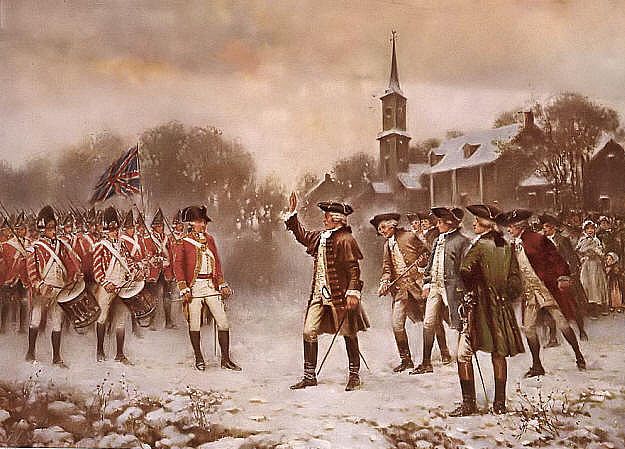
What event is depicted in this image?
a)
Boston Massacre
b)
Boston Tea Party
c)
Battle of Bunker Hill
d)
Lexington and Concord
57.
This patriot made a daring ride to warn colonists that British soldiers were approaching.
a)
Patrick Henry
b)
Paul Revere
c)
Phillis Wheatley
d)
Samuel Adams
58.
This enslaved person wrote poems and plays supporting American independence.
a)
Harriet Tubman
b)
Benjamin Banneker
c)
Paul Revere
d)
Phillis Wheatley
59.
Which one of these is not an advantage that helped the American patriots defeat Great Britain.
a)
defense of their own land, principles and beliefs
b)
support from France
c)
superior numbers of soldiers and greater experience
d)
strong leadership from men like George Washington
60.
What patriot leader is represented by this image?
a)
John Adams
b)
Samuel Adams
c)
Paul Revere
d)
Patrick Henry
61.
What is another name for British soldiers?
a)
Redcoats
b)
Patriots
c)
Minutemen
d)
Continental Soldiers
62.
Who were the Minutemen?
a)
Patriots who were ready to fight at a minutes notice
b)
British soldiers who were ready to fight at a minutes notice
c)
Sons of Liberty who were ready to fight at a minutes notice
d)
Hessians who were ready to fight at a minutes notice
63.
Who fired "the shot heard round the world?"
a)
the British
b)
the minutemen
c)
it is a mystery!
64.
What country joined the colonists to help them win the war?
a)
Germany
b)
France
c)
Netherlands
d)
Africa
65.
One weakness of the Articles of the Confederation was ____________. 
a)
The ability of Congress to tax.
b)
The inability of Congress to tax.
c)
The ability of Congress to declare war.
d)
The ability of Congress to create courts.
66.
In order to change (amend) the Articles of Confederation,  __________ out of 13 states had to agree. 
a)
9
b)
10
c)
13
d)
15
67.
Under the Articles of Confederation, each state got __________ vote. 
a)
b)
2
c)
1
d)
5
68.
The Articles of Confederation created a _________________ type of government.
a)
strong
b)
average
c)
weak
d)
federal
69.

What city did the Constitutional Convention take place in?

a)

Philadelphia

b)

New York

c)

Pennsylvania

d)

Washington D.C.

70.

What was the Great Compromise?

a)

the decision to go with Virginia's plan of representatives based on population

b)

the decision to go with New Jersey's plan of one representative per state

c)

the decision to go with a two house legislature based on Virginia and New Jersey's plans

71.

What year was the Constitution ratified?

a)

1776

b)

1783

c)

1787

d)

1791

72.

Those that supported the Constitution were called

a)

Federalists

b)

Republicans

c)

Democrats

d)

Lobbyists

73.

Who is considered the Father of the Constitution?

a)

George Washington

b)

John Jay

c)

Thomas Jefferson

d)

James Madison

74.

The Constitution replaced the

a)

Federalist Papers

b)

The Declaration of Independence

c)

The Articles of Confederation

d)

The Mayflower Compact

75.
What was the Northwest Ordinance?
a)
The Northwest Ordinance divided the Northwest territory into smaller territories which could eventually become states
b)
The Northwest Ordinance divided the Louisiana territory into states
c)
The Northwest Ordinance established the border between the US and Canada
d)
The Northwest Ordinance declared the Northwest territory a slave territory
76.
Why was Shay's Rebellion important?
a)
Shay's Rebellion started the American Revolution
b)
Shay's Rebellion caused a new war with England
c)
Shay's Rebellion shocked Congress into calling a convention to revise the Articles of Confederation
77.
What was the greatest challenge for the delegates at the Constitutional Convention?
a)
The greatest challenge at the convention was how to balance the interests of the large states with the interests of the small states
b)
The greatest challenge at the convention was issue of women's rights
c)
The greatest challenge at the convention was the issue of taxes 
78.
How would the states be represented in the new congress?
a)
Senate = 2 representatives for each state
House of Representatives = representation determined by population
b)
Senate = representation determined by population 
House of Representatives = 2 representatives for each state
79.
What was the Three-Fifths Compromise?
a)
An agreement stating that Native Americans would be counted as three-fifths of a person when counting a state's population
b)
An agreement stating that enslaved persons would be counted as three-fifths of a person when counting a state's population
c)
An agreement stating that women would be counted as three-fifths of a person when counting a state's population
80.
What was a compromise at the Constitutional Convention?
a)
Congress could not interfere with the slave trade for 20 years
b)
Congress would vote for the President and Vice President
c)
Representation in Congress would be determined by the Electoral College 
81.
According to the delegates of the Constitutional Convention, who chooses the chief executive?
a)
The House of Representatives
b)
The Senate
c)
The Popular Vote
d)
The Electoral College 
82.
What is a federal system of government?
a)
A system of government where only the national government has power
b)
A system of government where power is shared by the national and state governments
c)
A system of government where the states have more power than the national government
83.
The Great Compromise solved the problem of both big and small states wanting representation. 
a)
True
b)
False
84.
The Three-Fifths Compromise help settle the debate over whether to count slaves in the population or not.
a)
True
b)
False
85.
Federalist SUPPORT a strong, national government and creating a new constitution.
a)
True
b)
False
86.
Anti-federalists SUPPORTED making a new constitution.
a)
True
b)
False
87.
Which compromise is made up of ideas from the Virginia Plan and the New Jersey plan?
a)
The Great Compromise
b)
The three-fifths compromise
c)
The constitutional compromise
d)
The big compromise
88.
Which group of people wanted the Constitution to include a Bill of Rights?
a)
Federalists
b)
Anti-federalists
c)
Democrats
d)
Northerners
89.
Which of the following is NOT a branch of the government?
a)
Legislative
b)
Judicial
c)
Executive
d)
Constitutional
90.
The Federalists papers were written to persuade people to support the new constitution.
a)
True
b)
False
91.
Which one of the following is not a guaranteed freedom found in the First Amendment?
a)
Right to own a gun
b)
Right to freedom of Speech
c)
Right to  petition the government
d)
Right to assemble peacefully
92.
______ is the belief that the government gets its power from the people.
a)
Rule of Law
b)
Popular Sovereignity
c)
Checks and balances
d)
Federalism
93.
The first ten Amendment to the Constitution are called the  _______.
a)
Bill of Rights
b)
Preamble
c)
Articles
d)
Naturalization
94.
What article of the Constitution created the Executive Branch of government?
a)
ArcticleI
b)
Article II
c)
Article III
d)
Article IV
95.
The _______ is the opening paragraph of the Constitution.
a)
Article 1
b)
Preamble
c)
Bill of Rights
d)
Prelude
96.
Which branch executes the laws?
a)
Executive
b)
Judicial
c)
Appellate
d)
Legislative
97.
Which branch interprets the laws?
a)
Executive
b)
Judicial
c)
Appellate
d)
Legislative
98.
Which branch makes the laws?
a)
Executive
b)
Judicial
c)
Appellate
d)
Legislative
99.
What is the name for a change or addition to the Constitution?
a)
Federalism
b)
Amendment
c)
Ratification
d)
Veto
100.
citizens elect representatives to carry out their will
a)
popular sovereignty
b)
federalism
c)
individual rights
d)
republicanism
101.
Patrick Henry opposed the Constitution because...?
a)
The states would give too much power to the Federal government
b)
The Federal government would give too much power to the states
c)
He was the main author of the Articles of Confederation
d)
He wanted the U.S. to be part of England again
102.
George Mason refused to sign the Constitution because...?
a)
He felt that it did not do a good enough job protecting individual rights
b)
He felt that the executive branch did not have enough power over the military
c)
The legislative branch was weaker then the executive branch
d)
He wanted to be President
103.

The Fourth Amendment deals with:

a)

Searches

b)

Searches and seizures of property

c)

Seizures

d)

All of the above are correct

104.

The presidential veto is an example of

a)

concurrent powers

b)

reserved powers

c)

freedom of speech

d)

checks and balances

105.

At present, the number of formal amendments to the U.S. Constitution is

a)

10

b)

15

c)

27

d)

100

106.

The power to coin money is an example of a(n)

a)

expressed power

b)

reserved power

c)

concurrent power

d)

implied power

107.

Which of the following is a right guaranteed by the First Amendment?

a)

The right against self-incrimination

b)

The right to freedom of speech

c)

The right against double jeopardy

d)

The right to a speedy and public trial

108.

Which of the following is a right guaranteed by the Fifth Amendment?

a)

The right to remain silent

b)

The right of people to be secure in their persons, houses, papers, and effects

c)

The right to petition the government for redress of grievances

d)

Freedom of the press

109.

Which of the following is a right guaranteed by the Sixth Amendment?

a)

The right to keep and bear arms

b)

The right to peacably assemble

c)

The right against unreasonable search and seizure

d)

The right to a lawyer

110.

A formal amendment is a change or addition that actually alters the words of the Constitution.

a)

True

b)

False