wayground logo

Free Printable Worksheets

Font size

S
M
L
XL
Worksheets

Ocean Features

Total questions: 37

Worksheet time: 31mins

Name
Class
Date
1.
What is an underwater mountain formed by a volcano?
a)
trench
b)
rift zone
c)
seamount
d)
mid ocean ridge
2.
What is the steep slope at the edge of the continental shelf?
a)
seamount
b)
mid-ocean ridge
c)
continental slope
d)
rift zone
3.
Where is the shallowest part of the ocean floor?
a)
continental slope
b)
continental shelf
c)
abyssal plains
d)
rift zones
4.
What is the flat land located on either side of the mid-ocean ridge?
a)
continental slope
b)
continental shelf
c)
abyssal plain
d)
ocean basin
5.
What is the deepest part of the ocean basin?
a)
abyssal plains
b)
trenches
c)
rift zones
d)
mid-ocean ridge
6.
The _________ is the gradually sloping end of a continent that extends under the ocean to 350 m deep.
a)
continental shelf
b)
trench
c)
seamount
d)
abbysal plain
7.
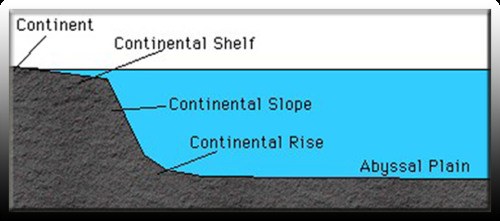
Label A
a)
continental slope
b)
continental shelf
c)
abyssal plain
d)
sea mount
8.
Label B
a)
continental slope
b)
continental shelf
c)
abyssal plain
d)
sea mount
9.
Label C
a)
continental slope
b)
continental shelf
c)
abyssal plain
d)
sea mount
10.
Label E
a)
continental slope
b)
volcanic island
c)
abyssal plain
d)
sea mount
11.
Label F
a)
continental slope
b)
continental shelf
c)
abyssal plain
d)
sea mount
12.

When we go to beach, we are on which of the following?

a)

continental slope

b)

continental shelf

c)

abyssal plain

d)

sea mount

13.

A shallow area of sediment near the shore...

a)

Continental Shelf

b)

Ocean Trench

c)

Continental Slope

d)

Abyssal Plain

14.

Which of these are the deepest parts of the oceans?

a)

Continental Shelf

b)

Abyssal Plain

c)

Ocean Trench

d)

Continental Rise

15.

Which ocean floor feature is the steep cliff-like drop beyond the continental shelf?

a)

Continental Shelf

b)

Continental Slope

c)

Abyssal Plain

d)

Ocean Trench

16.

Where are you walking when you are wading in the ocean?

a)

Ocean Trench

b)

Abyssal Plain

c)

Continental Slope

d)

Continental Shelf

17.

Wind causes waves?

a)

True

b)

False

18.
The currents of the Earth's oceans are caused by 
a)
marine organisms and volcanic eruptions.
b)
global winds and differences in temperature and salinity.
c)
waves and earthquakes along tectonic plate boundaries.
d)
disturbances by submarines and large ships
19.
What does an ocean’s salinity refer to?
a)
the depth of the ocean trenches.
b)
the height of the waves. 
c)
the temperature level of the water.
d)
the level of minerals in the water.
20.

What is a tide?

a)

laundry detergent

b)

repeated movement of water

c)

ongoing movement of water

d)

the rise and fall of the ocean's surface

21.

What is a current?

a)

moon's gravity

b)

the ongoing movement of the ocean's water

c)

the space between a barrier island

d)

a big wave

22.

the gravitational pull from the moon causes....

a)

children to go crazy

b)

tides

c)

waves

d)

oceans

23.

flowing streams of water that continually move through the ocean in a certain direction are _______________.

a)

currents

b)

waves

c)

tides

d)

tears from narwhals and sea monsters
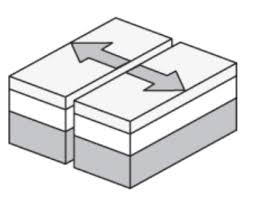
24.
What is a divergent plate boundary?
a)
A boundary between two plates that are moving apart
b)
A boundary between two plates that are crashing together
c)
A boundary between two plates that are sliding past each other
d)
A boundary between two plates that are not moving
25.
Name the boundary
a)
convergent boundary
b)
divergent boundary
c)
transform boundary
d)
sergent boundary
26.
Name the boundary
a)
convergent boundary
b)
divergent boundary
c)
transform boundary
d)
sergent boundary
27.
Name the boundary
a)
convergent boundary
b)
divergent boundary
c)
transform boundary
d)
sergent boundary
28.
Transform boundaries are most likely to produce what phenomenon?
a)
volcanoes
b)
deep sea trenches
c)
underwater mountain ranges
d)
earthquakes
29.

Which type of plate boundary sometimes results in the formation of lakes and seas?

a)

Convergent

b)

Divergent

c)

Transform

30.
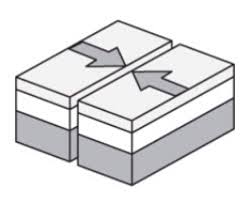
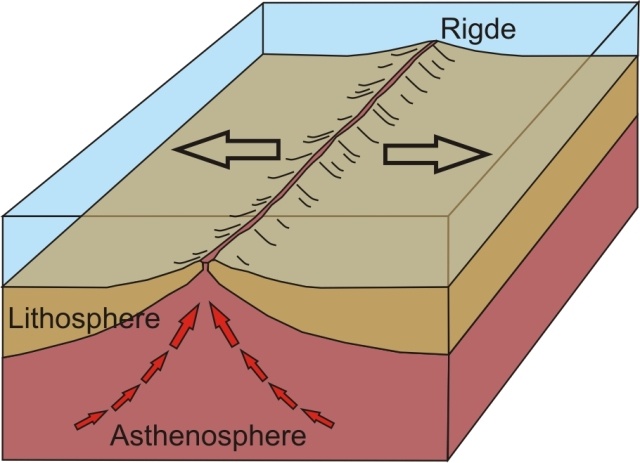
What kind of plate boundary is shown here?
a)
divergent
b)
convergent
c)
transform
d)
subducting
31.
What kind of plate boundary is shown here?
a)
divergent
b)
convergent
c)
transform
d)
submergent
32.
What kind of plate boundary is shown here?
a)
divergent
b)
convergent
c)
transform
d)
strike slip
33.
What geologic feature/event you be most likely to find at a transform boundary?
a)
Earthquakes
b)
Volcanoes
c)
Mountains
d)
Rift Valleys
34.
In which type of boundary do the plates move away from each other?
a)
convergent
b)
normal
c)
divergent
d)
transform
35.
The area where two or more plates meet is called a __________________.
a)
fault
b)
plate boundary
c)
plate edge
d)
ring of fire
36.
Plates slide past one another at ____________ boundaries.
a)
divergent
b)
convergent
c)
transform
d)
submergent
37.
Plates slide past one another at ____________ boundaries.
a)
divergent
b)
convergent
c)
transform
d)
submergent