
 Worksheets
Density and Solar System Review
Total questions: 35
Worksheet time: 23mins
Name
Class
Date
1.
A can of Coke will sink in a bowl of water. A can of Diet Coke will float in a bowl of water. What does this tell you about the density of the Diet Coke?
a)
it is bigger than 1
b)
it is smaller than 1
c)
it is equal to 1
d)
it is equal to -1
2.
The following liquids are poured together in a beaker: alcohol (density=0.79), corn syrup (density=1.38), water (density=1.0), and cooking oil (density=0.93). Which of these liquids will sink to the bottom of the beaker?
a)
alcohol
b)
corn syrup
c)
water
d)
cooking oil
3.
What is the density of a liquid that has a mass of 27g and a volume of 30ml?
a)
0.9 g/ml
b)
3 g/ml
c)
57 g/ml
d)
810 g/ml
4.
Jack has a rock. The rock has a mass of 14g and a volume of 2cm3. What is the density of the rock?
a)
7 mL
b)
7 g/cm3
c)
28 g/cm3
d)
1/7 g/cm3
5.
Which units of measurement are used for volume?
a)
grams
b)
centimeters
c)
grams/milliliter
d)
milliliter
6.

What is the volume of Object X?
a)
10.0 cm3
b)
15.0 cm3
c)
20.0 cm3
d)
25.0 cm3
7.
True or False: The density of a specific type of material never changes.
a)
True
b)
False
8.

I have two objects with the same volume but different masses. Which object will be more dense?
a)
The object with less weight.
b)
The object with more weight.
c)
The object with more mass.
d)
The object with less mass.
9.
What is the formula for density?
a)
density = mass x volume
b)
density = mass / volume
c)
density = mass + volume
d)
density = mass - volume
10.
Frank has an eraser. It has a mass of 4g, and a volume of 2cm3. What is its density?
a)
8 g/cm3
b)
2 g/cm3
c)
1/2 g/cm3
d)
24 g/cm3
11.
___________ is a force of attraction between two or more objects with mass.
a)
gravity
b)
speed
c)
energy
d)
simple machines
12.
The farther apart two objects move, the _____ their gravitational attraction becomes.
a)
stonger
b)
weaker
13.
Earth is very massive, so it has a _________ gravitational pull.
a)
strong
b)
weak
14.
__________ is a measure of the amount of matter in an object.
a)
Mass
b)
Weight
15.
_________ is a measure of the force of gravity on an object.
a)
Mass
b)
Weight
16.
If you weigh 100 pounds on Earth, you would weigh only 16.6 pounds on the ______.
a)
Jupiter
b)
Moon
c)
Sun
17.
Weight depends on _________ of the object which attracts it.
a)
gravitational pull
b)
Galilean Moons
c)
size
18.
________ remains the same regardless of where a person (or object) is in space.
a)
mass
b)
weight
19.
Because the Sun is the most massive object in the solar system, it has the ____________ gravitational pull.
a)
strongest
b)
weakest
20.
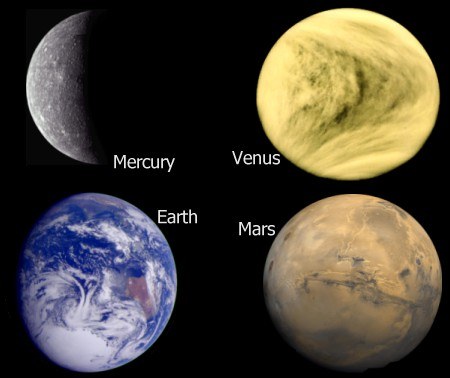
Earth and the other planets closest to the Sun are made mostly of _______
a)
gas
b)
metal
c)
water
d)
rock
21.

The __________ has planets, moons, comets, and asteroids.
a)
solar system
b)
earth
c)
rotation
d)
United States
22.
One of the main differences between the outer and inner planets is __________.
a)
The inner planets all have water
b)
the inner planets are much bigger than the outer planets
c)
the outer planets are gas planets
d)
the outer planets have rings, and the inner planets don't
23.

Where is the asteroid belt found?
a)
between earth and mars
b)
Between Uranus and Neptune
c)
Between Mercury and Venus
d)
Between Mars and Jupiter
24.
A ball of ice and dust with a tail of gas and dust pointing away from the sun.
a)
Asteroid
b)
Comet
c)
Moon
d)
Meteor
25.
A small rocky object orbiting the sun.
a)
Asteroid
b)
Comet
c)
Moon
d)
Meteor
26.
The four inner planets are...
a)
Rocky and small
b)
Very large and made of ice
c)
Small and made of ice
d)
Very large and made of gases
27.
What holds the planets in their orbits around the sun?
a)
gravity
b)
speed
c)
string
d)
air currents
28.

The time it takes a planet to ORBIT around the Sun ONE time is called ...
a)
One day
b)
one week
c)
one month
d)
one year
29.

The time it takes a planet to SPIN AROUND on its axis (rotate) ONE time is called a ...
a)
one day
b)
one week
c)
one month
d)
one year
30.
Which of these solar system objects does NOT orbit the Sun?
a)
planet
b)
comet
c)
moon
d)
asteroid
31.
What keeps ALL of the objects in motion around our solar system?
a)
Gravity from the Earth
b)
Gravity from the Sun
c)
Gravity from Jupiter
d)
gravity from a black hole
32.
What object(s) can be found between Mars and Jupiter, can be very large, made of rock or metal. and orbit the sun?
a)
comets
b)
meteoroids
c)
asteroids
d)
moons
33.
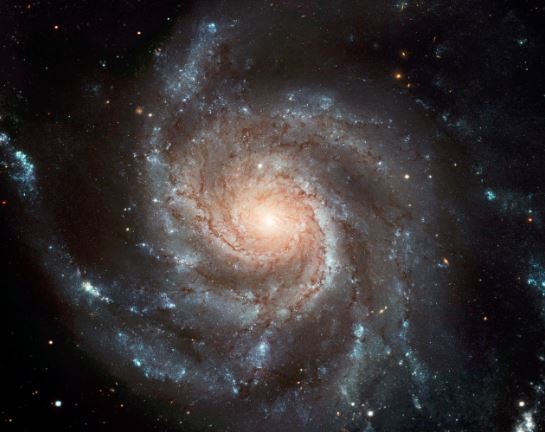
Without gravity the stars in the galaxy would
a)
continue to orbit in a circle
b)
move in a random direction
c)
move in a straight line
34.

Without gravity the moon would
a)
go around the Earth
b)
collide with Earth
c)
move in a straight line
35.

The gravitational force of the sun causes the planets to orbit around it.
a)
True
b)
False
100 %

