wayground logo

Free Printable Worksheets

Font size

S
M
L
XL
Worksheets

8th Grade Art (B Day 2018)

Total questions: 50

Worksheet time: 25mins

Name
Class
Date
1.
The elements of art are:
a)
the way art is arranged
b)
pure chemical substances used in art
c)
the building blocks of art
d)
pens, pencils, paint, ect...
2.
A line is a mark with 
a)
length and direction
b)
width and height
c)
dots and squiggles
d)
ink or pencil
3.
What you see when you look at an artwork is called the:
a)
theme
b)
subject
c)
background
d)
picture
4.
The relative lightness or darkness of an object is:
a)
texture
b)
color
c)
contrast
d)
value
5.
The main idea of an artwork is called the
a)
frame
b)
theme
c)
subject
d)
purpose
6.
The two categories of texture are:
a)
sharp and soft
b)
fluffy and rough
c)
visual and actual
d)
bumpy and smooth
7.
What kind of space does this image show?
a)
shallow space
b)
outer space
c)
deep space
d)
inter space
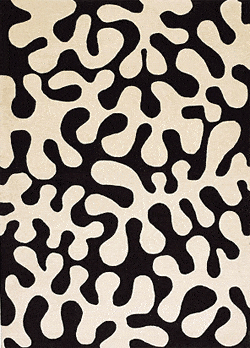
8.
What phrase best describes this image?
a)
geometric forms
b)
geometric shapes
c)
organic shapes
d)
organic forms
9.
The area around, above or inside an object is called:
a)
form
b)
perspective
c)
contrast
d)
space
10.
Which of these is not an example of art media?
a)
clay
b)
oil paint
c)
paint brush
d)
marble
11.
The negative space of an artwork is usually located where?
a)
background
b)
foreground
c)
the important parts of an artwork
d)
inside the positive space
12.
Shapes are
a)
the form of an object
b)
two-dimensional
c)
three-dimensional
d)
open spaces
13.
This image shows an example of:
a)
shallow space
b)
outer space
c)
inter space
d)
deep space
14.
This image shows an example of what?
a)
light values
b)
dark values
c)
immoral values
d)
righteous values
15.
This image shows an example of:
a)
Light values
b)
Expensive values
c)
Darn good values
d)
Dark values
16.
Which letter shows an example of negative space?
a)
S
b)
H
c)
I
d)
F
17.
A three-dimensional object is called:
a)
a square
b)
a mold
c)
a form
d)
a circle
18.
This image shows an example of:
a)
visual texture
b)
actual texture
c)
slippery texture
d)
soft texture
19.
What is the subject of this artwork?
a)
interior
b)
still life
c)
portrait
d)
landscape
20.
Using a variety of thin and thick lines is called:
a)
interest
b)
line variation
c)
line definition
d)
value
21.
Lines that follow the outer edges of an object are:
a)
Crispy Lines
b)
Cross-hatching
c)
Contour Lines
d)
Carbon Lines
22.
When you create a blind contour drawing you don't: 
a)
look at the paper
b)
look at anything
c)
use your imagination
d)
draw any lines
23.
This image shows an example of:
a)
line variation
b)
contour lines
c)
low contrast
d)
high contrast
24.
A small difference between values is called:
a)
value scale
b)
low contrast
c)
dark values
d)
high contrast
25.

The subject of an artwork is like a

a)

big idea

b)

genre

c)

theme

d)

frame

26.

Which of these is NOT a possible theme?

a)

identity

b)

power

c)

love

d)

portrait

27.

The language used to communicate in art.

a)

Elements

b)

Middle Ground

c)

Line

d)

Color Wheel

28.

A mark made by a point moving across a surface.

a)

Organic Shape

b)

Line

c)

Hue

d)

Geometric Shape

29.

Shapes that are found in nature.

a)

Shape

b)

Actual Texture

c)

Organic Shape

d)

Implied Texture

30.

Shapes that are mathematical.

a)

Form

b)

Texture

c)

Geometric Shapes

d)

Background

31.

An area that has height and width.

a)

Value

b)

Positive Space

c)

Shading

d)

Shape

32.

Has height, width, and depth.

a)

Form

b)

Space

c)

Primary Colors

d)

Secondary Colors

33.

The lightness or darkness of a color.

a)

Elements

b)

Value

c)

Middle Ground

d)

Color Wheel

34.

A gradual change from light to dark.

a)

Line

b)

Shading

c)

Hue

d)

Organic Shape

35.

The colors mixed to make all other colors.

a)

Geometric Shapes

b)

Actual Texture

c)

Primary Colors

d)

Shape

36.

Colors made my mixing two primary colors.

a)

Form

b)

Implied Texture

c)

Value

d)

Secondary Colors

37.

The area around, above, between, inside, or below objects.

a)

Space

b)

Line

c)

Color Wheel

d)

Geometric Shapes

38.

The area occupied by an object.

a)

Form

b)

Positive Space

c)

Actual Texture

d)

Shading

39.

The objects that are farthest away from the viewer.

a)

Secondary Colors

b)

Background

c)

Positive Space

d)

Space

40.

The way something feels or looks like it feels.

a)

Texture

b)

Organic Shape

c)

Hue

d)

Form

41.

The way something looks like it feels.

a)

Primary Colors

b)

Implied Texture

c)

Space

d)

Texture

42.

Another name for color.

a)

Geometric Shapes

b)

Shading

c)

Positive Space

d)

Hue

43.

Shows relationship between colors.

a)

Middle Ground

b)

Shape

c)

Secondary Colors

d)

Color Wheel

44.

The section between the foreground and the background.

a)

Implied Texture

b)

Form

c)

Middle Ground

d)

Background

45.

What's this?

a)

It's a painting.

b)

It's a sculpture.

c)

It's a drawing.

46.

What are they doing?

a)

They're making a sculpture.

b)

They're playing an instrument.

c)

They´re dancing.

47.

Line is

a)

the lightness or darkness of a color or shade

b)

something that goes straight in either direction forever

c)

a moving point

d)

a Principle of Design

48.

Which is NOT an Element of Art?

a)

Line

b)

Balance

c)

Shape

d)

Value

49.

The Principles of Design are:

a)

The building blocks of Art

b)

The rules of art

c)

The materials used to make art

d)

The place you go to look at art

50.

One way to show space in an artwork is:

a)

add complementary colors

b)

add light and dark values

c)

add patterns to shapes

d)

add foreground, middleground, background