Wayground logo

Free Printable Worksheets

Font size

S
M
L
XL
Worksheets

Geometry Final Review Part 2

Total questions: 78

Worksheet time: 2hrs 41mins

Name
Class
Date
1.
a)

A

b)

B

c)

C

d)

D

2.
a)

A

b)

B

c)

C

d)

D

3.

Given angle 1 is congruent to angle 2, Why are the lines parallel?

a)

Converse of Corresponding angles

b)

Converse of Alternate interior angles

c)

Converse of Same Side Interior angles

d)

Converse of vertical angles

4.

Why is line OJ parallel to line MK?

a)

Converse of Corresponding Angles

b)

Converse of Alternate Interior angles

c)

Converse of Same Side interior Angles

d)

They are not parallel

5.

Why is line m parallel to line n?

a)

Converse of Corresponding angles

b)

Converse of Alternate Interior Angles

c)

Converse of Same Side interior Angles

d)

Converse of Vertical angles

6.
Find HG
a)
28
b)
14
c)
41
d)
7
7.
Find SV
a)
18
b)
36
c)
21
d)
9
8.
Find LK
a)
3
b)
5
c)
-3
d)
6
9.
Find AD AND BC
a)
5;12
b)
16;4
c)
12; 16
d)
5;16
10.
What is the length of DC
a)
4
b)
1
c)
2
d)
3
11.
Name that shape. 
a)
square
b)
square
rhombus
c)
quadrilateral
parallelogram
rhombus
d)
quadrilateral
parallelogram
square
12.
Name that shape.
a)
trapezoid
b)
quadrilateral
c)
parallelogram
d)
rhombus
13.
Name that shape.
a)
quadrilateral, rectangle
b)
quadrilateral, rectangle, square
c)
quadrilateral, parallelogram, rectangle
d)
quadrilateral, parallelogram, rectangle, square
14.
A __________________ is always a rhombus, but a rhombus is not always a _______________. 
a)
kite
b)
parallelogram
c)
square
d)
rectangle
15.
If a quadrilateral has 4 equal sides, then it is a square. 
a)
TRUE
b)
FALSE
16.
A trapezoid is a quadrilateral with exactly ONE set of parallel sides. 
a)
TRUE
b)
FALSE
17.
A __________________ is a quadrilateral with two sets of parallel sides and 4 right angles.
a)
trapezoid
b)
parallelogram
c)
rectangle
d)
square
18.
A quadrilateral with two sets of parallel sides, 4 right angles, and 4 congruent (equal) sides is a __________________.
a)
trapezoid
b)
parallelogram
c)
rectangle
d)
square
19.
A ___________ is a quadrilateral with two sets or parallel sides and 4 congruent (equal) sides. 
a)
trapezoid
b)
rhombus
c)
parallelogram
d)
rectangle
20.
A _______________ is a quadrilateral with two sets of parallel sides.
a)
trapezoid
b)
parallelogram
c)
kite
d)
triangle
21.
I have 2 adjacent sides of equal length, what am I?
a)
a trapezoid
b)
a rectangle
c)
a kite
d)
a pentagon
22.
Find the measure of  angle b.
a)
b=51
b)
b=129
c)
180
23.
Is there enough information to determine that this quadrilateral is a parallelogram?
a)
yes
b)
no
24.
Is there enough information to determine that this quadrilateral is a parallelogram?
a)
yes
b)
no
25.
Is there enough information to determine that this quadrilateral is a parallelogram?
a)
yes
b)
no
26.
Is there enough information to determine that this quadrilateral is a parallelogram?
a)
yes
b)
no
27.
Figure A is a...
a)
Rectangle
b)
Square
c)
Rhombus
28.

Is this a parallelogram? How do we know?

a)

yes,opposite sides are congruent

b)

no we can not prove it is a parallelogram

c)

yes, one pair of sides are congruent and parallel

d)

yes, opposite sides are parallel

e)

yes, diagonals bisect each other

29.
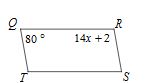
The figure is a parallelogram.  
Solve for x.  
a)
7
b)
2
c)
0
d)
4
30.
The figure is a parallelogram.  
Solve for x.  
a)
7
b)
1
c)
5
d)
2
31.
Solve for the variables.
a)
m=68, n=70
b)
m=35, n=70
c)
m=35, n=110
d)
m=68, n=110
32.
What is the value of x?
a)
4
b)
360
c)
12
d)
6
33.
How many degrees are in the shape?
a)
180
b)
360
c)
80
d)
100
34.
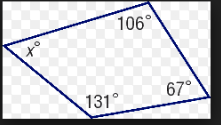
What is the value of the missing angle in this quadrilateral?
a)
56 degrees
b)
67 degrees
c)
304 degrees
d)
360 degrees
35.
Where would A' be if you translated A 3 units to the right and 4 units down?
a)
(-4, 4)
b)
(-1, 0)
c)
(0, -1)
36.
What transformation is happening?
(x, y) ----> (x + 2, y - 3) 
a)
slide up 2, left 3
b)
slide right 2, up 3
c)
slide right 2, down 3
d)
slide left 3, right 2
37.
What rule describes the translation?
a)
(x - 6, y + 2)
b)
(x - 2, y + 6)
c)
(x + 2, y - 6)
d)
(x + 6, y - 2)
38.
Determine where T' would be if you translated T 3 units to the right and 6 units up.
a)
(5, 1)
b)
(2, -5)
c)
(-1, 1)
d)
(8, -2)
39.
What does a translation do to an image?
a)
Turns it 90* clockwise
b)
Mirrors it
c)
Shrinks it
d)
Slides it
40.
Write the rule for this translation:
Slide 3 up and 2 right
a)
(x, y)---->(x + 3, y + 2)
b)
(x, y)-----> (x+2, y + 3)
c)
(x, y)----> (x - 2, y + 3)
41.
If the dotted figure is the image, the original figure was reflected over the ...
a)
x-axis
b)
y-axis
42.
What is the Algebraic Notation for this Reflection?
a)
(x, y) → (y, x)
b)
(x, y) → (-x, y)
c)
(x, y) → (-y, -x)
d)
(x, y) → (x, -y)
43.
Which answer shows a reflection across the x-axis?
a)
d
b)
c
c)
b
d)
a
44.
What is a reflection?
a)
When you turn an object around a point.
b)
When you slide an object form one place to another.
c)
When you flip or mirror an object across a line.
d)
When you resize an object.
45.
Reflecting over the y-axis changes the ____-_____________. 
a)
x-axis
b)
x-coordinate
c)
y-coordinate
d)
none of the above
46.
A type of transformation where a geometric figure slides horizontally, vertically, or both. What type of transformation is this? 
a)
dilation
b)
translation
c)
rotation
d)
reflection
47.
Reflections over the x-axis change the ____-__________. 
a)
y-coordinate
b)
x-coordinate
c)
y-axis
d)
x-axis 
48.
Identify the transformation.
a)
Reflection across y axis
b)
Reflection across x-axis
c)
180 Rotation
d)
Translation 2 units down
49.
What is the sequence of transformations for the image given? 
a)
Reflect over the x-axis, translate (x+8,y)
b)
Reflect over the x-axis then translate (x+6, y)
c)
Reflect over the y-axis then (x+1, y+1)
d)
Translate down 4 (y-4) and to the right 5 (x+5)
50.
Which of the following lines goes through the point (0, 4) and is parallel to y = 5x - 3?
a)
y = 1/5x - 3
b)
y= 5x - 7
c)
y = 5x + 4
d)
y = -5x - 3
51.
Which of the following lines goes through the point        (-3, 4) and is perpendicular to  y = 3/2x + 6?
a)
y = 3/2x - 6
b)
y = 2/3x + 3
c)
y = -2/3x - 2
d)
y = -2/3x + 2
52.
Given the line 2x-3y=9, write the equation of a line parallel to it that passes through the point (4, -1)
a)
y = 2/3x - 3
b)
y = 2/3x - 11/3
c)
y = 2/3x - 4
d)
y = 2/3x - 5/3
53.
Line m contains the points (-3, 4) and (1, 0). Write the equation of a line that would be parallel to this one, and pass through the point (-2, 6).
a)
y = -x + 4
b)
y = x + 6
c)
y = 3x - 5
d)
y = 2x 
54.
Which formula should be used to prove lines are parallel or perpendicular?
a)
Distance Formula
b)
Slope Formula
c)
Midpoint Formula
d)
Pythagorean Theorem
55.
What formula do we use to find the length of a side of a figure?
a)
Midpoint Formula
b)
Slope Formula
c)
Pythagorean Theorem
d)
Distance Formula
56.
How do you prove a quadrilateral is a parallelogram?
a)
Both pairs of opposite sides are congruent
b)
Diagonals are congruent
c)
One pair of opposite sides are congruent 
d)
Both pairs of opposite sides are congruent and diagonals are congruent
57.
How do you prove a quadrilateral is a Rectangle?
a)
Both pairs of opposite sides are congruent
b)
Diagonals are congruent
c)
One pair of opposite sides are congruent 
d)
Both pairs of opposite sides are congruent and diagonals are congruent
58.
How do you prove a quadrilateral is a Square?
a)
All sides are congruent
b)
Diagonals are congruent
c)
All sides are congruent and diagonals are congruent
d)
All sides are parallel
59.
How do you prove a quadrilateral is a Trapezoid?
a)
All sides are congruent
b)
Both pairs of opposite sides are parallel
c)
One pair of opposite sides are parallel and the other pair is not parallel
d)
One pair of congruent sides
60.
How do you prove a quadrilateral is an Isosceles Trapezoid?
a)
One pair of sides is parallel
b)
One pair of sides is parallel and the non parallel sides are congruent
c)
Opposite sides are congruent
d)
Show the figure has 4 sides
61.
How do you prove a quadrilateral is a Rhombus?
a)
All sides are congruent
b)
Diagonals are congruent
c)
All sides are congruent and diagonals are congruent
d)
All sides are parallel
62.
How do we prove a triangle is an isosceles triangle?
a)
Prove all sides are different lenghts
b)
Show that the three sides satisfy the pythagorean theorem
c)
Show that opposite angles are congruent
d)
Show that two sides are congruent
63.
How do we prove a triangle is a right triangle?
a)
Prove all sides are different lenghts
b)
Show that the three sides satisfy the pythagorean theorem
c)
Show that opposite angles are congruent
d)
Show that two sides are congruent
64.
Fill in the missing proofs.
a)
Transitive Property, SAS(Side-Angle-Side)
b)
Reflexive Property, SAS(Side-Angle-Side)
c)
Reflexive Property, Vertical Angles Thm.
d)
Transitive Property, SSS(Side-Side-Side)
65.
a)
Transitive Property, SAS(Side-Angle-Side)
b)
Reflexive Property, SAS(Side-Angle-Side)
c)
Transitive Property, SSS(Side-Side-Side)
d)
Reflexive Property, SSS(Side-Side-Side)
66.
What is the "statement" for step 3 of the proof? 
a)
∡EDA≅∡DCB
b)
∡AED≅∡BEC
c)
DE=CE
d)
∡AED≅∡CED
67.
What is the "statement" for step 3 of the proof?
a)
HA=HA
b)
HA=AH
c)
MA=AM
d)
MA=MA
68.
What is the reason?
a)
Transitive 
b)
Substitution
c)
Middle Man
d)
Replacing 
69.
What is the reason?
a)
Definition of Complementary
b)
Definition of 180 
c)
Definition of supplementary
d)
Angle Addition
70.

What is the reason?

a)

Definition of complementary

b)

Definition of supplementary

71.
Which property justifies the next step?
a)
Segment addition postulate
b)
Definition of an angle bisector
c)
Angle addition postulate
d)
Definition of right angles
72.
What is always the 1st statement in reason column of a proof?
a)
Prove
b)
Given
c)
Reason
d)
Statement
73.

What do you never write as a statement or reason for your proof?

a)

Prove

b)

Prove

c)

Prove

d)

Prove

74.
When do you use "CPCTC in a proof?
a)
ALWAYS at the beginning
b)
ALWAYS at the end
c)
It's optional
d)
NEver
75.
Fill in the blank.
a)
Given
b)
Reflexive Property
c)
Transitive Property
d)
They're the same side!!!!!! 
76.
Fill in the missing proofs.
a)
Transitive Property, SAS(Side-Angle-Side)
b)
Reflexive Property, SAS(Side-Angle-Side)
c)
Reflexive Property, Vertical Angles Thm.
d)
Transitive Property, SSS(Side-Side-Side)
77.
What is the reason?
a)
Definition of perpendicular
b)
Definition of Right angle
c)
Definition of 90 
d)
Definition of angle
78.
What is the "reason" for step 3 of the proof?
a)
Vertical Angle Theorem
b)
given
c)
reflexive property
d)
proof