
 Worksheets
Natural Selection and Selective Breeding
Total questions: 26
Worksheet time: 27mins
Name
Class
Date
1.
Where the better adapted organisms survive to pass traits along to offspring.
a)
Evolution
b)
Natural Selection
c)
Extinction
d)
Artifical Selection
2.
What is the advantage of having different shaped beaks?
a)
To look different from other species.
b)
To be able to eat the food readily available in the environment.
c)
To protect itself against predators.
d)
To protect itself against prey.
3.
The theory of evolution by natural selection means that what is changing over time?
a)
The inherited traits of a population.
b)
The acquired traits of a population.
c)
Hair color and eye color
d)
Attractive features.
4.
Why are advantageous traits more likely to be passed onto offspring?
a)
Because they are more likely to survive and reproduce.
b)
Because they come from dominant alleles.
c)
Because they come from recessive alleles.
d)
Because the trait is an acquired phenotype.
5.
The differences among a species, like different bird beaks, are called
a)
genes.
b)
variations.
c)
traits.
d)
theories.
6.
Do organisms "decide" to evolve and change?
a)
Yes, they know they need to change to survive
b)
No, they change because of natural selection
7.
Which organisms are most likely to survive?
a)
the best adapted
b)
the fastest
c)
the strongest
d)
the most domesticated (tamed)
8.
What word describes a trait that helps an organism survive in its environment?
a)
natural selection
b)
mutation
c)
camouflage
d)
adaptation
9.
The differences among a species, like different bird beaks, are called
a)
genes.
b)
variations.
c)
traits.
d)
theories.
10.
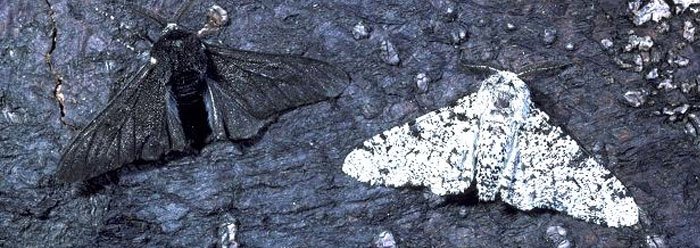
The trees these moths used to live on were white, but have been covered in soot from coal factories. Which moth will be more successful in this environment?
a)
Dark moth
b)
Light moth
c)
Both will be equally successful
d)
Neither will be successful
11.

Since the 1800s humans have stopped burning coal, and the trees have returned to their original color. Which moth will be more successful in this environment?
a)
Dark moth
b)
Light moth
c)
Both will be equally successful
d)
Neither will be successful
12.

What process is being shown in this image?
a)
Variation
b)
Natural Selection
c)
Selective Breeding
d)
Homeostasis
13.
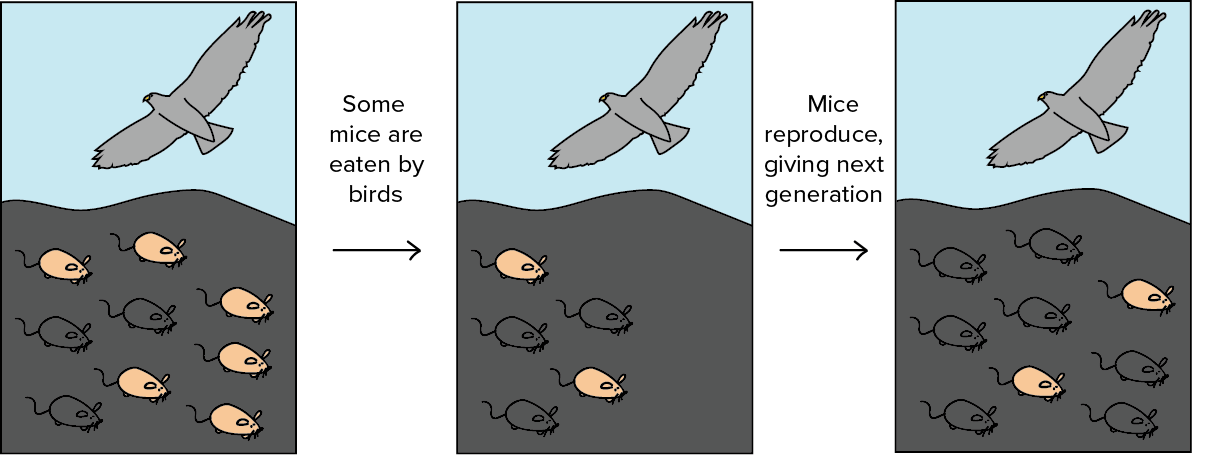
Why is the mouse population changing over time?
a)
The light mice can reproduce more successfully than the dark mice
b)
The hawks eat more dark mice than light mice because the dark mice taste better
c)
The hawks eat more light mice than dark mice because they can see the light mice more easily
d)
The hawks eat more dark mice than light mice because they can see the dark mice more easily
14.
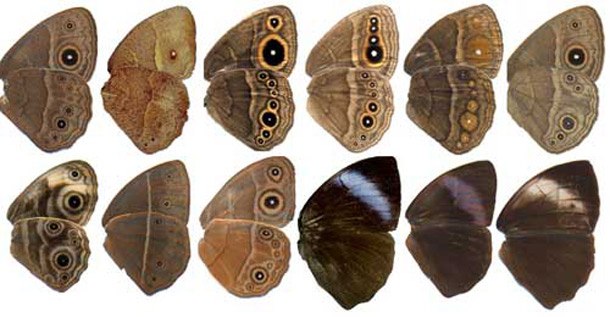
These moths are all the same species. The differences between their wings is an example of ________________
a)
Natural Selection
b)
Variation
c)
Homeostasis
d)
Extinction
15.
Organisms that are better adapted to the environment survive to pass traits to their offspring
a)
Natural Selection
b)
Homeostasis
c)
Selective Breeding
d)
Extinction
16.
Selective breeding is where ___________ decides which traits should be passed on
a)
Nature
b)
A human
c)
Mr. Holt
d)
The illuminati
17.
Natural selection is where ___________ decides which traits should be passed on
a)
Nature
b)
A human
c)
Mr. Holt
d)
The illuminati
18.
The more genetic variation a population has,
the more likely it is for some individuals to
a)
evolve
b)
migrate
c)
survive
d)
mutate
19.
Individuals that are well adapted to their environment will survive and produce:
a)
Fewer mutations
b)
Stronger genes
c)
More offspring
d)
Better traits
20.
According to the theory of natural selection, some individuals more likely than others to survive and reproduce because they:
a)
pass on to their offspring their newly acquired traits.
b)
are better adapted to their environment than others and will pass on those adaptations to future offspring.
c)
do not pass on newly acquired traits.
d)
produce fewer offspring than others in the same environment.
21.
Natural selection
a)
process by which individuals that are better suited to their environment survive and reproduce most successfully; also called survival of the fittest
b)
Humans select which animals live and die
c)
both
d)
IDK
22.
Intentional breeding of organisms with desirable traits so that offspring have similar desirable traits.
a)
Mutation
b)
Natural Selection
c)
Evolution
d)
Selective Breeding
23.
According to the theory of natural selection, what is likely to happen to a population of birds after the seeds they normally eat are no longer available and all that is left are seeds that are harder to crack open?
Note: a population is a group of individuals of the same species.
Note: a population is a group of individuals of the same species.
a)
The individual birds that already have the kind of beak that allows them to eat the seeds that are harder to crack open would be more likely to survive and reproduce.
b)
All of the individual birds would develop new beaks as they attempt to eat new seeds. All of the birds would survive and reproduce.
c)
Some of the individual birds would try to develop new beaks so that they could eat the seeds. Those birds would be more likely to survive and reproduce, and the other birds would likely die.
d)
Because the population of birds is all of the same species, they all have the same physical traits. No individual bird would have an advantage in cracking open the seeds, and all of the birds would die.
24.
Which of the following correctly describes what happens when a population of bacteria becomes resistant to an antibiotic?
a)
When subject to antibiotics, each bacterium tries to become resistant. Only some are able to do this and passes it on to their offspring.
b)
When subject to antibiotics, all bacteria become more resistant to it if they are exposed to it longer.
c)
When subject to antibiotics, most bacteria will die. Randomly some bacteria will become resistant and pass this on to their offspring.
d)
When subject to bacteria, only those individual bacteria that already have a trait that helps them survive the effects of the antibiotic will live and pass it on to their offspring.
25.
Natural selection is best described as...
a)
The ability to generate new adaptations that better suit the species.
b)
The mechanism that leads to perfect species.
c)
Variations of traits causes those better suited to the environment to survive and reproduce.
d)
Causing the death of a significant part of the population.
26.
Which population of organisms would be in greatest danger of becoming extinct?
a)
A population of organisms having few variations living in a stable environment.
b)
A population of organisms having few variations living in an unstable environment.
c)
A population of organisms having many variations living in a stable environment.
d)
A population of organisms having many variations living in an unstable environment.
100 %

