wayground logo

Free Printable Worksheets

Font size

S
M
L
XL
Worksheets

Ancient China

Total questions: 48

Worksheet time: 32mins

Name
Class
Date
1.

Which of these rivers is NOT located in China?

a)

Euphrates River

b)

Yellow River

c)

Yangzi River

d)

Xijiang River

2.

Line of rulers from the same family is a

a)

cultural diffusion

b)

dynasty

3.
Chinese philosophy developed by Hanfeizi; taught that humans are naturally evil and therefore need to be ruled by harsh laws
a)
Confucianism
b)
Daoism
c)
Legalism
d)
Mandate of Heaven
4.
A philosophy based on respect for elders and authority. 
a)
Daoism
b)
Legalism
c)
Confucianism
d)
Qin
5.
What were oracle bones used for?
a)
Cooking
b)
Telling stories
c)
Building the Great Wall of China
d)
Asking for advice from the gods
6.
Chinese philosophy based on the teachings of Laozi; taught that people should turn to nature and give up their worldly concerns
a)
Daoism
b)
Legalism
c)
Confucianism
d)
Zhou
7.
This belief stressed that people were bad by nature, and needed to be controlled and punished.
a)
Confucianism
b)
Daoism
c)
Legalism
8.
A system of beliefs based on the teachings of Confucius
a)
Buddhism
b)
Legalism
c)
Daoism
d)
Confucianism
9.

Why did Qin Shi huangdi build the Great Wall of China?

a)

For shelter

b)

For protection from invaders from the north

c)

For decoration

d)

For fun

10.
Which one of these achievements was Shi Huangdi responsible for?
a)
Standardized writing, measurement and currency
b)
Built the Great Pyramids
c)
Founded Islam
d)
Founded Christianity
11.
Buddhism spreading from India along the Silk Road is an example of
a)
Christianity
b)
cultural diffusion
c)
Legalism
d)
filial piety
12.
How was Chinese civilization affected by mountains and deserts?
a)
They became wealthy.
b)
They were isolated from other civilizations.
c)
They made it easier to travel.
d)
They made China easy to be attacked.
13.
The Silk Road refers to...
a)
A giant factory where silk is made
b)
A road made of a stringy material
c)
A religious path
d)
A series of trade routes between Asia and Europe
14.
Legalism, Confucianism, and Daoism are religions
a)
True
b)
False
15.

Why did Qin Shi Huang burn all of the books

a)

So that the people could lean only about him

b)

So that there was no idea of rebellion
16.
What did Emperor Qin build that allowed no one to leave, or invade, for thousands of years?
a)
a statue of himself
b)
a fortress
c)
The Great Wall
d)
a model of a dinosaur
17.
What was the natural border of China that was a mountain range?
a)
Rocky Mountains
b)
Himalayan Mountains
c)
Appalachian Mountains
d)
Sierra-Nevada Mountains
18.
Confucius a very famous ____________, in Ancient China
a)
emperor
b)
philosopher
c)
army leader
d)
god
19.
What is a contribution from Ancient China?
a)
silk
b)
spices
c)
bronze
d)
all of them
20.
Along what river did China's earliest civilizations develop?
a)
Huang He (Yellow)
b)
Indus
c)
Yangtze
d)
Nile
21.
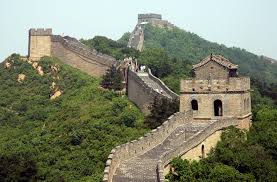
What is the purpose of the structure pictured here?
a)
It is a temple
b)
To protect China's northern border
c)
To protect China's Southern border
d)
To protect China from India 
22.
The Shang and Zhou kings used the Mandate of ______ to prove that God had chosen them to rule.
a)
Gods
b)
Heaven
c)
Kings
d)
Men
23.
What is the central idea of Daoism
a)
Duty to community
b)
Living in harmony with nature
c)
Enforcing laws with harsh punishments
d)
Humans are naturally evil
24.
The main river in China is __________. 
a)
Mississippi
b)
Huang He
c)
James
d)
Rio Grande
25.

What was the name of China's first dynasty with written evidence?

a)

Shang

b)

Zhou

c)

Hanfeizi

d)

Xia

26.
Which is an example of Ancient Chinese architecture?
a)
Pyramids
b)
Teepee's
c)
The Great Wall
d)
School
27.
________________________ is a type of cloth invented by the Ancient Chinese. 
a)
Cotton
b)
Silk
c)
Jeans
28.
What is an empire?
a)
land under the rule of one leader
b)
a government that is based on religion
c)
a democracy
d)
a group of people who ruled together
29.
The belief that the Chinese king’s right to rule came from the gods
a)
Confucianism
b)
Mandate of Heaven
c)
dynasty
d)
Daoism
30.
Why did the Emperor of Qin order all Confucian books brought to the capital?
a)
so he could destroy them
b)
so he could learn from them 
c)
so he could start a new library
d)
so he could have them translated to the common language
31.
Why was the Great Wall of China built? 
a)
to protect China from natural disasters
b)
to serve as a boundary between China and its neighbors
c)
to spread the ideas of Chinese culture
d)
to serve as a watchtower for scientists
32.
Why did the Silk Road develop?
a)
Trails were used for communication
b)
Certain resources were not available everywhere
c)
Travelers enjoyed exploring nearby lands
d)
People wanted to conquer lands
33.
How did the Silk Road effect China?
a)
China became wealthy
b)
China ended farmed
c)
China started a war
d)
China stopped trading
34.

Which of the following were traded on the Silk Road?

a)

Spices

b)

Religion

c)

Fabric

d)

All of the above

35.
What religion was spread to China on the Silk Road?
a)
Christianity
b)
Buddhism
c)
Islam
d)
Hinduism
36.
Pick a Chinese invention.
a)
School
b)
Paper
c)
Flag
d)
Crackers
37.

Civil servants were chosen based on

a)

status

b)

military ability

c)

knowledge

d)

where you live

38.

The seismograph was helpful because

a)

it helped determine the correct positioning for temples, graves, and homes

b)

carry water in buckets from the ditches to the fields

c)

extract salt from the Earth

d)

it can detect which direction an earthquake is coming from

39.
What was the army made of that Qin built to keep him from harm in the afterlife?
a)
Stone
b)
Terra Cotta
c)
Jade
d)
Copper
40.
What dynasty did the Qin defeat?
a)
Xia
b)
Shang
c)
Zhou
d)
Han
41.
The idea that all can rise to positions of power if they are good, moral and educated is most closely associated with which idea of philosophy?
a)
Legalism
b)
Confucianism
c)
The Mandate of Heaven
d)
Daoism
42.
Creator of the Han Dynasty
a)
Sima Qian
b)
Wudi
c)
Qin Shi Huangdi
d)
Liu Bang
43.

How was the Zhou dynasty similar to and different from the Shang dynasty?

a)

Same basic laws, similar clothing, same language, bronze art; differences were no human sacrifice or oracle bones.

b)

They both depended too much on nobles. But one dynasty was stronger than the other.

c)

They both worshiped the same gods and didn't travel much. But the Shang were better artists.

d)

Same types of art was created, and lived near the desert, but the Zhou didn't continue trade with the outside world.

44.
What metal was the Shang Dynasty known for using?
a)
Steel
b)
Bronze
c)
Jade
d)
Gold
45.
How did scholars learn that the Shang Dynasty was real and not just a myth?
a)
They read old books
b)
They found artifacts
c)
They learned the language
d)
They asked Chinese elders
46.
The Warring States Period was a time when China's states were fighting with each other for control.
TRUE or False
a)
True
b)
False
47.

Which of the following explains what led to the rise of the Zhou Dynasty?

a)

The Zhou Dynasty was also known as the Chou Dynasty

b)

The Shang People were tired of their cruel leaders

c)

People turned to the Zhou for protection

48.

Which dynasty took over after the fall of the Shang?

a)

Qin

b)

Han

c)

Zhou

d)

Ming