
 Worksheets
Asexual and Sexual Reproduction
Total questions: 12
Worksheet time: 9mins

___________________ is a type of asexual reproduction in which a piece of a parent organism breaks off to form an new organism (ex. starfish).
fission
budding
fragmentation
fertiliztion

When a single-celled organism splits into 2 new organisms it is called _________________.
fragmentation
fission
budding
sporulation
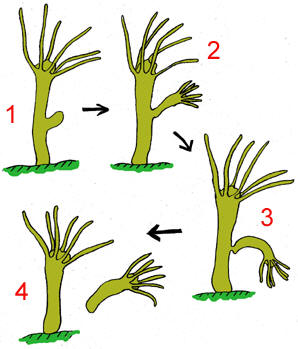
When an offspring grows off from the body of a parent organism it is called __________________.
budding
fission
fragmentation
sporulation
Some advantages of sexual reproduction include: (select all that apply)
genetic variation
improves chances of adapting to the environment
helps species survive catastrophes
it doesn't take as much energy as asexual reproduction
What are some disadvantages to sexual reproduction? (select all that apply)
it takes a lot of energy to find a mate
you don't need another mate
it requires a male and a female
more genetic errors can occur
What are some advantages of asexual reproduction are: (select all that apply)
it only requires one organism
it takes less energy than sexual reproduction
offspring are already well-adapted for the environment
there is a lot of genetic variety
Male and female reproductive cells are collectively known as:
spores
pollen
gametes
offspring
Genetically identical offspring are _____________ the parent organism.
opposite of
clones of
superior to
inferior to
____________________ occurs when a male gamete (sperm) combines with a female gamete (egg).
sporulation
fertilization
fission
regeneration
In fission, how does the DNA of the daughter cells compare to the DNA of the parent cell?
it is exactly the same
it is different due to meiosis
it is mostly the same with slight changes
it is better than the parent DNA
How many parents are required for sexual reproduction?
0
1
2
3
If a sex cell has 10 chromosomes, how many chromosomes will there be after fertilization?
5
10
15
20

