wayground logo

Free Printable Worksheets

Font size

S
M
L
XL
Worksheets

First Semester Science Review

Total questions: 33

Worksheet time: 1hrs 2mins

Name
Class
Date
1.

What is matter?

a)

The amount of matter in an object measured in grams

b)

Anything that has mass and takes up space

c)

The property of attraction to a magnet

d)

The classification of matter as a solid, liquid, or a gas

2.

What is the process called when a substance changes from a gas to a liquid?

a)

condensation

b)

evaporation

c)

melting

d)

none of the above

3.
How are liquids and gases different?
a)
liquids take shape, while gas has no definite shape
b)
Gas has definite shape, while liquid has no shape
c)
They are the same
4.

Mass, relative density, solubility, color, texture, state of matter, and conductivity are examples of:

a)

Physical states

b)

Insulators

c)

Physical properties

d)

Inferences

5.
What do sugar, salt, Kool-Aid powder, Crystal Light, etc., do in liquid water?
a)
turn into ice 
b)
remain in powder form 
c)
dissolve
6.
What is a conductor?
a)
A material that stops electric current from flowing
b)
A material that allows electric current to flow easily
7.
Which is an example of an insulator?
a)
Rubber
b)
Copper
c)
Iron
d)
Steel
8.

A combination of two or more substances that can be easily separated is called-

a)

a mixture

b)

a solution

c)

a solute

d)

a solvent

9.

A combination of two or more substances that cannot easily be separated--

a)

mixture

b)

solution

c)

solute

d)

solvent

10.

What would work best for separating the iron nails from the styrofoam balls and pebbles?

a)

coffee filter

b)

magnet

c)

boiling/evaporation

d)

spoon

11.

The energy associated with movement is called

a)

mechanical energy

b)

thermal energy

c)

electromagnetic energy

d)

chemical energy

12.
A lamp uses electrical energy to produce what two other kinds of energy?
a)
mechanical and sound
b)
heat and mechanical
c)
light and sound
d)
heat and light
13.
Which form of energy allows us to see our reflection in a mirror?
a)
Electrical
b)
light
c)
thermal
d)
mechanical
14.

The light ray striking the object is?

El rayo de luz que golpea el objeto es?

a)

absorbed

absorbar

b)

stopped

parar

c)

reflected

reflejar

d)

refracted

refractar

15.

What happens to light passing through a hand lens that makes the image of the penny appear larger?

¿Qué pasa con la luz que pasa a través de una lente de mano que hace que la imagen del penique parezca más grande?

a)

absorbed

absorbar

b)

reflected

reflejar

c)

refracted

refractar

d)

stopped

parar

16.

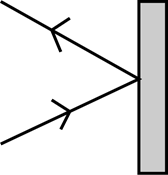
Reflection or refraction?

¿reflexión o refracción?

a)

Reflection

el reflejo

b)

Refraction

la refracción

17.

Reflection or refraction?

¿reflexión o refracción?

a)

Reflection

el reflejo

b)

Refraction

la refracción

18.

Reflection or refraction?

¿reflexión o refracción?

a)

Reflection

el reflejo

b)

Refraction

la refracción

19.

Which word describes a push or pull on an object?

a)

Position

b)

Hypothesis

c)

Mass

d)

Force

20.
A polar bear slides down an ice covered hill. As he slides, he slows down. Eventually he comes to a stop. What force  acts on an object to slow or stop its motion?
a)
Speed
b)
Friction
c)
Gravity
d)
Direction
21.
A boy applies a pushing force on a ball thrown into the air. What applies a pulling force on the ball at the same time?
a)
Gravity
b)
The height of the boy
c)
Friction
d)
The mass of the ball
22.
When designing an experiment, why is it important to test only one variable?
a)
Testing one variable explains what  caused the change once data has been gathered.
b)
Testing one variable collects inaccurate data and repeats the investigation more than necessary.
c)
Testing one variable decreases the reliability of the investigation.
d)
It is not necessary to test only one variable.
23.
When conducting an experiment, in order to get reliable results, it is important to:
a)
Disregard results that do not match your hypothesis
b)
Test many different variables at the same time
c)
Test all forces at the same time
d)
Repeat the investigation several times
24.
What causes the pressure necessary to form sedimentary rocks?
a)
Chemicals in the rock
b)
Temperatures inside the earth
c)
Weight from rocks above
d)
Water flowing over rock
25.
The layers of sedimentary rock were found in this order beneath the ground.  Which layer formed first?
a)
Layer A
b)
Layer B
c)
Layer C
d)
Layer A, B, and C were formed at the same time.
26.
Which two processes contributed to the formation of sedimentary rocks?
a)
Compaction and Melting
b)
Cementation and Molding
c)
Compaction and Cementation
d)
Molding and Melting
27.
Fossil Fuels are formed...
a)
From the remains of organisms
b)
By high winds and temperatures
c)
In shallow areas over short period of time.
d)
In shallow areas over short periods of time.
28.
What are the 3 main fossil fuels?
a)
Coal, Oil, and Gasoline
b)
Coal, Oil, and Natural Gas
c)
Electricity, Gasoline, Petroleum
d)
Coal, Oil, Non-renewable Resources
29.
The breaking down of rock on the surface of the Earth, usually by the force of water, wind or ice.
a)
Weathering
b)
Erosion
c)
Deposition
d)
Landform
30.
The high walls along a river and the river itself.
a)
Glacier
b)
Earthquake
c)
Canyon
d)
Volcano
31.
A large, flat area of land at the mouth of a river formed by the deposition of sediments.
a)
Canyon
b)
Erosion
c)
Landslide
d)
Delta
32.
The process by which materials that have been eroded are dropped in a new place.
a)
Weathering
b)
Erosion
c)
Deposition
d)
All of the above
33.
The movement of weathered particles by water, wind, or ice.
a)
Weathering
b)
Erosion
c)
Deposition
d)
All of the above