
 Worksheets
Physical and Chemical Properties
Total questions: 25
Worksheet time: 17mins
Name
Class
Date
1.
what is the definition of chemical change?
a)
any change that results in the formation of new chemical substances.
b)
changing clothes
c)
matter cannot be created or destroyed, only change form
d)
changes affecting the form of a chemical substance, but not its chemical composition.
2.
which one is the definition of chemical property?
a)
a property or characteristic of a substance that is observed during a reaction where the chemical composition of a substance is changed
b)
any change that results in the formation of new chemical substances
c)
combustibility
3.
what is the definition of physical change?
a)
any change that results in the formation of new chemical substances.
b)
rusting
c)
changes affecting the form of a chemical substance, but not its chemical composition.
d)
any property that is measurable, whose value describes a state of a physical system
4.
what is burning?
a)
physical change
b)
physical property
c)
chemical change
d)
chemical property
5.
which one is a chemical property?
a)
odor
b)
combustibility
c)
solubility
d)
all of the above
6.
One cup of water is left outside for two days when it was checked there was only half a cup left. What happened?
a)
evaporation; chemical change
b)
condensation; physical change
c)
evaporation; physical change
d)
condensation; chemical change
7.
what happens when water freezes?
a)
ice is formed; chemical property
b)
cold water is formed; physical change
c)
ice is formed; physical change
d)
cold water is formed; chemical change
8.
what stays the same when there is a physical change?
a)
density
b)
volume
c)
neither
9.

A rusting bike is an Example of ?
a)
chemical property
b)
physical property
10.
spoiled food is a ......
a)
chemical
b)
property
11.

Melting a popsicle
a)
Physical
b)
Chemical
12.

Freezing Food...
a)
Physical
b)
Chemical
13.
You cut a piece of wood into smaller sized pieces
a)
Physical
b)
Chemical
14.
A block has a mass of 54g and a volume of 20cm3. What is the density of the block?
a)
74 g/cm3
b)
1080 g/cm3
c)
34 g/cm3
d)
2.7 g/cm3
15.
Why do ice cubes float in a glass of water?
a)
the ice cubes are more dense than the water
b)
the water is more dense than the ice cubes
c)
the water is more dense than the glass
d)
the ice is more dense than the glass
16.
Veal finds a gold colored rock in a river. It has a mass of 9.65 grams and a volume of 0.5 cm3. What is the density of the rock?
a)
10.15 g/cm3
b)
19.3 g/cm3
c)
9.15 g/cm3
d)
4.825 g/cm3
17.
Which property of matter is determined by dividing its mass by its volume?
a)
elasticity
b)
buoyancy
c)
density
d)
viscosity
18.

What is the volume of the liquid in this graduated cylinder?
a)
19 mL
b)
35 mL
c)
24 mL
d)
1.9 mL
19.
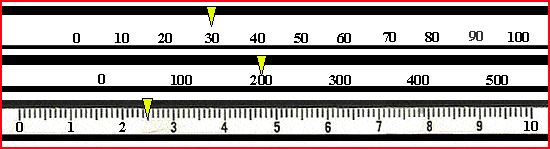
What is the mass on the triple beam balance?
a)
232.5
b)
237.0
c)
750.
20.

What is the mass on the triple beam balance?
a)
345.5
b)
304.5
c)
700.5
21.
The abbreviation "g" stands for ___________.
a)
ounces
b)
gorillas
c)
pounds
d)
grams
22.
Triple beam balances measure ________________.
a)
Volume
b)
Length
c)
Mass
d)
Weight
23.
What is a solvent
a)
the liquid in which a solute is dissolved to form a solution.
b)
Another word for solution
c)
A thing that make drinks turn colors
d)
Its a metal molecole
24.
vinegar reacts with baking soda when mixed
a)
chemical
b)
physical
25.
Is Flamability a Chemical Property?
a)
Chemical Property
b)
Chemical
c)
Yes
d)
No
100 %

