
 Worksheets
AP Human Geography - Midterm Review
Total questions: 50
Worksheet time: 39mins
One way geographers describe the location of a place is by situation. Situation identifies a place by its
location relative to other objects.
absolute location on the Earth's surface.
unique physical characteristics.
cultural features, such as language and religion.
Which of the following terms describes the art, science, and practice of making maps?
Projection
Cartography
Demography
Topography
GPS satellites allow for the determination of which of the following?
Amount of detail that can be shown on a thematic map
The weather forecast in for any area
Absolute location on the surface of the Earth
Relationship between the size of an earth feature and its size on the map
Which of the following is a term used in the study of place names?
Loconyms
Toponyms
Isonyms
Phenonyms
Which of the following modern trends is most directly responsible for the phenomenon of space-time compression?
Regionalization
Globalization
Periodization
Acculturation
Which of the following types of maps would have the smallest map scale?
Street map of Annapolis
Subway system map in London
Political world map
Map of the United States

The map above illustrates
a Robinson projection map.
a contour map.
a Mercator projection map.
a Peters projection map.

The map above represents what kind of map projection?
A homolosine projection with continuity of landmasses
A gnomic projection with distortions of bodies of water
A Robinson projection with distortions at the equator
A Mercator projection with distorted land areas

The map shown above best fits which of the following map types?
Choropleth
Dot distribution
Isoline
Cartogram
The arithmetic density of population for a country is determined by dividing the total
population by the number of farmers
area of square miles by 5
population by the total area
area of the country by the population
The number of people per unit area of agriculturally productive land is the
average density
physiological density
total density
agricultural density
Over the past century, the population of the world has been...
growing even though fertility rates have been decreasing
growing even though the average life expectancy is decreasing
growing because global fertility rates have been increasing
declining because average life expectancy is decreasing
The average number of children a woman will have throughout her childbearing years is defined as the
Child Increase Rate (CIR)
Total Fertility Rate (TFR)
Crude Birth Rate (CBR)
Natural Increase Rate (NIR)
The distribution of an area’s population by age and gender is most often represented by
population pyramid
dot distribution
thematic graph
population cartogram
Globally, the four largest population concentrations are located in
Europe, North America, and East Asia, Latin America
East Asia, Southeast Asia, South Asia and Western Africa
Southeast Asia, Southern Africa, East Asia, Europe
Europe, South Asia, Southeast Asia and East Asia
The dependency ratio is most useful for indicating the
relationship between the total fertility rate and the infant mortality rate
graphical representation of a place’s population for each age and gender
relationship between the potential labor force and the remainder of a country’s population
reliance of a country on imported fossil fuels
Despite a falling fertility rate, the population of a country with a large percentage of young people continues to grow. This phenomenon is known as
the mortality revolution
arithmetic growth
demographic momentum
natural increase

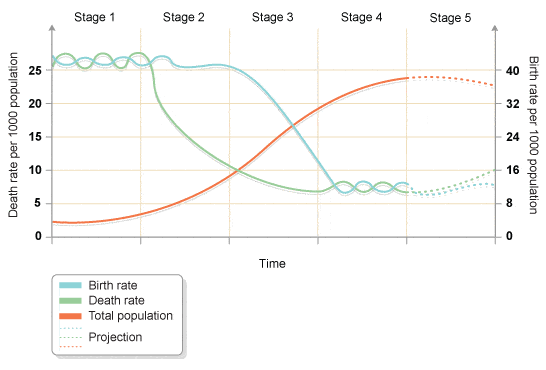
According to demographic transition theory, a country’s population is most likely to increase at which stages of development?
Stages 1 and 2
Stages 2 and 3
Stages 2 and 4
Stages 3 and 4

Which stage of Demographic Transition does the population pyramid above represent?
Stage 1
Stage 2
Stage 3
Stage 4

Which stage of Demographic Transition does the population pyramid above represent?
Stage 2
Stage 3
Stage 4
Stage 5
Thomas Malthus predicted that
population would increase at the same rate as farming production
population would eventually decline due to birth control and family planning
population would eventually outgrow food production
moral restraint would lower population growth
Which is the most common negative impact of emigration on the country of origin?
An increase in unemployment rates
Loss of working age population to another country
Loss of farmers resulting in smaller food supply
An increase in youth dependency
Individuals who have been forced to flee their homes due to political, cultural, or environmental threats but have not left the territory of their own country
Undocumented immigrants
Refugees
Internally displaced persons
Asylum seekers
Which of the following is NOT true according to Ravenstein's laws of migration?
Most migrants are young adults
Most migration is over very long distance
Migration generally occurs in steps
Migration is most often for economic reasons
The transfer of money by migrants to family or community members in their country of origin is known as
a remittance
brain drain
counterflow migration
an intervening opportunity
Based on what you have read about globalization, you could surmise that the main effect of modern communications on social customs has been to
preserve folk cultures, by increasing awareness of their uniqueness.
stimulate the diffusion of folk cultures around the world.
increase the similarity of social customs in different locations.
have little effect on the diffusion of social customs.
Which of the following language families is the largest in terms of the total number of speakers.
Sino-Tibetan
Indo-European
Niger-Congo
Afro-Asiatic
Which statement best describes the most common reason groups wish to preserve their traditional languages.
Language is used to religious services, so preserving a language is primarily a religious obligation.
Language is central to cultural identity, so preserving a language helps preserve a culture
Language is used for trade, so preserving language is one way to keep a group economically prosperous
Language preservation passes on a group’s history, so preserving a language is the only way to record history accurately.
All of the following are characteristics of universalizing religions EXCEPT
they appeals to people living in a wide variety of locations.
they actively seek converts to their broad views and beliefs.
they have remained embedded in the culture where they originated.
they have a precise place of origin.
Where did both Hinduism and Buddhism begin?
India
China
Sumer
Egypt
A husband migrates from Mexico to the United States and earns money to allow for his family to follow him to the United States. This is an example of:
chain migration
forced migration
distance decay
internal migration
The nine regions that the Census Bureau has established within the United States are examples of
formal regions
vernacular regions
nodal regions
functional regions

