wayground logo

Free Printable Worksheets

NEW

Font size

S
M
L
XL
Worksheets

Chemistry Chp. 6 Practice Test

Total questions: 68

Worksheet time: 3hrs 24mins

Name
Class
Date
1.

Al, aluminum wire is

a)

an ionic solid.

b)

a metallic solid.

c)

a network solid with covalent bonds.

d)

a molecular solid with nonpolar molecules.

2.

CO2, dry ice is

a)

an ionic solid.

b)

a metallic solid.

c)

a network solid with covalent bonds.

d)

a molecular solid with nonpolar molecules.

3.

C12H22O11, sucrose is

a)

an ionic solid

b)

a metallic solid

c)

a network solid with covalent bonds

d)

a molecular solid with nonpolar molecules

4.

C(s), powdered graphite is

a)

an ionic solid.

b)

a metallic solid.

c)

a network solid with covalent bonds.

d)

a molecular solid with nonpolar molecules.

5.

Which of the following molecules is predicted to have the smallest molecular dipole moment?

a)

HBr

b)

HCl

c)

HI

d)

H2

6.

Which compound exhibits a bent molecular geometry?

a)

HCl

b)

PH3

c)

CH4

d)

SO2

7.

In the water molecule, the H-O-H bond angle is 105º. Which distribution of electrons around the central oxygen atom provides the best explanation for this bond angle?

a)

4 shared pairs

b)

3 shared pairs, 1 unshared pair

c)

2 shared pairs, 2 unshared pairs

d)

1 shared pair, 3 unshared pairs

8.

The H-N-H bond angle in ammonia, NH3, is 107º. Which distribution of electron pairs around the central nitrogen atom provides the best explanation for this bond angle?

a)

4 shared pairs

b)

3 shared pairs, 1 unshared pair

c)

2 shared pairs, 2 unshared pairs

d)

1 shared pair, 3 unshared pairs

9.

In the tetrachloromethane (carbon tetrachloride) molecule, the Cl-C-Cl bond angle is 109.5º. Which distribution of electron pairs around the central carbon atom provides the best explanation for this bond angle?

a)

4 shared pairs

b)

3 shared pairs, 1 unshared pair

c)

2 shared pairs, 2 unshared pairs

d)

1 shared pair, 3 unshared pairs

10.

The shape of the BF3 molecule is best described as

a)

see-saw

b)

T-shaped

c)

tetrahedral

d)

trigonal planar

11.
Are the atoms more stable when they are bonded together or when they are apart? 
a)
Bonded Together
b)
Apart
12.
Ionic Bonding involves...
a)
The transfer of protons
b)
The transfer of nuetrons 
c)
The transfer of electrons
d)
None Of the above
13.
What do atoms that form positive ions tend to do?
a)
Tend to lose electrons 
b)
Tend to lose protons
c)
Tend to gain electrons
d)
Tend to gain protons
14.

What usually forms the positive ion?

a)

Metals

b)

Nonmetals

c)

None

15.

What usually forms the negative ion?

a)

Nonmetals

b)

Metals

c)

None

16.

Covalent compounds

a)

share electrons

b)

transfer electrons

c)

contain a sea of electrons

d)

conduct electricity

17.
What two types of atoms make a covalent bond?
a)
2 Nonmetals
b)
1 Nonmetal and 1 Metal
c)
2 Metals
d)
2 Noble Gases
18.

What happens when an atom gains an electron?

a)

Neutral(no charge)

b)

Positive charge

c)

Negative charge

19.
What elements generally make an ionic bond?
a)
metal and nonmetal
b)
2 or more nonmetals
c)
metal
d)
none of the above
20.
What elements generally make a covalent bond?
a)
metal and nonmetal
b)
2 or more nonmetals
c)
metal
d)
none of the above
21.
Predict the bond that will form between Be and F.
a)
Ionic
b)
Covalent
22.
Predict the bond that will form between Se and Cl.
a)
Ionic
b)
Covalent
23.

What is a valence electron?

a)

An electron that is found in the outermost shell of an atom.

b)

An electron found in the innermost shell of an atom.

c)

An electron found in the middle shell.

24.
What is the number of valence electrons for Oxygen?
a)
8
b)
6
c)
2
d)
1
25.
What is the number of valence electrons for Beryillum?
a)
1
b)
4
c)
2
d)
7
26.
What is the number of valence electrons for Silicon?
a)
1
b)
2
c)
6
d)
4
27.
How many valence electrons in this structure?
a)
6
b)
5
c)
4
d)
7
28.

Why do atoms share electrons?

a)

To attain the electron configuration of a noble gas.

b)

To become ions and create unstable compounds.

c)

To increase the mass of the compound.

d)

It's a nice thing to do.

29.

How many electrons are shared in a single covalent bond?

a)

2 pairs

b)

4

c)

2

d)

1

30.
What do we call a covalent bond where electrons are shared UNEVENLY or UNEQUALLY?
a)
Ionic
b)
Polar Covalent
c)
Nonpolar Covalent
d)
Van der Waals Force
31.

Which is stronger...

a)

N − N

b)

N = N

c)

N ≡ N

32.

Shorter bonds are ____ longer bonds.

a)

weaker than

b)

stronger than

c)

the same strength as

33.

What is the charge on an Aluminium ion?

a)

3

b)

+3

c)

+2

d)

+1

34.

What is the charge on a chloride ion?

a)

-1

b)

1

c)

+2

d)

+1

35.

When an atom loses an electron, it becomes a:

a)

positive ion

b)

negative ion

c)

neutral ion

d)

neutral atom

36.

Which of the following is a characteristic property of ionic compounds?

a)

They form hard, brittle crystals with characteristic shapes

b)

They have low melting points

c)

They have low boiling points

d)

They contain no charged particles

37.

In what form can an ionic compound conduct electricity?

a)

when dissolved in water

b)

as a solid

c)

as a crystal

d)

when warmed slightly

38.

An ionic bond is the attraction between:

a)

oppositely charged ions

b)

similarly charged ions

c)

neutral ions

d)

neutral atoms

39.

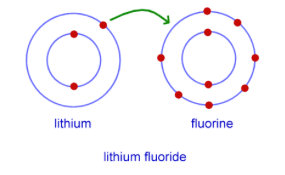
What type of bond is this?

a)

ionic

b)

covalent

40.

Definition: a regular, ordered arrangement of atoms, ions, or molecules

a)

crystal lattice

b)

atomic lattice

c)

ionic lattice

d)

molecular lattice

41.

These usually lose electrons and form positive ions.

a)

halogens

b)

metalloids

c)

metals

d)

nonmetals

42.

Anions are _________, while cations are _________.

a)

negatively-charged; positively-charged

b)

positively-charged; negatively-charged

c)

neutral ions; negatively-charged

d)

neutral ions; positively charged

43.
Nitrogen will ____ electrons when forming an ionic bond.
a)
gain 1
b)
lose 1
c)
gain 3
d)
lose 3
44.
Ionic bonds form between metals and ____.
a)
metalloids
b)
metals
c)
nonmetals
45.
A mixture of two or more metals is called:
a)
mixture
b)
solution
c)
compound
d)
alloy
46.

What is the basis of a metallic bond?

a)

The attraction of neutral metal atoms.

b)

The attraction between protons and neutrons.

c)

The attraction between positive metal ions and interlocking electrons.

d)

The attraction between positive metal ions and free floating electrons.

47.

At room temperature, most metals are

a)

liquids

b)

solids

c)

gases

d)

alloys

48.
Which of these is NOT an alloy?
a)
bronze
b)
copper
c)
brass
d)
stainless steel
49.

Electrons that are free to move in metals are

a)

delocalized electrons.

b)

oxidation numbers.

c)

chemical bonds.

d)

salts.

50.
What is the ability of a substance to be pulled into a thin strand?
a)
Malleability
b)
Ductility 
c)
Conductivity
d)
Solubility
51.
What is the ability of a substance to allow heat, sound, or electricity to flow through it?
a)
Malleability
b)
Ductility
c)
Solubility
d)
Conductivity
52.
What is the ability of a substance to be rolled or pounded into a thin sheet?
a)
Malleability
b)
Ductility
c)
Conductivity
d)
Solubility
53.
Choose the correct shape for this molecule:
a)
Trigonal planar
b)
Trigonal pyramidal
c)
Tetrahedral
d)
Linear
54.
Choose the correct shape for this molecule:
a)
Trigonal planar
b)
Trigonal pyramidal
c)
Bent
d)
Linear
55.
Choose the correct shape for this molecule:
a)
Bent
b)
Trigonal pyramidal
c)
Trigonal planar
d)
Linear
56.
Choose the correct shape for this molecule:
a)
Trigonal planar
b)
Trigonal pyramidal
c)
Bent
d)
Tetrahedral
57.
Choose the correct shape for this molecule:
a)
linear
b)
Trigonal pyramidal
c)
Bent
d)
Tetrahedral
58.
Choose the correct shape for this molecule:
a)
linear
b)
Trigonal pyramidal
c)
Bent
d)
Tetrahedral
59.
Choose the correct shape for this molecule:
a)
Tetrahedral
b)
Trigonal pyramidal
c)
Bent
d)
Trigonal planar
60.
Which of the following most likely represents the molecular geometry of water?
a)
A
b)
B
c)
C
d)
D
61.
What is the geometric configuration of CO2
a)
Bent 
b)
Trigonal planar
c)
Trigonal pyramidal
d)
Linear 
62.
What are all the bond angles in the linear arrangement as predicted by VSEPR theory? 
a)
90°
b)
180°
c)
120°
d)
109.5°
63.
What is the name of pairs of electrons that do not participate in bonding? 
a)
outer pair
b)
unvalenced pair
c)
lone pair
d)
inner pair
64.
What is the measure of a tetrahedral bond angle?
a)
90 Degrees
b)
109.5 Degrees
c)
120 Degrees
d)
180 Degrees
65.
The bond angle for a trigonal planar molecule is 
a)
90 Degrees
b)
109.5 Degrees
c)
120 Degrees
d)
180 Degrees
66.

What could this be?

a)

H2O

b)

NH3

c)

CO2

d)

CH4

67.
According to VSEPR, molecules adjust their shapes to keep which of the following as far away as possible?
a)
Pairs of valence electrons
b)
Inner shell electrons
c)
Mobile Electrons
d)
Electrons closest to the nucleus
68.

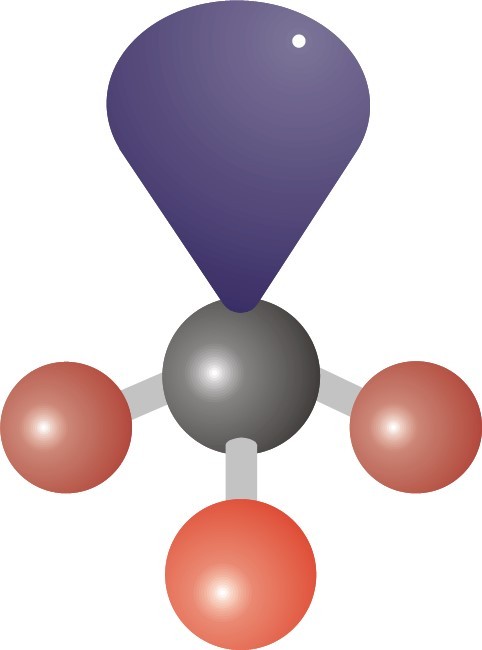
Determine the molecular geometry of the given structure.

a)

Trigonal Pyramidal

b)

Trigonal Bipyramidal

c)

Trigonal Planar

d)

Tetrahedral