wayground logo

Free Printable Worksheets

NEW

Font size

S
M
L
XL
Worksheets

Geometry Midterm Review 2020

Total questions: 40

Worksheet time: 2hrs 10mins

Name
Class
Date
1.

Find the distance between (-4, 5) and (7, 18) after a translation three units right and two units up.

a)

15.96

b)

16.08

c)

16.23

d)

17.03

2.

A parallelogram must be a rectangle when its

a)

diagonals are perpendicular.

b)

diagonals are congruent.

c)

opposite sides are parallel.

d)

opposite sides are congruent.

3.
a)

124

b)

112

c)

68

d)

56

4.

Use the image to answer the question.

a)

SSS

b)

ASA

c)

SAS

d)

SSA

5.

Which quadrilateral must have diagonals that are congruent and perpendicular?

a)

rhombus

b)

square

c)

trapezoid

d)

parallelogram

6.

Which transformation is not a rigid motion?

a)

Translation 2 units left.

b)

Rotation 90 degrees counter clockwise.

c)

Reflection over the y-axis.

d)

Dilation with a scale factor of 1/2.

7.

Use the image to answer the question.

a)

63

b)

27

c)

117

d)

153

8.

Use the image to answer the question.

a)

13

b)

25

c)

53

d)

65

9.

Use the image to answer the question.

a)

Option 1

b)

Option 2

c)

Option 3

d)

Option 4

10.

Use the image to answer the question.

a)

Option 1

b)

Option 2

c)

Option 3

d)

Option 4

11.

Given quadrilateral ABCDshown in the diagram below, which information is not enough to prove that ABCDis a parallelogram?

a)

Choice 1

b)

Choice 2

c)

Choice 3

d)

Choice 4

12.

Use the image to answer the question.

a)

Option 1

b)

Option 2

c)

Option 3

d)

Option 4

13.

Use the image to answer the question.

a)

Option 1

b)

Option 2

c)

Option 3

d)

Option 4

14.

If Triangle ABC is mapped onto Triangle DEF after a rotation and Triangle DEF is mapped onto Triangle XYZ after a translation, the relationship between Triangle ABC and Triangle XYZ is that they are always...

a)

congruent and similar

b)

congruent but not similar

c)

similar but not congruent

d)

neither similar nor congruent

15.

Use the image below to answer the question.

a)

SSS

b)

AAA

c)

SAS

d)

AAS

16.

Use the image to answer the question.

a)

Option 1

b)

Option 2

c)

Option 3

d)

Option 4

17.

What is the midpoint between (3, -1) and (7, -5)?

a)

(5, -2)

b)

(10, -6)

c)

(5, -3)

d)

(2, -2)

18.
Describe the transformation in the picture from the black triangle to the blue triangle.
a)
Reflection over the y-axis
b)
Reflection over the x-axis
c)
Reflection over y=x
d)
Reflection over y=-x
19.
Describe the transformation in the picture from the black triangle to the blue triangle.
a)
Translation 2 units to the left
b)
Translation 2 units to the right
c)
Translation 2 units up
d)
Translation 2 units down
20.
State if the triangles are congruent. If they are, state how you know.
a)
SAS
b)
ASA
c)
AAS
d)
Not Congruent
21.
State if the triangles are congruent. If they are, state how you know.
a)
SSS
b)
AAS
c)
AA
d)
Not Congruent
22.
If ∆ABC ≅∆DEF, what side is congruent to CA?
a)
FE
b)
DE
c)
FD
d)
DF
23.
Describe the angle relationship.
a)
Same Side Interior
b)
Corresponding
c)
Alternate Interior
d)
Same Side Exterior
24.
What type of triangle is shown?  Complete the statement:  ∠A≅∠_.
a)
Equilateral; C
b)
Isosceles; C
c)
Isosceles; B
d)
Scalene; None
25.

In △ABC, m∠A = 3x + 1, m∠B = 4x - 17, and m∠C = 5x - 20. Which type of triangle is △ABC?

a)

Right

b)

Scalene

c)

Isosceles

d)

Equilateral

26.
What is the measure of angle b?
a)
36o
b)
56o
c)
63o
d)
117o
27.

Which transformation does not produce an image that is congruent to the original?

a)

A dilation of scale factor 1 centered at (2,4)

b)

A dilation of scale factor ½ centered at the origin

c)

A reflection over y = 4x

d)

A rotation of 270 degrees followed by a translation down 2

28.

Given: △ABD, BC is the perpendicular bisector of AD

Which statement cannot always be proven?

a)

AC ≅ DC

b)

BC ≅ CD

c)

∠ACB ≅ ∠DCB

d)

△ABC ≅ △DBC

29.

Which transformation is not a rigid motion?

a)

Translation 2 units left.

b)

Rotation 90 degrees counter clockwise.

c)

Reflection over the y-axis.

d)

Dilation with a scale factor of 1/2.

30.

Which quadrilateral must have diagonals that are congruent and perpendicular?

a)

rhombus

b)

square

c)

trapezoid

d)

parallelogram

31.
Which of the following describes the sequence of transformations shown?
a)
Reflect across the x-axis and then rotate -90 degrees around the origin
b)
Rotate -90 degrees around the origin and then translate down.
c)
Reflect across the x-axis and then reflect across the y-axis.
d)
Translate up and then rotate 90 degrees about the origin.
32.
Find the y-coordinate of the midpoint of the line
a)
1
b)
2
c)
-2
d)
3
33.
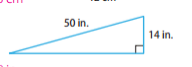
Find the length of the missing side. 
a)
48 in.
b)
52 in.
c)
16 in.
d)
24 in.
34.
Given Rhombus TUVW. Find m∠2.
a)
62
b)
28
c)
90
d)
78
35.
The diagonals of a rhombus are
a)
parallel
b)
congruent
c)
perpendicular
d)
equal to the side lengths
36.
What is the value of x?
a)
51
b)
49
c)
78
37.
Fill in the missing proofs.
a)
Transitive Property, SAS(Side-Angle-Side)
b)
Reflexive Property, SAS(Side-Angle-Side)
c)
Reflexive Property, Vertical Angles Thm.
d)
Transitive Property, SSS(Side-Side-Side)
38.
What is the "statement" for step 2 of the proof?
a)
∆BAC≅∆DAC
b)
BC=DC
c)
∡B≅∡D
d)
∡BAC≅∡DAC
39.
What is the "reason" for step 5 of the proof?
a)
Vertical Angle Theorem
b)
proof
c)
def. of angle bisector
d)
CPCTC 
40.
AB = AB
a)
Reflexive POE
b)
Transitive POE
c)
Symmetric POE
d)
Distributive POE