
NEW
Font size
S
M
L
XL
 Worksheets
Ionic and Covalent Bonding
Total questions: 25
Worksheet time: 22mins
Name
Class
Date
1.
How many valence electrons does calcium have?
a)
2
b)
4
c)
6
d)
7
2.
How many valence electrons does hydrogen have?
a)
1
b)
2
c)
3
d)
4
3.
When an atom loses an electron, it becomes a:
a)
positive ion
b)
negative ion
c)
neutral ion
d)
neutral atom
4.
Which of the following is NOT a property of ionic compounds?
a)
They have very high melting points
b)
They conduct electricity when in solution
c)
They have high boiling points
d)
They are insoluble in water
5.
Ionic compounds are formed when one or more valence electrons are transferred from _____
a)
a nonmetal atom to a metal atom
b)
a nonmetal atom to a nonmetal atom
c)
a metal atom to a nonmetal atom
d)
a metal atom to a metal atom
6.

This is a correct dot diagram for neon (Ne)
a)
true
b)
false
7.

This could be the dot diagram of
a)
Ne
b)
H
c)
C
d)
F
8.

This is a correct dot diagram for oxygen (O)
a)
true
b)
false
9.
How are covalent bonds explained?
a)
When one atom takes the other atom's electron
b)
When the atom shares an electron with an another atom
c)
When the two nucleus merge
d)
When the neutrons leave the nucleus
10.
What two types of atoms make a covalent bond?
a)
2 Nonmetals
b)
1 Nonmetal and 1 Metal
c)
2 Metals
d)
2 Noble Gases
11.
A covalent bond in which electrons are shared unequally is:
a)
polar
b)
a double bond
c)
ionic
d)
polyatomic
12.
How many valence electrons do most atoms need to be stable?
a)
1
b)
2
c)
6
d)
8
13.
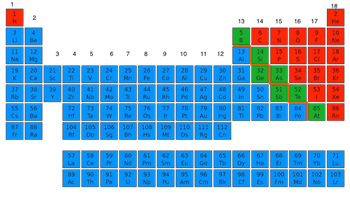
Where are the nonmetals located on the periodic table?
a)
Blue
b)
Red
c)
Green
14.

What is the correct formula for this molecule?
a)
NH
b)
N3H
c)
NH3
d)
NH4
15.
In the correct Lewis Structure for methane (CH4), how many unpaired electrons can be found around Carbon?
a)
0
b)
2
c)
4
d)
8
16.
A(n) _________ is an ion with a positive (+) charge.
a)
anion
b)
cation
c)
ion
d)
solute
17.
Magnesium bromide is an ionic compound with the chemical formula MgBr₂. What does the "2" tell you?
a)
There are 2 bromide ions for every magnesium ion
b)
Bromide has a 2- charge
c)
Bromide has a 2+ charge
d)
There are 2 magnesium ions to every bromide ion
18.
In the chemical formula for an ionic compound, which item is written first?
a)
positive ion
b)
negative ion
c)
subscript
d)
the female
19.
Which of the following is a characteristic property of ionic compounds?
a)
They form hard, brittle crystals with characteristic shapes
b)
They have low melting points
c)
They have low boiling points
d)
They contain no charged particles
20.
Elements in Group 1 lose one electron to form ions with a _________________ charge.
a)
1+
b)
2+
c)
0
d)
1-
21.
Nitrogen will ____ electrons when forming an ionic bond.
a)
gain 1
b)
lose 1
c)
gain 3
d)
lose 3
22.
What will be the compound name of the following chemical formula?
NaCl
NaCl
a)
Potassium Chloride
b)
Sodium Chloride
c)
Calcium Chloride
d)
Sodium Chlorine
23.
Ionic bonds form between metals and ____.
a)
metalloids
b)
metals
c)
nonmetals
24.
If the name of a compound ends in "IDE", what does that tell us about the atoms that make it up?
a)
That it is a molecule
b)
That it contains two different elements
c)
That it contains two atoms
d)
That it is an ionic compound
25.
What are ionic bonds?
a)
valence electrons transferred between atoms
b)
Inner most electrons transferred between atoms
Reset

