wayground logo

Free Printable Worksheets

NEW

Font size

S
M
L
XL
Worksheets

Chapter 14 Lesson 1: Waves

Total questions: 36

Worksheet time: 3hrs 0mins

Name
Class
Date
1.

A wave is a disturbance that transfers __________ from place to place without transferring matter.

a)

matter

b)

energy

c)

people

d)

material

2.

What are the two main types of waves?

a)

mechanical and sound

b)

sound and electromagnetic

c)

mechanical and electromagnetic

d)

compression and seismic

3.
The highest point on a wave is:
a)
the crest
b)
the trough
c)
the top
d)
the coast 
4.
The lowest point on a wave is the:
a)
Amplitude
b)
Crest
c)
Trough
d)
Wavelength
5.
The number of wavelengths that pass a point each per second is:
a)
frequency
b)
period
c)
longitudinal 
d)
transverse wave 
6.
The type of waves that require medium to pass:
a)
Mechanical Waves
b)
Electromagnetic Waves
7.
What kind of wave moves at right angles to the direction of the wave?
a)
compressional waves
b)
mechanical waves
c)
transverse waves
d)
ultraviolet rays
8.
How would you describe the movement of a longitudinal wave?
a)
Up and down
b)
Back and forth
c)
In zigzags
d)
Linear
9.
How would you describe the movement of a transverse wave?
a)
Up and down
b)
Back and forth
c)
In zigzags
d)
Linear
10.
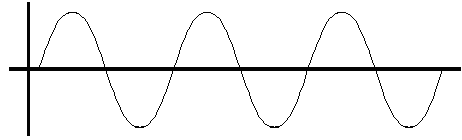
Which wave is pictured?
a)
Transverse
b)
Longitudinal
c)
Both
d)
Neither
11.
Which wave is pictured?
a)
Transverse
b)
Longitudinal
c)
Both
d)
Neither
12.

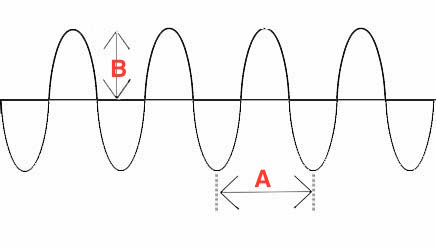
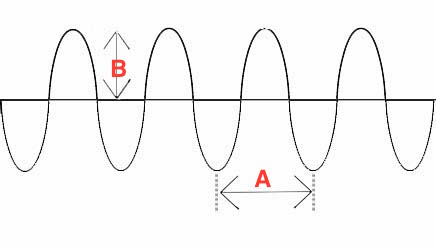
What property of this wave is represented by the letter "A"

a)

amplitude

b)

crest

c)

trough

d)

wavelength

13.
What property of the wave is represented by the letter "B"?
a)
amplitude
b)
crest
c)
trough
d)
wavelength
14.
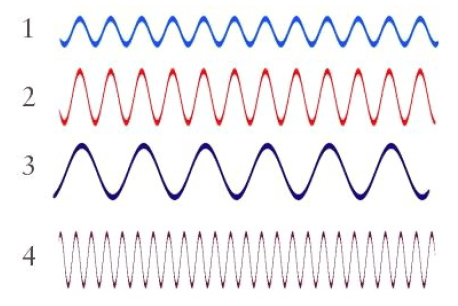
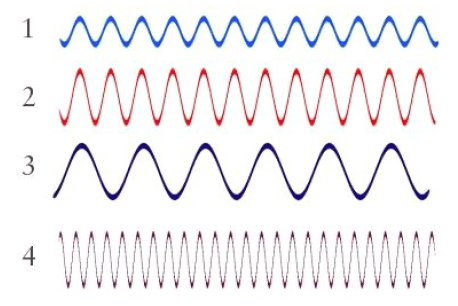
Which wave in the diagram has the greatest frequency?
a)
1
b)
2
c)
3
d)
4
15.
Which wave in the diagram has the greatest wavelength?
a)
1
b)
2
c)
3
d)
4
16.
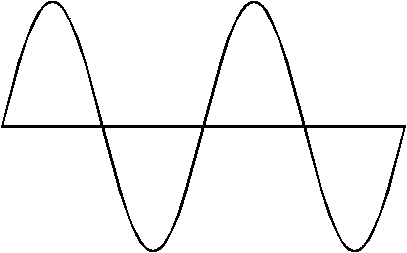
How many waves are in this picture?
a)
1
b)
2
c)
3.5
d)
4
17.
A compressional wave is another name for a 
a)
longitudinal wave
b)
electromagnetic wave
c)
radio wave
d)
hair wave
18.
Amplitude is a measure of how much _________ the wave is carrying
a)
energy
b)
matter
c)
medium
d)
frequency
19.
_____________________ is the distance between a point on one wave and the identical point of the next wave.
a)
Amplitude
b)
Wavelength
c)
Frequency
d)
Crest
20.
The longer the _____________  the ______________ the frequency.
a)
wavelength, lower
b)
wavelength, higher
c)
amplitude, lower
d)
amplitude, higher
21.

The part of a longitudinal wave where the waves are squeezed together?

a)

compression

b)

rarefaction

c)

crest

d)

trough

22.

The part of a longitudinal wave that is spread a part?

a)

compression

b)

rarefaction

c)

crest

d)

trough

23.
Which letter represents the wave crest?
a)
A
b)
B
c)
C
d)
D
24.
Which letter represents the wave trough?
a)
A
b)
B
c)
C
d)
D
25.
What kind of wave can travel through space?
a)
electromagnetic waves
b)
compressional waves
c)
transverse waves
d)
longitudinal waves
26.
The units for frequency are measured in _____________.
a)
hertz
b)
seconds
c)
m/s
d)
m
27.

A material in which a wave travels

a)

wave

b)

compression

c)

medium

d)

trough

e)

crest

28.
A mechanical wave cannot travel through...
a)
a vacuum(empty space).
b)
water.
c)
air. 
d)
glass.
29.
Electromagnetic waves include the following except
a)
radio waves
b)
X-rays
c)
doing the wave at a football game
d)
microwaves
30.
What is the arrow pointing to in this image of a longitudinal wave?
a)
rarefaction
b)
compression
c)
longitudinal
d)
crest
31.
Which of these waves do NOT require a medium?
a)
A. ocean waves       
b)
B. seismic waves
c)
C. sound waves     
d)
D. radio waves
32.
What type of waves are formed during an Earthquake?
a)
seismic
b)
transverse
c)
compressional
d)
electromagnetic
33.

A slinky resembles which type of wave?

a)

transverse

b)

longitudinal

c)

seismic

d)

electromagnetic

34.

__________ waves are a combination of longitudinal and transverse waves.

a)

mechanical

b)

electromagnetic

c)

compression

d)

surface

35.

What is the arrow pointing to in this image of a longitudinal wave?

a)

crest

b)

trough

c)

compression

d)

rarefaction

36.

What is the section marked in this image of a longitudinal wave?

a)

surface

b)

frequency

c)

wavelength

d)

amplitude