
 Worksheets
Convection and Conduction
Total questions: 32
Worksheet time: 31mins
Name
Class
Date
1.
In heat transfer, heat always flows from the _______________ substance to the _______________ substance.
a)
Hotter to colder
b)
Colder to hotter
c)
Hotter to hotter
d)
Colder to colder
2.
The type of heat transfer that happens through direct contact of molecules or particles with each other is ___________________.
a)
Convection
b)
Conduction
c)
Radiation
d)
insulation.
3.
___________________ is the type of heat transfer that occurs in fluids, such as warm air rising and cold air sinking; creating wind.
a)
Convection
b)
Conduction
c)
Radiation
d)
insulation.
4.
Which statement is true?
a)
The quicker a molecule moves, the colder it is.
b)
The slower a molecule moves, the warmer it is.
c)
The quicker a molecule moves, the warmer it is
d)
The movement on molecule don�t affect its temperature
5.
Two objects at different temperatures are in contact. Which of the following happens to their thermal energy?
a)
Their thermal energies remain the same.
b)
Thermal energy passes from the cooler object to the warmer object
c)
Thermal energy passes from the warmer object to the cooler object.
d)
Thermal energy passes back and forth equally between the two objects.
6.
Students in a science class performed an experiment with hot and cold water. They dyed the hot water red and the cold water blue. When the students layered the water, they noticed that the hot water rose to the top and the cold water sank. What was this demonstrating?
a)
Radiation
b)
Air Pressure
c)
Evaporation
d)
Density
7.
The handle of a metal spoon warms up when it is placed in a hot bowl of soup because of
a)
Convection
b)
Conduction
c)
Radiation
d)
insulation.
8.
A large house being heated by heater warms a house when the air is circulating.
a)
Convection
b)
Conduction
c)
Radiation
d)
insulation.
9.
Which of the following is the best example of conduction?
a)
A light bulb warming a lampshade
b)
An egg cooking in a frying pan
c)
Water boiling in a pot
d)
Gases circulating in the atmosphere
10.
Which situation best represents convection?
a)
Heat from a campfire
b)
A hot air balloon taking off
c)
Touching a hot piece of metal
d)
Getting sunburned
11.
Which situation best represents conduction?
a)
Heat from a campfire
b)
A hot air balloon taking off
c)
Touching a hot piece of metal
d)
Getting sunburned
12.
The process by which gases in the atmosphere absorb thermal energy and radiate it back to earth is called
a)
the thermal effect.
b)
the greenhouse effect.
c)
global warming.
d)
radiation balance
13.
What is the definition of CONDUCTION?
a)
When heat is transferred from objects like rays of light or electromagnetically.
b)
a hot liquid or air that expands, becomes less dense, and rises or becomes more dense, and sinks.
c)
When heat transfers from objects that are touching.
d)
When heat transfers through the heater or AC in your house.
14.
What is the definition of CONVECTION
a)
When heat transfers through waves.
b)
When heat transfers from objects that are touching.
c)
a hot liquid or air that expands, becomes less dense, and rises or becomes more dense, and sinks.
d)
Heat traveling from the sun
15.
What heat transfer happens when you burn your hand by touching a fire?
a)
Radiation
b)
Conduction
c)
Convectio
d)
I don't know!!!!!!!!!!!
16.
Which of the following is needed for convection to happen?
a)
Fluid/s
b)
Light in the form or rays
c)
Electromagnetic waves
d)
Fire
17.
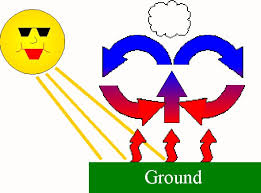
Warm air rises and the cool air sinks demonstrates this type of heat transfer.
a)
conduction
b)
convection
c)
radiation
d)
Insolation
18.
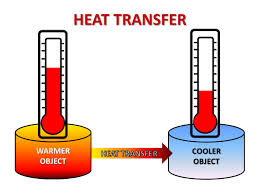
Heat transfers from an area of ____temperature to an area of ___ temperature.
a)
high to low
b)
low to high
c)
high to high
d)
It can travel high to low and low to high.
19.

The Gulf Stream is a current that brings warm ocean water from the south to the north. What type of heat transfer is this?
a)
conduction
b)
convection
c)
radiation
d)
Insolation
20.
Warm air is __________ dense than cold air and rises creating convection currents.
a)
more
b)
less
21.
Transfer of thermal energy through "flow" of liquids and gases
a)
conduction
b)
convection
c)
radiation
22.
The cause of weather systems on earth is
a)
conduction
b)
convection
c)
radiation
23.

The way the heat is moving from the hot coffee is called...
a)
convection
b)
radiation
c)
insulation
d)
conduction
24.
Near the ceiling of a room the air is warmer. The warm air rises because of
a)
conduction
b)
convection
c)
radiation
25.
Molecules that are less dense than the surrounding particles will...
a)
rise up
b)
sink down
c)
stay put
26.
____________ occurs when heat is transferred into an object through motion or movement; an example would be boiling water.
a)
conduction
b)
convection
c)
radiation
27.
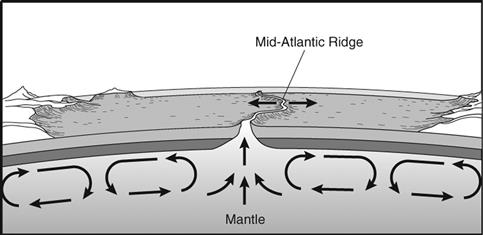
The diagram represents the movement of the mantle under the earth's crust. Which process is represented by the diagram?
a)
rotation
b)
conduction
c)
radiation
d)
convection
28.
Hot matter is _________ dense and ___________
a)
less, sinks
b)
less, rises
c)
more, sinks
d)
more, rises
29.

Which liquid is the least dense?
a)
oil
b)
water
c)
syrup
d)
plastic bottle
30.
What causes wind?
a)
movement of high pressure to low pressure
b)
movement of low pressure to high pressure
31.
In an ocean, warm water moves __________ and cold water moves ____________.
a)
Down, Up
b)
Up, Down
32.
During convection, more dense currents _________ and less dense currents _________.
a)
sink, rise
b)
rise, sink
100 %

