Wayground logo

Free Printable Worksheets

Font size

S
M
L
XL
Worksheets

8th Unit 4 Review

Total questions: 40

Worksheet time: 24mins

Name
Class
Date
1.
People who study fossils are called ____.
a)
meterologists
b)
fossilologists
c)
paleontologists
d)
fossil hunters
2.
In which kind of rock do we usually find a fossil?
a)
sedimentary  rock
b)
metamorphic rock
c)
igneous rock
3.
In order for a fossil to form, which of the following events must happen FIRST?
a)
Slowly, minerals in the water replace the bone.
b)
Sediment covers the bone.
c)
An animal dies.
d)
The bone is no longer a bone, but a rock copy.
4.
What happens when a group of animals become extinct?
a)
All of its members have died.
b)
Only a few of its members are still living.
c)
The animals can no longer lay eggs.
d)
All of its members move to another place.
5.
Where can the oldest layer be found?
a)
The top layer
b)
The middle layer
c)
They are all the same age
d)
The bottom layer
6.
How are fossils created?
a)
Traces of organisms get turned into stone.
b)
Dead organisms are quickly buried for millions of years.
c)
Animals get trapped.
d)
All of the above
7.
Which layer formed first?
a)
Rock Layer W
b)
Rock Layer X
c)
Rock Layer Y
d)
Rock Layer Z
8.
Several wooly mammoth fossils have been found. Mammoths, which lived hundreds of thousands of years ago, were covered with thick fur.  Based on the evidence, mammoth fossils tell us that the area in which they are found - 
a)
has too many humans 
b)
no longer has large animals 
c)
was, at one time, very cold
d)
receives more rain that it used to 
9.
Preserved parts or traces of animals and plants that lived in the past
a)
natural gas
b)
imprints
c)
photos
d)
fossils
10.

Geologic processes that occur suddenly

a)

uniformitarism

b)

catastrophism

c)

geologic time scale

11.

Geologic processes that happened in the past can be explained by current processes

a)

Catastrophism

b)

Uniformitarianism

c)

Geologic Time Scale

12.

All of fossils discovered on Earth

a)

Mold

b)

Cast

c)

Fossil Record

d)

Trace Fossil

13.

Fossils in which minerals replace an organism's cells

a)

Trace Fossils

b)

Petrified Fossils

c)

Mold

d)

Cast

14.

Solid copy of the shape of an organism

a)

Cast

b)

Mold

c)

Trace Fossil

d)

Index Fossil

15.

Evidence of ancient organism such as a footprint

a)

Petrified Fossil

b)

Mold

c)

Cast

d)

Trace Fossil

16.

Breakdown of radioactive isotope to stable isotope

a)

Half-life

b)

Radioactive Decay

c)

Radiometric Dating

17.

Used to determine whether an object is older or younger than other objects

a)

Superposition

b)

Relative Dating

c)

Fossil

d)

Crosscutting

18.

States that younger rocks lie above older rocks if the layers have not been disturbed

a)

Law of crosscutting

b)

Law of superposition

c)

Relative Dating

d)

Absolute Dating

19.

An ordered arrangement of rock layers that is based on the relative ages of the rocks

a)

Superposition

b)

Crosscutting

c)

Layered

d)

Geologic Column

20.
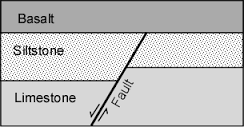
How does the law of crosscutting explain the age of a fault?
a)
The fault is younger than the rocks above it.
b)
The fault is younger than the rocks it cuts through.
c)
The fault is older than the rocks above it.
d)
The fault is older than the rocks it cuts through.
21.
What are the relative ages of the features in order from oldest to youngest?
a)
Limestone, Basalt, Fault, Siltstone
b)
Siltstone, Fault, Basalt, Limestone
c)
Limestone, Fault, Basalt, Siltstone
d)
Limestone, Siltstone, Fault, Basalt
22.
According to the law of superposition, the oldest fossils are found 
a)
At the top of the rock layers
b)
Near the bottom of the rock layers
c)
In the middle of the rock layers
d)
Somewhat near the surface
23.
According to the law of superposition, which layer is the youngest?
a)
A
b)
B
c)
C
24.

Time needed for half of radioactive isotope to undergo radioactive decay to form daughter isotope

a)

Full-Life

b)

Half-Life

c)

Radioactive Life

25.
Scientists use radioactive decay to measure...
a)
relative time
b)
absolute time
c)
half-lives
d)
time of day
26.
The original element that undergoes radioactive decay is known as the...
a)
daughter element
b)
half-life
c)
parent element
d)
carbon-14
27.
The Earth is estimated to be how old?
a)
4.6 Million years old
b)
6,000 years old
c)
4.6 Billion years old
d)
Who knows
28.
Barium-122 has a half-life of 2 minutes. A fresh sample weighing 80 g was obtained. If it takes 10 minutes to set up an experiment using barium-122, how much barium-122 will be left when the experiment begins?
a)
0.25g
b)
2.5g
c)
25g
d)
80g
29.
The half-life of strontium-90 is 25 years. How much strontium-90 will remain after 100 years if the initial amount is 4.0 g?
a)
3.0g
b)
0.25mg
c)
0.3g
d)
0.25g
30.

What is NOT a way for fossils to be preserved?

a)

Amber

b)

Frozen

c)

Buried in sedimentary rock

d)

Buried in igneous rock

31.

As a tree grows, it forms a ring on the trunk. If the tree ring is thick, that indicates the tree grew well due to

a)

lack of precipitation

b)

plenty of precipitation

c)

more birds living in trees

d)

more squirrels living in tree

32.

What method of radiometric dating involves measuring the amount of carbon to nitrogen of organic remains?

a)

radiocarbon dating

b)

uranium-lead dating

c)

potassium-argon dating

33.

What method of radiometric dating involves measuring potassium's daughter isotope, argon, to date igneous rocks?

a)

radiocarbon dating

b)

uranium-lead dating

c)

potassium-argon dating

34.

What is NOT a characteristic of an index fossil?

a)

lived during short geologic time span

b)

found in large area

c)

unique features

d)

uncommon

35.

An eon is the largest unit of time on the geologic time scale. It is divided into eras which are divided into _______.

a)

periods

b)

epochs

36.

What division of time was the longest ?

a)

Paleozoic

b)

Mesozoic

c)

Cenozoic

d)

Precambrian

37.

What era did dinosaurs go extinct ?

a)

Paleozoic

b)

Mesozoic

c)

Cenozoic

38.

What is the geological time scale ?

a)

A clock

b)

A calendar

c)

Something that divides Earths history into groups

39.

Put the ERAs of the Phanerozoic EON in the correct order(oldest to youngest):

a)

Paleozoic, Mesozoic, Cenozoic

b)

Cenozoic, Mesozoic, Paleozoic

c)

Mesozoic, Paleozoic, Cenozoic

40.

Put the PERIODS of the Mesozoic Era in the correct order(oldest to youngest):

a)

Cambrian, Ordovician, Silurian

b)

Triassic, Jurassic, Cretaceous

c)

Cretaceous, Jurassic, Triassic

d)

Paleozoic, Mesozoic, Cenozoic