wayground logo

Free Printable Worksheets

Font size

S
M
L
XL
Worksheets

B3 Organisation and the Digestive System AQA

Total questions: 41

Worksheet time: 25mins

Name
Class
Date
1.
B2.2.1 - What does amylase break down?
a)
Starch
b)
Glucose
c)
Protein
d)
Cellulose
2.
B2.2.3 - What do platelets do?
a)
Help with blood clotting
b)
Transport nutrients
c)
They are part of the body's immune system
d)
They carry oxygen around the body
3.
B2.2.3 What does blood plasma contain?
a)
Platelets
b)
Red blood cells
c)
All of these
d)
White blood cells
4.
B2.2.3 - What are these? 
a)
White blood cells
b)
Platelets
c)
Red blood cells
d)
Blood plasma 
5.

Which one of the following is an adaptation to improving the efficiency of gaseous exchange?

a)

Clusters of alveoli in the lungs increase the efficiency of gaseous exchange

b)

The presence of rings of cartilage in the trachea

c)

The fattened, globular shape of plants such as cacti

6.

How are blood capillaries well-adapted for gaseous exchange?

a)

There are always very high concentration gradients across capillaries

b)

Their walls are just one cell thick

c)

The blood in them is under high pressure

7.

Which chemical test is used to detect the presence of glucose in food?

a)

Benedict's test

b)

Iodine test

c)

Sudan III test (Biuret)

8.

The digestion of which food molecule by enzymes begins in the mouth?

a)

Glucose

b)

Protein

c)

Starch

9.

What is the main function of the small intestine?

a)

Absorption of digested food molecules

b)

The breakdown of starch into maltose

c)

The absorption of water from the gut

10.

What is the function of bile?

a)

Bile contains hydrochloric acid to provide the optimum pH for protease activity

b)

Bile contains a mixture of digestive enzymes

c)

Bile emulsifies lipids to smaller droplets

d)

Bile neutralises stomach acid

11.

Which path describes the movement of oxygenated blood?

a)

Vena cava to right atrium to right ventricle

b)

Pulmonary vein to left atrium to left ventricle

c)

Right ventricle to pulmonary artery to lungs

12.

Which type of blood cell does not have a nucleus?

a)

Phagocyte

b)

Lymphocyte

c)

Red blood cell

13.

Which statement best describes a vein?

a)

Veins have thin walls and a wide lumen

b)

Veins have thick, muscular walls

c)

Veins always carry deoxygenated blood

14.

What substance(s) is transported in the xylem?

a)

Water

b)

Water and mineral ions

c)

Sugars and amino acids

15.

What feature of palisade cells makes them efficient at photosynthesis?

a)

They have a thick, waxy coating

b)

They are packed with chloroplasts

c)

They are very close to most of the stomata

16.

How does water enter a root hair cell?

a)

By osmosis

b)

By active transport

c)

By diffusion

17.

Which of the following is the best definition of a non-communicable disease?

a)

A disease that is spread by the transfer of pathogens

b)

A genetic disease

c)

A disease that cannot be transferred from person to person

18.

Which of the following is a major cause of type 2 diabetes?

a)

Too little sugar in the diet, lowering blood sugar

b)

Obesity

c)

Too vigorous exercise, causing a reduction in carbohydrate in the body

19.
What type of cell are animal and plant cells?
a)
A Bacterial
b)
B Eukaryotic
c)
C Prokaryotic
d)
D Yeast
20.
Which specialised animal cell has the function of fertilising an egg cell?
a)
A Nerve cell
b)
B Muscle cell
c)
C Phloem cell
d)
D Sperm cell
21.
Bile is made by which digestive organ?
a)
Gallbladder
b)
Stomach
c)
Rectum
d)
Liver
22.
What is one secondary (helper) organ of the digestive system?
a)
Small Intestine
b)
Esophagus
c)
Gallbladder
d)
Stomach
23.
Nutrients from digested food are absorbed in which digestive organ?
a)
Small Intestine
b)
Stomach
c)
Large Intestine
d)
Gallbladder
24.
Which of the following is NOT part of the digestive tract?  (Hint:  Identify the secondary organ.)
a)
Mouth
b)
Esophagus
c)
Small Intestine
d)
Liver
25.
Number 3 is pointing to the...
a)
Small intestine
b)
Rectum
c)
Large intestine
d)
Stomach
26.
As waste moves through the digestive system, the ______ absorbs water before storing waste in the rectum.
a)
Small intestine
b)
Stomach
c)
Esophagus
d)
Large intestine
27.
Bile is stored in which secondary digestive organ?
a)
Stomach
b)
Liver
c)
Gallbladder
d)
Pancreas
28.
Enzymes (chemicals) in your saliva help break down food while chewing.  This is...
a)
Mechanical digestion
b)
Chemical digestion
29.
Most chemical digestion takes place in which organ?
a)
Stomach
b)
Small intestine
c)
Rectum
d)
Esophagus
30.
Enzymes are considered to be 
a)
Lipids
b)
Carbohydrate
c)
Protein
d)
Nucleic Acid
31.
What is the purpose  of an enzyme?
a)
give permission for the reaction
b)
raise activation energy
c)
speed up reactions
d)
control how many reactions occur
32.
Where do substrates bind on an enzyme?
a)
voltage-gated channels
b)
surface receptor
c)
calcium channels
d)
active site
33.
Enzymes are capable of increasing the rate of a chemical reaction within a living cell.  Enzymes accomplish this through which of the following means?
a)
reducing the number of products   
b)
reducing the activation energy
c)
increasing the temperature of the cell
d)
increasing the concentration of reactants 
34.
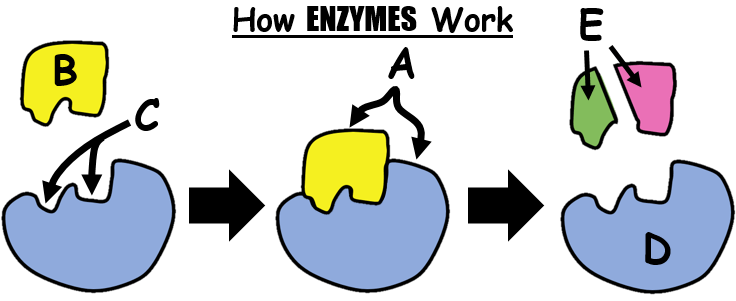
What is structure D?
a)
Substrate
b)
Active site
c)
Enzyme
d)
Products
35.
What is a substance called if it speeds up a chemical reaction?
a)
reusable
b)
catalyst
c)
specific
d)
fragile
36.
Which of the following conclusions can be drawn from this graph?
a)
The optimum pH of the enzyme is 6.6.
b)
The optimum pH of the enzyme is 5.8
c)
The enzyme’s activity increases as pH increases 5.0 to 9.0
d)
The enzyme’s activity is greater around pH of 8.0 .
37.
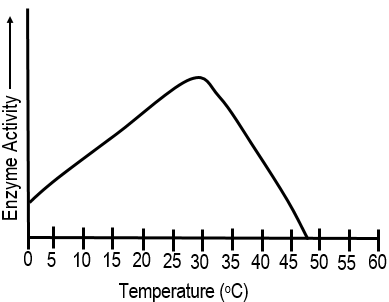
Based on the graph, what is the optimal temperature for this enzyme? 
a)
15oC
b)
40oC
c)
30oC
d)
35oC
38.
What happens when enzymes are heated to a high temperature?
a)
The enzymes die.
b)
The shapes of the enzyme are altered denature
c)
The enzymes' amino acid sequence changes.
d)
The enzymes remain the same
39.
Which of these is most likely an enzyme?  
a)
Sucrose
b)
Galactose
c)
Fructose
d)
Amylase
40.
Letter B...
a)
active site
b)
enzyme
c)
substrate
d)
products
41.
Where do substrates bind on an enzyme?
a)
voltage-gated channels
b)
surface receptor
c)
calcium channels
d)
active site