
 Worksheets
Newton's Laws of Motion
Total questions: 35
Worksheet time: 21mins
What kind force produces a change in motion?
unbalanced force
balanced force
gravitational force
frictional force
normal force
What is the standard metric unit of force?
Newtons
pounds
grams
meters
Newton's first law of motion is also called the law of (a) ?
Which of these objects has the most Inertia?
person
ant
cat
bike
Which formula would you use to calculate the force acting on an object using Newton's 2nd law of motion?
F = am
F = m+a
F= aF
What is Newton's Third Law?
Object in motion stays in motion and an object at rest stays at rest unless acted on by a outside force
Force = mass x acceleration
For every action force there is an equal and opposite reaction force
According to Newton's second law, if you increase the force applied to an object :
it increases the acceleration of the object
it increases the mass of the object
it increases the inertia of the object
it slows the motion the object
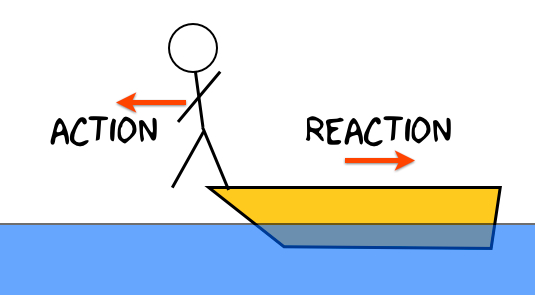
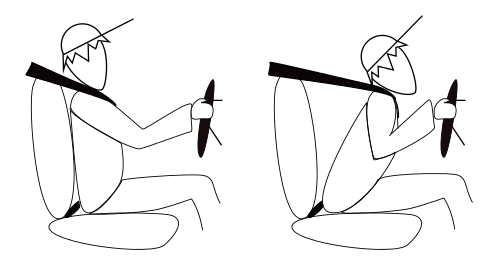
Which law of motion does this picture represent
Newtons 2nd law
Law of gravity
Newtons 1st law
Newtons 5th law
Change in velocity over a given period of time is
velocity
motion
speed
acceleration
Which of the following actions can describe "acceleration"?
slowing down motion
increasing motion
changing direction
All of the above
The rate at which motion CHANGES is:
acceleration
speed
velocity
physics
Which law of motion states that forces always act in equal and opposite pairs.
Newton's 1st Law
Newton's 3rd Law
Newton's second law
An empty truck and a fully loaded truck are next to each other at a traffic light. When the light turns green, the truck with less mass increases speed more quickly. Which of these best explains this situations
Newton's first law
Newton's second law
Newton's third law
Conservation of momentum
1st
Law of Motion
2nd
Law of Motion
3rd
Law of Motion
1st
Law of Motion
2nd
Law of Motion
3rd
Law of Motion
1st
Law of Motion
2nd
Law of Motion
3rd
Law of Motion
1st
Law of Motion
2nd
Law of Motion
3rd
Law of Motion
1st
Law of Motion
2nd
Law of Motion
3rd
Law of Motion
1st
Law of Motion
2nd
Law of Motion
3rd
Law of Motion
Determine the acceleration that result when a 12 newton net force is applied to a 3 kg object.
36 m/s2
4 ft/s 2
15 m/s2
4 m/s 2
Objects with greater mass have less inertia; objects with greater mass have less inertia.
true
false
Which of the following is the equivalent unit to a newton?
m/s2
m/s
kg x m/s2
s2

What is the net force on the refrigerator shown to the right?
2200 Newtons to the right
250 Newtons to the left
0 newtons, all forces are balanced
150 Newtons to the right
What is the acceleration of a truck with a mass of 2,000 kg when its brakes apply a force of 10,000 Newtons?
5 m/s2
12,000 m/s2
20,000 Newtons
8,000 kg x m/s2
While an object is moving at a constant 20 m/s, a 5-N force pushes the object to the left. At the same time, a 5-N force is pushing the object to the right. What will the object’s velocity?
20 m/s
2 m/s
0 m/s
30 m/s
According to Isaac Newton's 2nd law of motion a larger force makes a proportionally larger (a) .
According to Isaac Newton's 2nd law of motion an object's acceleration is inversely proportional to (a) .

A tow truck pulls a car with an acceleration of 5 m/s2 and with a net force of 4,000 newtons. What is the mass of the car?
(a)
Which formula would you use to calculate the mass of an object using Newton's 2nd law of motion?
m = aF
m = Fa
m = F×a
Which formula would you use to calculate the acceleration of an object using Newton's 2nd law of motion?
a = mF
a = Fm
a = F×m

Which of the following are NOT one of Santa's 8 tiny reindeers.
Donny
Prancer
Vixen
Rodolph
Blitzen

