
 Worksheets
Evidence of Evolution
Total questions: 18
Worksheet time: 28mins
Name
Class
Date
1.
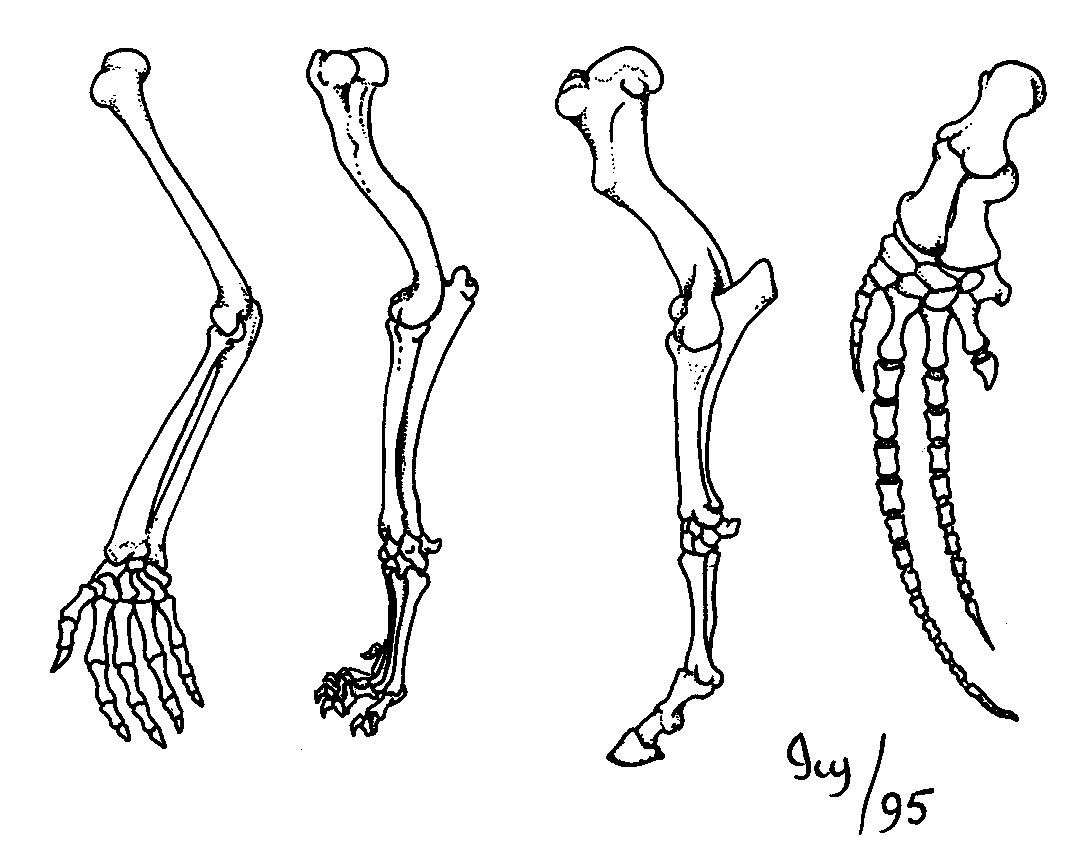
Structures with the same parts have different functions; suggests that organisms share a common ancestry
a)
vestigial structures
b)
homologous structures
c)
adaptive radiation
d)
fossil
2.
The process by which populations slowly change over time is called__________
a)
selective breeding
b)
adaptation
c)
sepeciation
d)
evolution
3.

Study of embryos of various organisms to show a common ancestor because of similarities in development
a)
natural selection
b)
embryology
c)
speciation
d)
evolution
4.
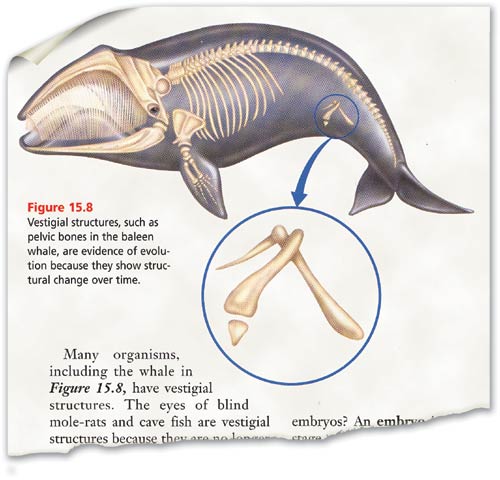
Which of the following is an example of a vestigial structure?
a)
the wings of a red-tailed hawk
b)
the hind limbs of a house cat
c)
the fins of sharks
d)
the tailbone of a human
5.

Two organisms that are closely related would have
a)
very similar DNA sequence
b)
exactly the same DNA sequences
c)
no proteins in common
d)
completely different DNA sequence
6.

Which layer is the oldest
a)
B
b)
A
c)
E
d)
C
7.

The diagram shows fossils in different rock layers. Which of these statements about the age of these fossils is most likely correct?
a)
Fossil A and C are the same age
b)
Fossil B is older than fossil C
c)
Fossils A is older than fossil B
d)
Fossil D is older than fossil C
8.
If two organisms have similar traits of DNA they are probably
a)
share a common ancestor
b)
share a common environment
c)
share a common population
d)
speciation
9.
What does Darwin's theory of evolution suggest?
a)
species change over time
b)
extinct species are not related to living species
c)
different species can interbreed
d)
animals that look alike are most closely related
10.
Whales are aquatic mammals that contain a pelvis bone. Even though it does not aid in its movement, the function must have been used by a common ancestor of the whale. Thus, the pelvis is referred to as a(n)
a)
vestigial structure
b)
analogous structure
c)
homologous structure
11.
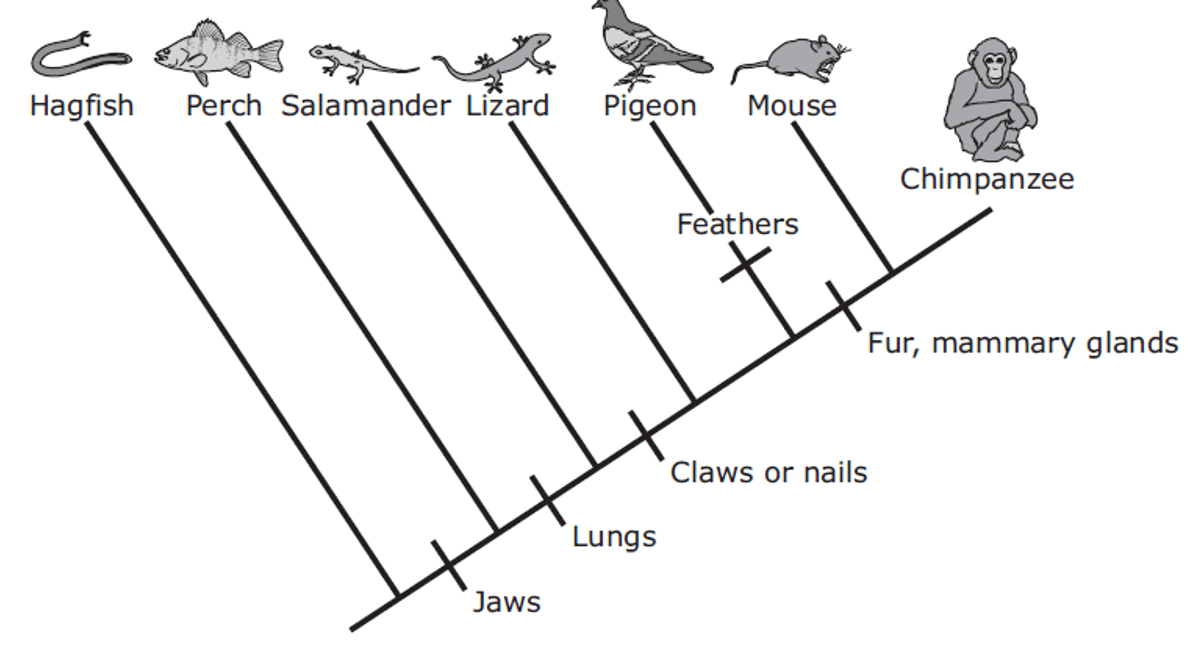
All the animals to the right of the hagfish would have the common characteristic of -
a)
Fur
b)
Claws or nails
c)
Lungs
d)
Jaws
12.

According to this cladogram, birds are LEAST related to -
a)
Amphibians
b)
Sharks
c)
Ray Finned Fish
d)
Crocodiles
13.
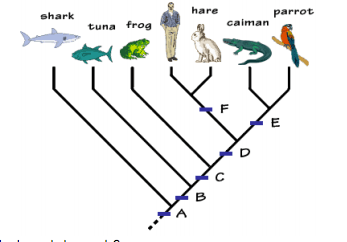
On the cladogram, which organism is the closest relative of the human?
a)
Frog
b)
Hare
c)
Caiman
d)
Parrot
14.

According to the diagram, which organism is older: the ammonite or the coral?
a)
ammonite
b)
coral
15.

Father of Evolution, wrote Origin of Species and studied organisms from Galapagos to support his proposal that natural selection occurs
a)
natural selection
b)
evolution
c)
homologous structures
d)
Darwin
16.

Preserved remains or evidence of ancient organisms
a)
natural selection
b)
diversity
c)
morphology
d)
fossil
17.

Survival of the fittest. The organism best able to survive passes on its genes in the gene pool
a)
natural selection
b)
adaptation
c)
fossil
d)
morphology
18.

The similarities of organisms in which two areas numbered in the picture provide the best evidence for common ancestry?
a)
1 and 2
b)
3 and 4
c)
5 and 6
d)
7 and 8
100 %

